The Complete Guide to Federal Tax Credits for HVAC Efficiency Upgrades
Gray Duct

Learn how federal tax credits for hvac efficiency upgrades can reduce your 2025 tax bill before the deadline.
Federal Tax Credits for HVAC Efficiency Upgrades: What Twin Cities Homeowners Need to Know in 2026
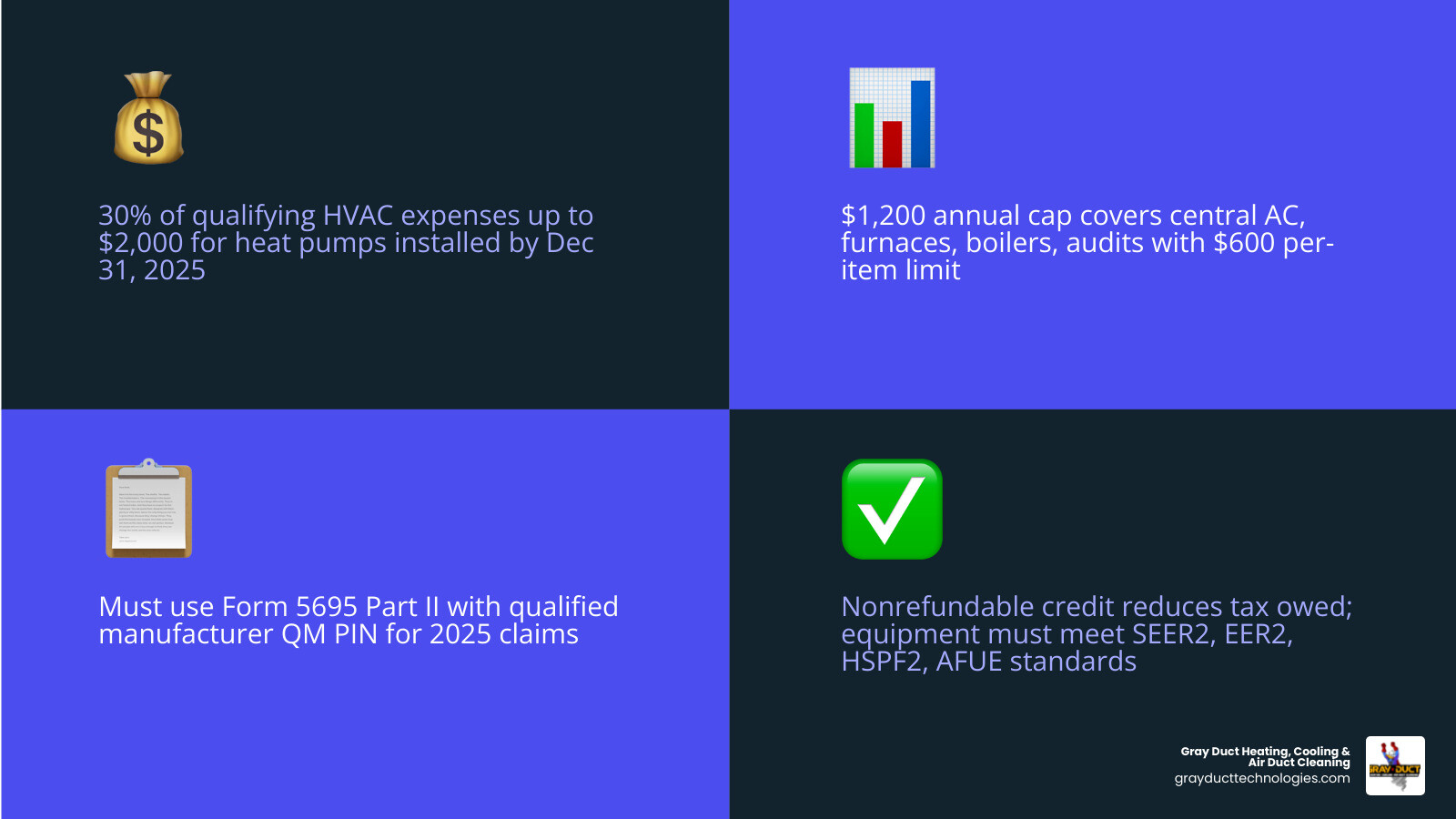
Federal tax credits for HVAC efficiency upgrades installed before December 31, 2025 are still claimable on your 2025 tax return — and the savings can be significant. Here is a quick summary of what is available:
Key Credits at a Glance (for qualifying 2025 installations):
| Upgrade Type | Credit Amount | Annual Cap |
|---|---|---|
| Heat pumps / heat pump water heaters | 30% of cost, up to $2,000 | $2,000 |
| Central air conditioners | 30% of cost, up to $600 | Part of $1,200 cap |
| Gas furnaces / boilers | 30% of cost, up to $600 | Part of $1,200 cap |
| Home energy audit | 30% of cost, up to $150 | Part of $1,200 cap |
| Maximum combined annual credit | — | $3,200 |
- These credits fall under Section 25C, the Energy Efficient Home Improvement Credit
- The credit equals 30% of qualified expenses, with no lifetime dollar limit through 2025
- Credits are nonrefundable — they reduce what you owe in taxes, but cannot generate a refund
- Equipment must meet specific efficiency standards (CEE tiers, SEER2, EER2, HSPF2, or AFUE thresholds)
- For 2025 installations, you must include a qualified manufacturer (QM) PIN on IRS Form 5695
- Claim the credit using IRS Form 5695, Part II
If your qualifying HVAC system was installed and placed in service by December 31, 2025, you can still claim this credit when you file your 2025 tax return — even though it is now May 2026.
For many Minnesota homeowners, heating and cooling represent the single largest energy expense in the home. A new heat pump, high-efficiency furnace, or central air conditioner is a major investment — and federal tax incentives were specifically designed to help offset that cost. Understanding how these credits work, what they cover, and how to claim them correctly can mean the difference between leaving hundreds of dollars on the table and walking away with a meaningfully lower tax bill.
This guide walks you through everything you need to know: which upgrades qualified, how much you can save, what efficiency standards apply, and exactly how to file your claim.
I’m Jason Giandalia, founder of Gray Duct Heating, Cooling & Air Duct Cleaning, and I’ve worked with Twin Cities homeowners through every step of HVAC upgrades where federal tax credits for HVAC efficiency upgrades directly affect the value of the projects we help plan and install. My hands-on experience with high-efficiency systems and Minnesota’s cold-climate HVAC demands means I can help you cut through the confusion and get this right.
Federal Tax Credits for HVAC Efficiency Upgrades in 2026: What Is Still Available?
As we move through May 2026, many homeowners in areas like Bloomington and Plymouth are looking back at their 2025 home improvements. The primary vehicle for these savings is the Energy Efficient Home Improvement Credit (Section 25C). While the most robust version of this credit was active for systems “placed in service” between January 1, 2023, and December 31, 2025, the impact is felt now during the 2026 tax filing season.
Which HVAC tax credit applies to your upgrade?
There are two main sections of the tax code to distinguish between:
- Section 25C (Energy Efficient Home Improvement Credit): This is the one most homeowners use for standard HVAC equipment like air-source heat pumps, central air conditioners, and high-efficiency gas furnaces. It applies to existing homes and principal residences.
- Section 25D (Residential Clean Energy Credit): This is a separate credit with no annual cap, primarily used for geothermal heat pumps, solar, and wind energy. Unlike 25C, this credit can be carried forward to future tax years if you don’t use it all at once.
What changed after December 31, 2025?
The expiration of the 25C credit as it was structured under the Inflation Reduction Act means that for an upgrade to qualify for the current filing season, it must have been installed and operational (placed in service) by the end of 2025. If you are filing an extension or finalizing your 2025 returns now in May 2026, you are in the final window to claim these specific amounts for those 2025 installs.
Which HVAC upgrades qualified before the deadline?
To qualify for the 30% credit, the equipment had to meet stringent efficiency guidelines. This included:
- Air-source heat pumps (the “star” of the program with the highest limits).
- Heat pump water heaters.
- Central air conditioners.
- Natural gas, propane, or oil furnaces and boilers.
- Biomass stoves and boilers.
How Much Homeowners Can Save With federal tax credits for hvac efficiency upgrades
The math is relatively straightforward: the credit covers 30% of the total project cost (including labor for most HVAC items), but it is subject to specific annual caps. Unlike the old “lifetime” limits of $500 that many of us remember from years ago, the new system allowed for much higher savings by resetting every year.
How the $1,200 annual cap works
The “general” pool of the 25C credit has a $1,200 annual limit. This pool includes:
- Central Air Conditioners: Capped at $600.
- Furnaces and Boilers: Capped at $600.
- Home Energy Audits: Capped at $150.
- Building Envelope: Windows (capped at $600) and exterior doors ($250 per door, $500 total).
| Category | Item Limit | Total Category Cap |
|---|---|---|
| Central AC | $600 | $1,200 |
| Gas Furnace | $600 | $1,200 |
| Energy Audit | $150 | $1,200 |
How the separate $2,000 cap works for heat pump technology
Heat pumps and heat pump water heaters are in a league of their own. They have a separate annual aggregate limit of $2,000. This was designed to encourage homeowners to move toward electric heat pump technology. Because this cap is separate, a homeowner could theoretically claim the full $2,000 for a heat pump and still have the $1,200 limit available for other improvements.
How to combine the caps for maximum federal tax credits for hvac efficiency upgrades
By combining these two caps, the total maximum credit a taxpayer can claim in a single year is $3,200. We often advise our customers in the Twin Cities to think about HVAC optimization as a holistic project. For example, if you installed a heat pump ($2,000 credit) and also performed a home energy audit and upgraded your electrical panel to support that heat pump ($1,200 credit), you hit that $3,200 sweet spot.
Eligibility Rules for the Energy Efficient Home Improvement Credit (25C)
Not every building or every person qualifies for these credits. The IRS has specific “residency” and “use” tests that must be met.
Who can claim federal tax credits for hvac efficiency upgrades?
Generally, if you are a homeowner and you use the property as your principal residence, you are eligible. However, there are some nuances:
- Renters: If a renter pays for a qualifying upgrade (like a high-efficiency window AC unit that meets the standards or a heat pump), they may be able to claim the credit if the home is their primary residence.
- Second Home Owners: You can claim the credit for a second home you use as a residence, but you cannot claim it for a property that you never live in (like a pure rental property).
Which homes and properties qualify?
The home must be an existing home located in the United States. New construction generally does not qualify for the 25C credit, as builders have their own separate incentives (Section 45L) to make new homes efficient. Additionally, if you use your home significantly for business (more than 20%), the credit amount may be professionally prorated.
Expense rules homeowners often miss
One critical rule is that you must subtract any rebates or financial incentives from the total cost before calculating your 30%. For example, if your new AC cost $5,000 but you received a $500 utility rebate from a provider in Minneapolis, your “qualified expense” is $4,500. Also, these are nonrefundable credits. If you only owe $1,000 in federal income tax, a $2,000 credit will only reduce your bill to zero; you won’t get the remaining $1,000 back as a check.
HVAC Efficiency Standards Required to Qualify
To prevent “greenwashing,” the IRS requires equipment to meet high efficiency tiers set by the Consortium for Energy Efficiency (CEE).
Heat pump standards: CEE tiers, matched systems, and split-system rules
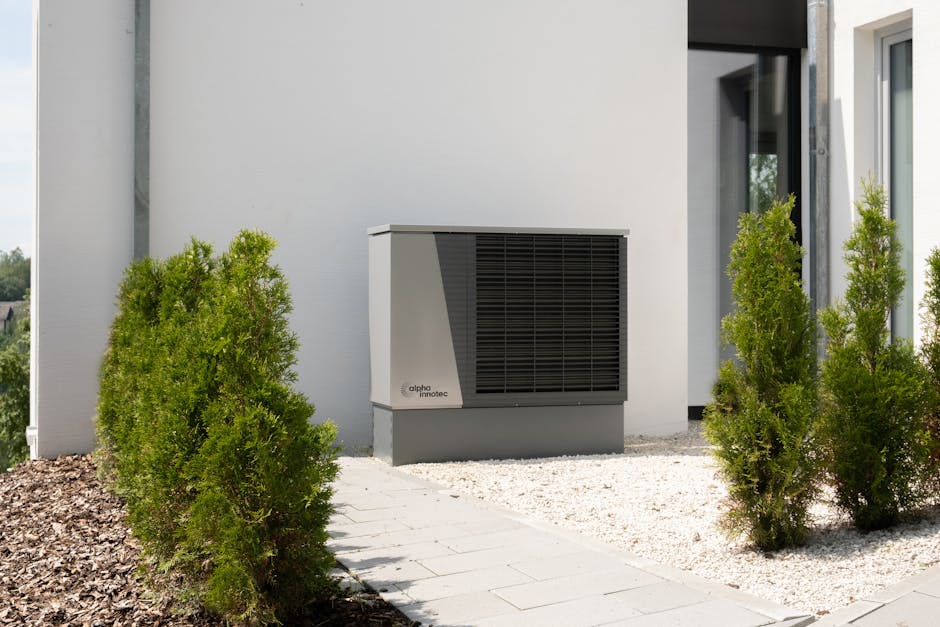
For a heat pump to qualify for the $2,000 credit, it must meet or exceed the highest CEE tier (not including advanced tiers) in effect at the start of the year. For split systems, this means the entire system—both the outdoor condenser and the indoor coil/air handler—must be a matched pair that hits the efficiency targets.
Central air conditioner standards: SEER2 and EER2 thresholds
In 2025, the standards for central AC were quite high.
- Split Systems: Must meet SEER2 ≥ 17.0 and EER2 ≥ 12.0.
- Packaged Systems: Must meet SEER2 ≥ 16.0 and EER2 ≥ 11.5. You can use a SEER calculator to understand how these ratings compare to older units.
Furnace and boiler standards: AFUE and applicable criteria
For those of us in the cold Minnesota climate, gas furnaces are still very common. To qualify for the $600 credit, a natural gas furnace must have an AFUE of 97% or higher. This essentially means the unit must be a top-tier condensing furnace.
How to verify a model before you claim
Don’t take a salesperson’s word for it. You should verify the equipment using the Department of Energy (DOE) lookup tool or the AHRI (Air-Conditioning, Heating, and Refrigeration Institute) directory. Most manufacturers also provide a “Tax Credit Certificate” for specific model combinations.
Documentation, QM PIN Codes, and How to Claim on Your Tax Return
The 2025 tax year introduced a new hurdle: the Qualified Manufacturer (QM) requirement.
What documentation to keep for 2025 HVAC claims
If the IRS comes knocking, you’ll need more than just a credit card statement. You should keep:
- The detailed invoice showing the model numbers of all components.
- The date the system was “placed in service” (usually the installation date).
- The Manufacturer’s Certification Statement.
QM PIN and qualified manufacturer rules for 2025 returns
For property placed in service after December 31, 2024, the equipment must be made by a “Qualified Manufacturer.” On your tax return, you are now required to provide a Qualified Management Identification Number (QMID) or a four-digit PIN provided by the manufacturer. This ensures the equipment actually meets the legal standards for the credit.
How to file IRS Form 5695 correctly
You will use IRS Form 5695, Part II to claim the Energy Efficient Home Improvement Credit. You’ll enter the cost of the equipment on the appropriate lines, calculate the 30%, and then apply the caps ($600 for AC, $2,000 for heat pumps, etc.). The final amount is then transferred to your Form 1040 to reduce your tax liability.
Smart Ways to Maximize Your HVAC Tax Savings Before and After Filing
Strategic planning is the key to getting the most out of these programs, especially when dealing with the harsh winters and humid summers in the Twin Cities.
Best sequencing strategies to maximize annual limits
Since the caps are annual, “stacking” projects across different years was the best way to maximize savings. For example, a homeowner might have done a home energy audit and insulation in 2024 (claiming $1,200), and then installed a heat pump in 2025 (claiming $2,000).
How federal credits work with rebates and other incentives
Minnesota is great about offering additional layers of savings. You can often stack federal tax credits with utility rebates from companies like Xcel Energy or CenterPoint Energy. Just remember to subtract the rebate from the cost before calculating the tax credit! We maintain a big list of Minnesota HVAC rebates to help our local neighbors find every possible dollar.
Planning an efficient upgrade path for Minnesota homes
In our local climate, we often recommend “dual-fuel” systems—combining an electric heat pump with a high-efficiency gas furnace. This allows you to use the heat pump for efficient cooling and mild-weather heating, while the gas furnace takes over during those sub-zero Saint Paul nights. This setup often allows you to tap into both the $2,000 and the $600 credit pools.
When financing may help you act before incentive windows close
High-efficiency equipment often has a higher upfront cost. Many homeowners use Financing to bridge the gap, allowing them to install the system before a deadline (like the 2025 year-end) and then use the tax savings to pay down the balance.
Frequently Asked Questions About Federal HVAC Tax Credits
Can I still claim a federal HVAC tax credit in 2026?
Yes, but only if the equipment was installed by December 31, 2025. You are claiming it on your 2025 tax return, which you are likely filing right now in early 2026.
Are these HVAC tax credits refundable?
No. They are nonrefundable. They can bring your tax bill to zero, but the IRS won’t send you a check for any “extra” credit amount.
Can I claim a credit for a rental property or vacation home?
You cannot claim the 25C credit for a property you rent out as a landlord. However, you can claim it for a second home (vacation home) as long as you use it as a residence during the year and it isn’t used exclusively as a rental.
Conclusion
Navigating federal tax credits for HVAC efficiency upgrades can feel like a full-time job, but the financial rewards are well worth the effort. By choosing high-efficiency systems, you aren’t just saving money on your taxes today; you’re lowering your monthly utility bills for the next 15 to 20 years.
At Gray Duct Heating, Cooling & Air Duct Cleaning, we take pride in helping our neighbors in Minneapolis, Saint Paul, and the surrounding suburbs like Eagan and Lakeville make smart, energy-efficient choices. Whether you need a simple maintenance check or a full HVAC replacement in Bloomington, our certified in-house team is here to ensure your home stays comfortable and your upgrades meet the highest standards.
If you have questions about which systems qualify or need help documenting your 2025 installation, don’t hesitate to reach out. We’re your local, family-owned partners in home comfort and efficiency.
Need HVAC Help?
Our NADCA-certified technicians are ready to help with all your heating, cooling, and air quality needs.
Get Free EstimateMore Articles
 HVAC Tips
What to Do When Your AC and Furnace Share the Same Air Filter
 HVAC Tips
Addressing Drafty Rooms Before Winter: Duct Sealing vs. Window Replacement
 HVAC Tips
Dryer Vent Routing: Rigid Metal vs. Flexible Foil in Cold Climates
 HVAC Tips
Why We Inspect the Heat Exchanger So Closely During Fall Maintenance
 HVAC Tips
Upgrading to a Two-Stage Furnace: Is the Investment Worth It in Minnesota?
Related Articles
Ready to Get Started?
Whether you need a repair, maintenance, or a new system installation, our expert team is here to help.