The Hidden Dangers of Lint Buildup and How to Spot Them
Gray Duct

Is Your Dryer a Hidden Fire Hazard? Here’s What to Look For Dryer vent fire hazard signs for homeowners are easier to spot than most people think — and catching them…
Is Your Dryer a Hidden Fire Hazard? Here’s What to Look For
Dryer vent fire hazard signs for homeowners are easier to spot than most people think — and catching them early could prevent a serious disaster. Here are the most critical warning signs to watch for right now:
- Clothes take more than one cycle to dry — especially towels or jeans
- Your dryer feels hot to the touch during or after a cycle
- You notice a burning smell while the dryer is running
- Lint is showing up on your clothes after drying
- The exterior vent flap doesn’t open when the dryer is on
- Your laundry room feels unusually hot or humid during a cycle
- Visible lint buildup around the dryer, vent hose, or exterior hood
- It’s been over a year since your dryer vent was last cleaned
According to the U.S. Fire Administration, approximately 15,600 clothes dryer fires occur in the United States every year, resulting in 20 deaths, 370 injuries, and over $75 million in property damage. The single leading cause? Failure to clean. In fact, roughly one-third of all dryer fires — and half of all dryer fire deaths — are directly linked to lint and debris buildup that was never cleared from the vent system.
Lint is more dangerous than most homeowners realize. It’s a highly compressed mix of cotton, synthetic, and wool fibers that can ignite at temperatures a dryer vent system is fully capable of producing. When airflow becomes restricted by a clog, heat has nowhere to go — and that’s when things get dangerous.
The problem is that most dryer vents don’t fail all at once. The warning signs show up gradually — a slightly longer dry time here, a warmer laundry room there — and it’s easy to chalk them up to a “quirky dryer” rather than a building fire hazard. By the time a burning smell appears, the situation may already be urgent.
I’m Jason Giandalia, founder of Gray Duct Heating, Cooling & Air Duct Cleaning, and over years of inspecting and cleaning dryer vent systems across Minnesota homes, I’ve seen how quickly lint accumulates into a genuine fire risk — which is exactly why I put together this guide on dryer vent fire hazard signs for homeowners. Let’s walk through what to look for and what to do about it.
Why Lint Buildup is a Leading Cause of Residential Fires
When we think of fire hazards in our homes, we often think of candles or cooking grease. However, the humble laundry room holds one of the most volatile substances in your house: lint. Under a microscope, lint is a tangled web of tiny fibers from cotton, wool, and synthetics. These fibers have a massive surface area relative to their weight, making them the perfect tinder.
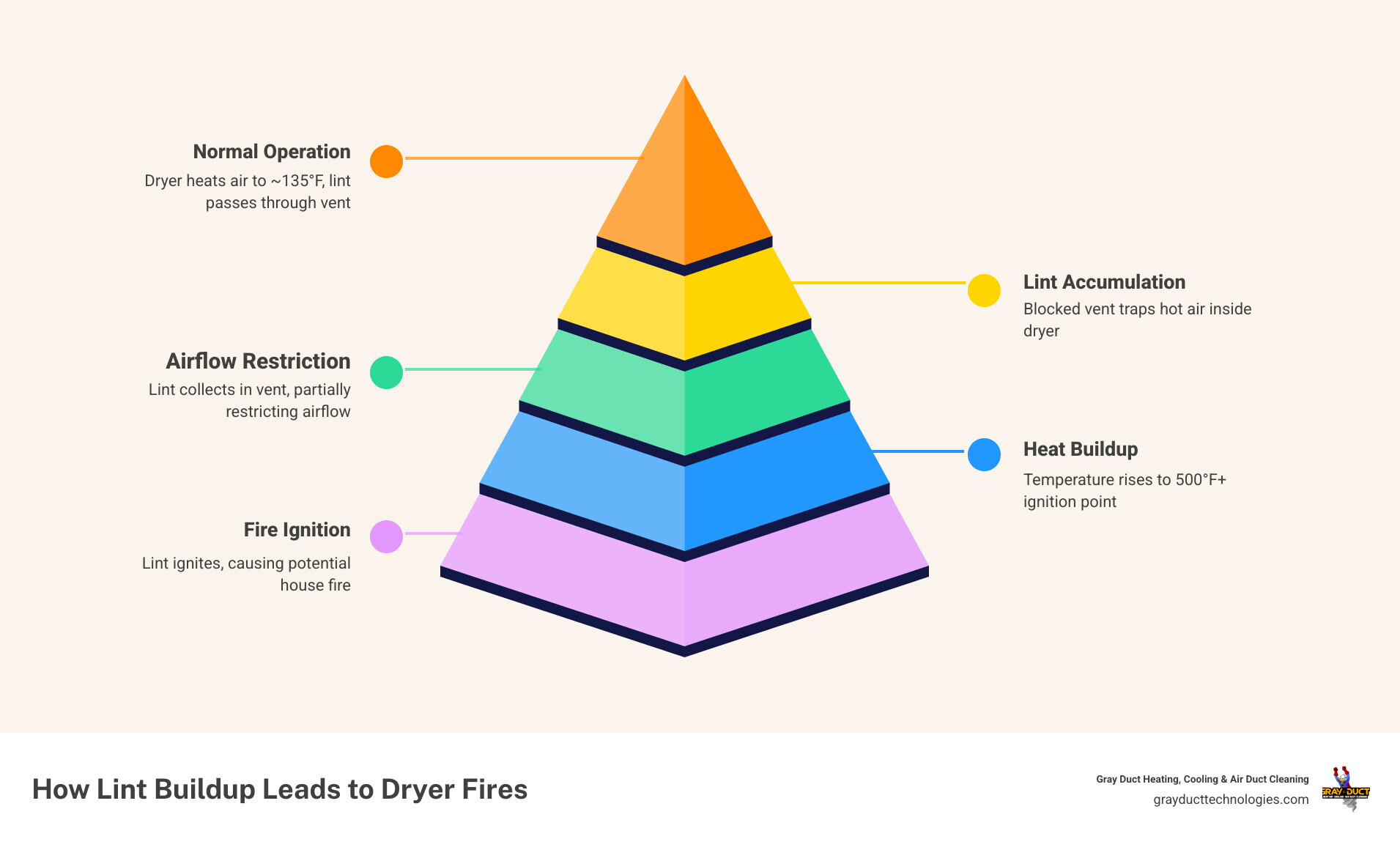
The statistics are sobering. Every year, nearly 2,900 residential clothes dryer fires are reported, resulting in an estimated five deaths and $35 million in property damage. The primary culprit is restricted airflow. Your dryer is designed to push hot, moist air out of the drum and through the vent to the outdoors. When lint builds up in that pipe, it acts like a dam.
As the airflow is choked off, the internal temperature of the dryer begins to climb. While a normal dryer cycle operates at safe levels, a clogged vent can cause internal temperatures to reach the ignition point of lint—which is roughly 500°F (though some synthetic fibers can melt or ignite even lower). Once a spark or excessive heat hits that dry, compressed lint, it spreads through the vent system like a fuse. Can a Clogged Dryer Vent Cause a Fire? The answer is a definitive yes, and it happens more often than most homeowners in the Twin Cities realize.
7 Critical Dryer Vent Fire Hazard Signs for Homeowners
Recognizing the dryer vent fire hazard signs for homeowners is the first step toward a safer home. We often see homeowners who have ignored these signs for months, thinking their appliance was just getting old. In reality, the dryer was screaming for a cleaning. Dryer Vent Cleaning for Fire Safety is not just about maintenance; it’s about disaster prevention.
Spotting Dryer Vent Fire Hazard Signs for Homeowners Early
The earliest signs are often related to performance. If your standard load of towels or jeans suddenly requires two or even three cycles to dry completely, that is a massive red flag. A standard load should dry in about 45 to 60 minutes on high heat. If you find yourself constantly adding “more time,” your vent is likely restricted, trapping moisture inside the drum.
Another early indicator is excessive heat. If the top of your dryer feels hot enough to burn your hand, or if your clothes come out with metal zippers and buttons that are scorching to the touch, the heat isn’t escaping. The most urgent sign, however, is a burning smell. If you catch even a whiff of something singed while the dryer is running, stop it immediately. This often means lint is already beginning to scorch or smolder near the heating element. Knowing these 5 Signs Your Dryer Vent Needs Cleaning Before It Becomes a Fire Hazard can save your home from a middle-of-the-night emergency.
Visible Indicators of a Dangerous Clog
Sometimes the signs are visible if you know where to look. Have you noticed lint sticking to your clothes even after a full drying cycle? This happens because the airflow isn’t strong enough to carry the lint into the trap, so it just recirculates in the drum. Similarly, if your laundry room feels like a sauna—hot and humid—it means the moist air is leaking out of the vent transitions because the main path is blocked.
Don’t forget to look outside. Go to the exterior of your home while the dryer is running. Is the vent flap opening fully? Is there a strong, warm breeze coming out? If the flap is barely moving or stuck shut by debris, you have a blockage. You might even see visible clumps of lint hanging out of the exterior hood or accumulating on the ground nearby. These are classic Signs Your Dryer Vent is Clogged and require immediate attention before the next load.
Why Certain Vent Installations Increase Your Risk in Minnesota
In the Twin Cities and South Metro area, we deal with unique environmental factors that can exacerbate vent clogs. Our harsh Minnesota winters create a significant temperature differential between the hot air in the vent and the freezing air outside. This leads to condensation inside the duct. Moist lint is “sticky” lint; it clings to the walls of the pipe much faster than dry lint does.
The physical installation of your vent also plays a huge role in fire risk. Many older homes in places like Minneapolis or Saint Paul use flexible plastic or foil “slinky” ducts. These are notorious fire hazards because they kink easily, restricting airflow, and their ridged internal surfaces trap lint at every turn. Furthermore, if your laundry room is in the basement and the vent has a long run with multiple elbows to reach the roof or a side wall, the risk of a clog increases exponentially. Every 90-degree turn in a vent line is a place where lint can settle and compact. If you aren’t sure how your system is routed, it’s vital to learn How to Tell If Your Dryer Vent is Blocked so you can identify these structural risks.
Maintenance Steps to Prevent Dryer Vent Fire Hazard Signs for Homeowners
Prevention is always better than a call to the fire department. While we recommend professional service for the deep cleaning of the entire duct run, there are daily and monthly habits you can adopt to keep your home safe.
- Clean the lint trap after every single load. This is the simplest and most effective way to reduce the amount of debris entering the main vent system.
- Inspect the area behind the dryer. Ensure the transition hose isn’t crushed or kinked against the wall.
- Switch to rigid metal ducting. If you currently have plastic or thin foil venting, replace it with rigid or semi-rigid metal piping. Metal is smoother, which prevents lint buildup, and it can contain a fire much better than plastic.
- Keep the exterior clear. Check your exterior vent hood monthly to ensure no bird nests, snowdrifts, or overgrown bushes are blocking the exit.
Understanding the proper Dryer Vent Cleaning Frequency is key. For most households in the Apple Valley or Lakeville areas, an annual professional cleaning is the standard. However, if you have a large family, pets that shed, or a particularly long vent run, you may need to increase that to every six months.
Testing for Dryer Vent Fire Hazard Signs for Homeowners at Home
You don’t need specialized tools for a basic safety check. We recommend the “Airflow Test.” Start your dryer on a high-heat cycle and walk to the exterior vent hood. You should feel a steady, strong stream of warm air—similar to a hair dryer on its highest setting. If the air feels weak, or if you don’t feel any air at all, there is a blockage somewhere in the line.
You can also perform a “Touch Test.” About 20 minutes into a cycle, feel the top of the dryer. It should be warm, but never uncomfortably hot. If you can’t keep your hand on the machine for more than a few seconds, shut it down. These quick DIY checks are part of knowing How to Tell If Your Dryer Vent is Blocked and can give you the heads-up you need to call in the pros before a spark occurs.
Emergency Protocol: Responding to Burning Smells and Fires
If you ignore the dryer vent fire hazard signs for homeowners for too long, you might find yourself facing an emergency. If you smell smoke or see flames, every second counts.
- Immediate Shutoff: If it is safe to do so, turn off the dryer and unplug it from the wall. If you have a gas dryer, knowing where the gas shutoff valve is located is essential.
- Don’t Open the Door: If you suspect a fire is inside the drum, keep the door closed. Opening it introduces oxygen, which can cause the fire to flare up or “backdraft” into the room.
- Use the Right Extinguisher: Only attempt to put out a very small fire if you have a Class C (electrical) fire extinguisher and an easy exit behind you. Never use water on an electrical fire.
- Evacuate and Call 911: If the fire is inside the wall or vent pipe, or if smoke is filling the room, get everyone out of the house immediately and call the fire department.
Once the emergency is over, do not attempt to use the dryer again until both the appliance and the vent system have been professionally inspected and cleaned. Dryer Vent Cleaning Prevent Fire Hazard protocols are designed to ensure that once a system is cleared, it is truly safe for operation.
Frequently Asked Questions about Dryer Safety
How often should I have my vents professionally cleaned?
For the average home in the Twin Cities, we recommend a professional cleaning at least once a year. If you find yourself doing more than five loads of laundry a week, or if you have heavy shedders (looking at you, Golden Retrievers!), you should consider a cleaning every six months. Avoid a Dryer Fire This Winter: How Often Should You Clean Your Dryer Vent? because winter is when usage peaks and condensation makes clogs more likely.
Is cleaning the lint trap enough to prevent a fire?
Unfortunately, no. The lint trap only catches about 70-80% of the lint produced by your clothes. The rest bypasses the screen and settles in the internal dryer housing and the vent pipe. Over time, this “bypass lint” creates a thick coating inside your walls that the trap can’t help with. This is why Regular Dryer Vent Cleaning of the entire duct run is mandatory for fire safety.
Why is my dryer so hot to the touch?
When air cannot circulate, the heating element continues to fire, but the heat stays trapped in the metal cabinet of the dryer. This can cause the thermal safety switch to trip, which shuts the dryer off mid-cycle. While this is a safety feature designed to prevent a fire, it’s also a sign that your machine is under immense stress. Beyond the fire risk, Why Dryer Vent Cleaning Saves You Money is simple: it prevents your heating element from burning out prematurely and lowers your monthly energy bills by reducing drying time.
Conclusion
At Gray Duct Heating, Cooling & Air Duct Cleaning, we treat every home as if it were our own. As a family-owned business serving the Twin Cities and South Metro—from Minneapolis and Saint Paul to Bloomington and Woodbury—we know that home safety starts with the things you can’t see. Our certified, in-house technicians specialize in identifying and removing the hidden clogs that lead to dangerous house fires.
Don’t wait until you smell smoke to take action. If you’ve noticed any of the dryer vent fire hazard signs for homeowners mentioned in this guide, or if it’s simply been too long since your last inspection, we are here to help. From Rochester to Maple Grove, we provide thorough, professional Dryer Vent Cleaning that gives you peace of mind every time you press “Start.” Keep your family safe, your energy bills low, and your dryer running efficiently—give us a call today.
<div class="elementor-element elementor-element-b5c55cb elementor-position-left elementor-widgetwidth-initial elementor-widget-tabletwidth-initial elementor-vertical-align-top elementor-widget elementor-widget-image-box" data-id="b5c55cb" data-elementtype="widget" data-e-type="widget" id="post-call-text" data-widgettype="image-box.default">Need HVAC Help?
Our NADCA-certified technicians are ready to help with all your heating, cooling, and air quality needs.
Get Free EstimateMore Articles
 HVAC Tips
What to Do When Your AC and Furnace Share the Same Air Filter
 HVAC Tips
Addressing Drafty Rooms Before Winter: Duct Sealing vs. Window Replacement
 HVAC Tips
Dryer Vent Routing: Rigid Metal vs. Flexible Foil in Cold Climates
 HVAC Tips
Why We Inspect the Heat Exchanger So Closely During Fall Maintenance
 HVAC Tips
Upgrading to a Two-Stage Furnace: Is the Investment Worth It in Minnesota?
Related Articles
Ready to Get Started?
Whether you need a repair, maintenance, or a new system installation, our expert team is here to help.