How to verify duct cleaning credentials like a private investigator
Gray Duct
Learn how to verify duct cleaning credentials like a PI: spot scams, check NADCA certs, licenses & insurance to protect your home.
Why Knowing How to Verify Duct Cleaning Credentials Could Save You From a Costly Scam
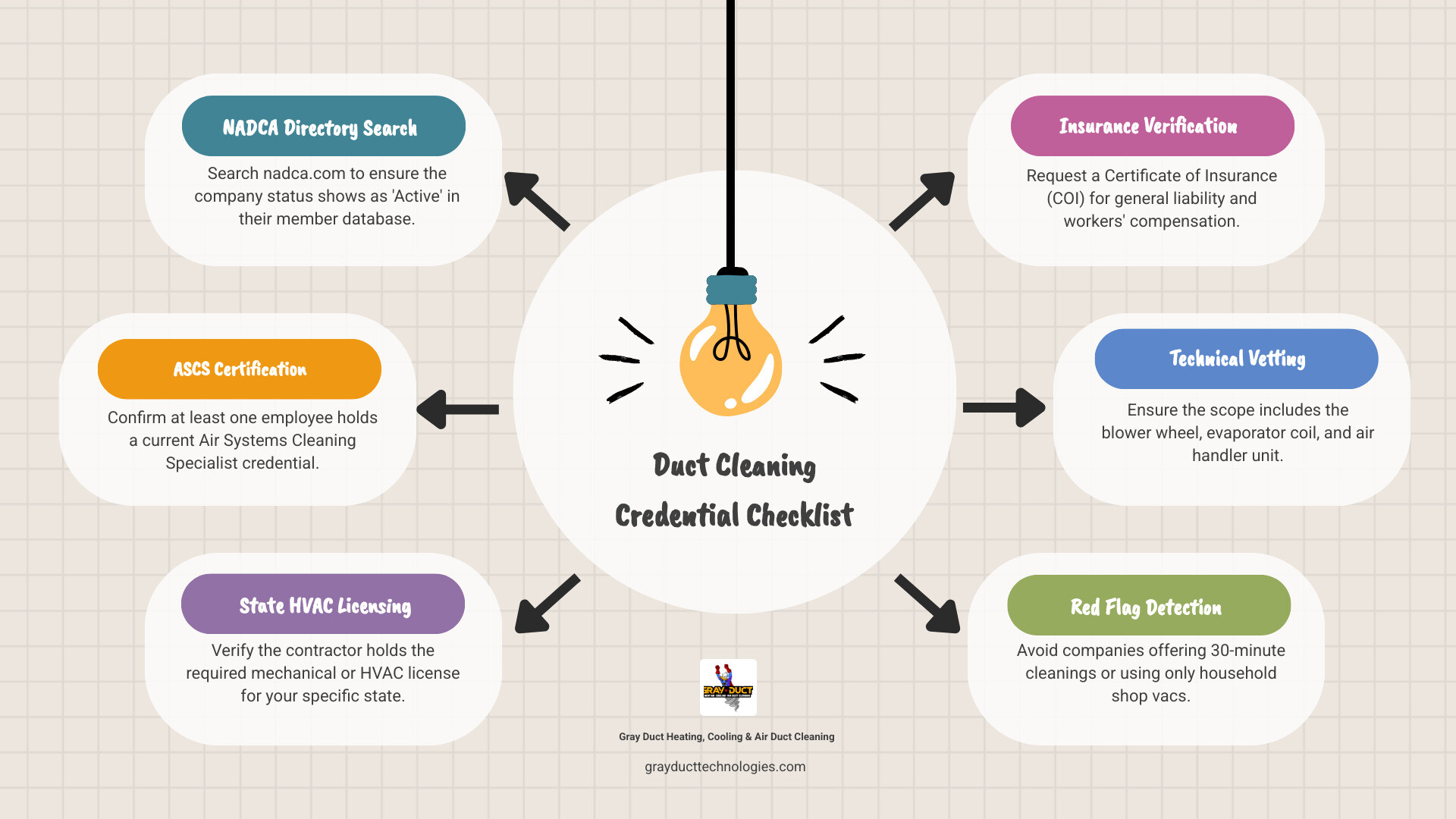
How to verify duct cleaning credentials is something every homeowner should know before letting anyone near their HVAC system. Here’s a quick overview of the key steps:
- Search the NADCA directory at nadca.com/find-a-professional using the company’s name or zip code and confirm their status shows as “Active”
- Confirm ASCS certification — at least one employee at the company must hold a current Air Systems Cleaning Specialist credential
- Check state licensing — verify the contractor holds the required HVAC license in your state through the relevant licensing board
- Request a certificate of insurance — ask for proof of general liability and workers’ compensation coverage before work begins
- Ask the right questions — a legitimate cleaning includes the blower wheel, evaporator coil, and air handler, and should take 6 to 8 hours for a full residential system
- Watch for red flags — suspiciously low whole-house offers, 30-minute job estimates, and shop vac equipment are all warning signs of a “blow and go” scam
Duct cleaning is, according to industry observers, the single most scammed business type online. In a review of 21 companies in the Houston metro area alone, only 9 held active NADCA membership — and at least 2 others were found to be falsely claiming certification they didn’t actually have. The same pattern plays out in metro areas across the country, including right here in Minnesota.
The good news? Protecting yourself doesn’t require a background in HVAC. It just requires knowing where to look and what to ask — and that’s exactly what this guide walks you through.
I’m Jason Giandalia, founder of Gray Duct Heating, Cooling & Air Duct Cleaning, and as an NADCA-certified Air Systems Cleaning Specialist (ASCS) with state licensure and bonding in Minnesota, I’ve built this guide around the same verification process I’d want a family member to use when learning how to verify duct cleaning credentials. Let’s get into it.
The Gold Standard: How to verify duct cleaning credentials through NADCA
When we talk about professional air duct cleaning, one name stands above the rest: the National Air Duct Cleaners Association (NADCA). Founded in 1989, NADCA is the global trade association that sets the benchmark for the HVAC inspection, cleaning, and restoration industry. If a company isn’t a member, they aren’t held to the industry’s most rigorous code of ethics or technical standards.
To be a member in good standing, a company must:
- Have at least one employee on staff who has earned the Air Systems Cleaning Specialist (ASCS) credential.
- Maintain general liability insurance.
- Agree to clean according to the ACR Standard (Assessment, Cleaning, and Restoration).
The ACR Standard is the “bible” of our industry. It mandates that source removal—actually getting the debris out of the system—is the only acceptable way to clean. At Gray Duct Technologies, we believe in these standards so much that we’ve integrated them into every job we perform. You can learn more about our commitment on our Certifications page or read about when NADCA Welcomes Gray Duct Technologies to the association.
Using the NADCA public member directory to verify credentials
Don’t just take a contractor’s word for it if they have a logo on their website. Scammers often “borrow” logos they haven’t earned. To truly understand how to verify duct cleaning credentials, you need to go to the source.
- Visit the NADCA “Find a Professional” directory.
- Enter your zip code or the company name.
- Check for the “Active” status.
If the company doesn’t appear, or if their membership has lapsed, they are not a NADCA member. This is a critical step because membership requires annual dues and continuing education. A company that was certified five years ago but hasn’t kept up with their credits is no longer a certified professional. For homeowners in the Twin Cities, verifying this information ensures you are receiving Professional Air Duct Cleaning Services from a team that actually answers to a higher authority.
Distinguishing between ASCS and CVI certifications
While browsing the directory, you might see two different acronyms: ASCS and CVI. Here is the breakdown of what they mean for your home:
- ASCS (Air Systems Cleaning Specialist): This is the foundational certification. It proves the technician has passed a proctored exam covering HVAC system anatomy, cleaning tools, and safety protocols. It is the global standard for HVAC hygiene.
- CVI (Certified Ventilation Inspector): This is an advanced credential. A CVI-certified professional is trained to perform high-level inspections, often for commercial buildings or complex residential issues, to assess the physical condition of the system and identify indoor air quality problems.
Spotting “Blow and Go” scams and red flags
The “blow and go” scam is the most common pitfall in our industry. These operations rely on high-volume, low-quality work. They use deceptive marketing to get into your home, then perform a superficial “cleaning” that can actually make your air quality worse by stirring up dust without removing it.
As of March 2026, research identified multiple active spam operations in major metro areas. These groups often use social media bots to post identical ads in local community groups. To stay safe, you must Avoid Scams by recognizing these warning signs.
| Feature | Professional Source Removal | “Blow and Go” Scam |
|---|---|---|
| Equipment | Truck-mounted vacuum or high-powered HEPA portable | Small shop vac or hand-held vacuum |
| Time on Site | 6 to 8 hours for a full system | 30 to 60 minutes |
| Components Cleaned | Ducts, blower wheel, coils, and air handler | Only the vents (supply registers) |
| Pricing | Based on system size and complexity | “Whole house” for a suspiciously low flat rate |
| Method | Negative pressure and mechanical agitation | Blowing air into vents without a vacuum seal |
If a company claims they can clean your entire house in an hour using a shop vac they brought in from their trunk, they aren’t cleaning—they’re just vacuuming your floor vents. For more tips on spotting these characters, check out our guide on how to Protect Your Home from Dishonest Duct Cleaners.
Investigating state licensing and insurance requirements
Beyond industry certifications, there are legal requirements. In many states, you cannot legally open an HVAC cabinet or touch the mechanical components of a furnace unless you hold a state-issued license.
- Texas: Requires a TACL (Texas Air Conditioning License).
- Florida: Requires licensing through the DBPR (Department of Business and Professional Regulation).
- Minnesota: While duct cleaning itself doesn’t always require a specific state “duct license,” any work involving the mechanical integrity of the HVAC system (like cleaning coils or blower wheels) should be performed by a licensed HVAC contractor.
Hiring an unlicensed contractor can void your manufacturer’s warranty and leave you liable for any damage they cause. We always recommend reading our guide on How to Choose a Reputable Duct Cleaning Company to ensure you’re checking all the legal boxes.
Verifying a contractor’s insurance and bonding
A professional company should carry at least $1 million in general liability insurance and active workers’ compensation. Why does this matter to you?
- Liability: If a technician accidentally drops a heavy vacuum and cracks your hardwood floors, their insurance pays for it—not you.
- Workers’ Comp: If a technician falls or gets injured on your property, workers’ comp covers their medical bills. Without it, the technician could potentially sue the homeowner for workplace injuries.
Always ask for a Certificate of Insurance (COI). A legitimate business will have their insurance agent email it to you directly. If they hesitate or say “it’s in the mail,” consider it a major red flag.
Technical vetting: Questions to ask your contractor
Think of yourself as a private investigator. Before you sign a contract, you need to interview the suspect. A legitimate NADCA professional will be happy to answer technical questions because they are proud of their process.
Ask these 4 questions:
- “Do you use negative pressure?” The answer must be yes. This involves hooking a high-powered vacuum to the main trunk line to create a vacuum seal, ensuring dust is pulled out of the house, not blown into your rooms.
- “Do you clean the blower wheel and evaporator coil?” If they say “no” or “that’s extra,” they aren’t performing a full system cleaning. These are the components where most mold and bacteria grow.
- “What kind of vacuum do you use?” Look for truck-mounted systems or specialized high-static pressure portable units.
- “How many jobs do your crews do per day?” If a crew is scheduled for 5 jobs in one day, they aren’t spending the time necessary to clean your system properly.
How to verify duct cleaning credentials through documentation
A professional’s work doesn’t end when the vacuum is turned off. Documentation is the final piece of the verification puzzle. When you book Professional Air Duct Cleaning Services, you should expect:
- A Written Scope of Work: This should itemize every component being cleaned (supply ducts, return ducts, air handler, blower motor, etc.).
- Before-and-After Photos: Since you can’t see inside your ducts, the technician should provide visual proof of the cleaning.
- Post-Cleaning Report: A summary of the system’s condition and any issues found during the process.
Frequently Asked Questions about duct cleaning verification
How long should a legitimate residential duct cleaning take?
A proper, full-system residential cleaning for a standard single-family home typically takes 6 to 8 hours. If a company tells you they will be done in 90 minutes, they are skipping the mechanical components and likely failing to establish proper negative pressure. Thoroughness takes time; there are no shortcuts to removing years of accumulated debris.
What mechanical components must be included in a proper cleaning?
According to NADCA’s ACR Standard, a “clean” system isn’t just about the tubes in the walls. The cleaning must include:
- The Blower Wheel: The fan that moves air through your home.
- The Evaporator Coil: The part that cools the air (and often gets clogged with pet hair).
- The Air Handler Cabinet: The interior of the furnace or AC unit.
- The Drain Pan: Where moisture collects and mold can thrive.
How can I identify active spam operations in my metro area?
Scammers have become sophisticated. In early 2026, research found that “duct cleaning” is the most common category for social media scams. Look for these signs:
- Duplicate Contact Info: Search the phone number on Google. If it appears in Facebook groups for Minneapolis, Houston, and Seattle simultaneously, it’s a scam.
- New Profiles: The “technician” posting the ad joined the group yesterday and has no local friends or history.
- Vague Business Names: They often use generic terms like “Air Duct Pro” but can’t provide a local physical address or a state license number.
Conclusion
Learning how to verify duct cleaning credentials is the best way to ensure your family is breathing clean air while protecting your wallet. At Gray Duct Heating, Cooling & Air Duct Cleaning, we don’t just talk about standards—we live them. As a family-owned business serving the Twin Cities and South Metro area, we use only in-house, certified technicians to ensure every job meets the NADCA gold standard.
We are proud to have been Voted Minnesota’s 2nd Best Air Duct Cleaning Company by the Star Tribune, a testament to our commitment to transparency and quality. Whether you are in Minneapolis, Lakeville, or Woodbury, we are here to provide the honest, thorough service your home deserves.
Ready for a cleaning you can actually verify? Schedule your professional air duct cleaning today and breathe easier knowing the job was done right.
Need HVAC Help?
Our NADCA-certified technicians are ready to help with all your heating, cooling, and air quality needs.
Get Free EstimateMore Articles
 HVAC Tips
What to Do When Your AC and Furnace Share the Same Air Filter
 HVAC Tips
Addressing Drafty Rooms Before Winter: Duct Sealing vs. Window Replacement
 HVAC Tips
Dryer Vent Routing: Rigid Metal vs. Flexible Foil in Cold Climates
 HVAC Tips
Why We Inspect the Heat Exchanger So Closely During Fall Maintenance
 HVAC Tips
Upgrading to a Two-Stage Furnace: Is the Investment Worth It in Minnesota?
Related Articles
Ready to Get Started?
Whether you need a repair, maintenance, or a new system installation, our expert team is here to help.