Protect Your Home from Dishonest Duct Cleaners
Gray Duct

Why Duct Cleaning Scams Are a Real Threat to Twin Cities Homeowners Duct cleaning scams how to avoid them is something every homeowner in the Twin Cities should understand before…
Why Duct Cleaning Scams Are a Real Threat to Twin Cities Homeowners
Duct cleaning scams how to avoid them is something every homeowner in the Twin Cities should understand before picking up the phone or clicking an online ad. Fraudulent duct cleaning operations cost American homeowners tens of millions of dollars every year — and Minnesota is no exception. These scams are designed to look legitimate, often arriving as a friendly flyer, a social media deal, or an unsolicited call promising a spotless HVAC system at an unbelievably low price.
Here is a quick overview of how to protect yourself:
- Ignore rock-bottom prices. Legitimate whole-house duct cleaning is not a quick or cheap job. Offers advertising extremely low flat rates are almost always bait.
- Verify credentials before scheduling. Look up the company on the NADCA (National Air Duct Cleaners Association) directory and check reviews on Google and the Better Business Bureau.
- Get everything in writing. A reputable company will provide a written estimate with a clear scope of work before any technician enters your home.
- Demand proof for any mold claims. If a technician says they found mold, ask to see it yourself and require lab confirmation before agreeing to any remediation work.
- Watch for high-pressure tactics. Legitimate companies give you time to make decisions. If someone is pushing you to commit on the spot, that is a red flag.
- Confirm the job takes adequate time. A proper whole-house cleaning takes anywhere from 2 to 6 hours. Anything significantly shorter likely means the work was not done properly.
- Avoid cash-only or upfront full-payment demands. Reputable providers do not require full payment before completing the job.
The air duct cleaning industry has developed a complicated reputation — not because quality cleaning is a myth, but because a small number of bad actors have made it hard for homeowners to know who to trust. With indoor air quality concerns on the rise in 2026, particularly among families dealing with allergies, pet dander, and post-renovation dust in Minnesota homes, that confusion has real consequences.
I’m Jason Giandalia, founder of Gray Duct Heating, Cooling & Air Duct Cleaning and a NADCA-certified Air Systems Cleaning Specialist (ASCS) with hands-on experience identifying exactly how duct cleaning scams how to avoid them plays out in real homes across the Twin Cities. In this guide, I’ll walk you through what to watch for, how to verify a legitimate provider, and how to make a confident, informed decision for your home and family.
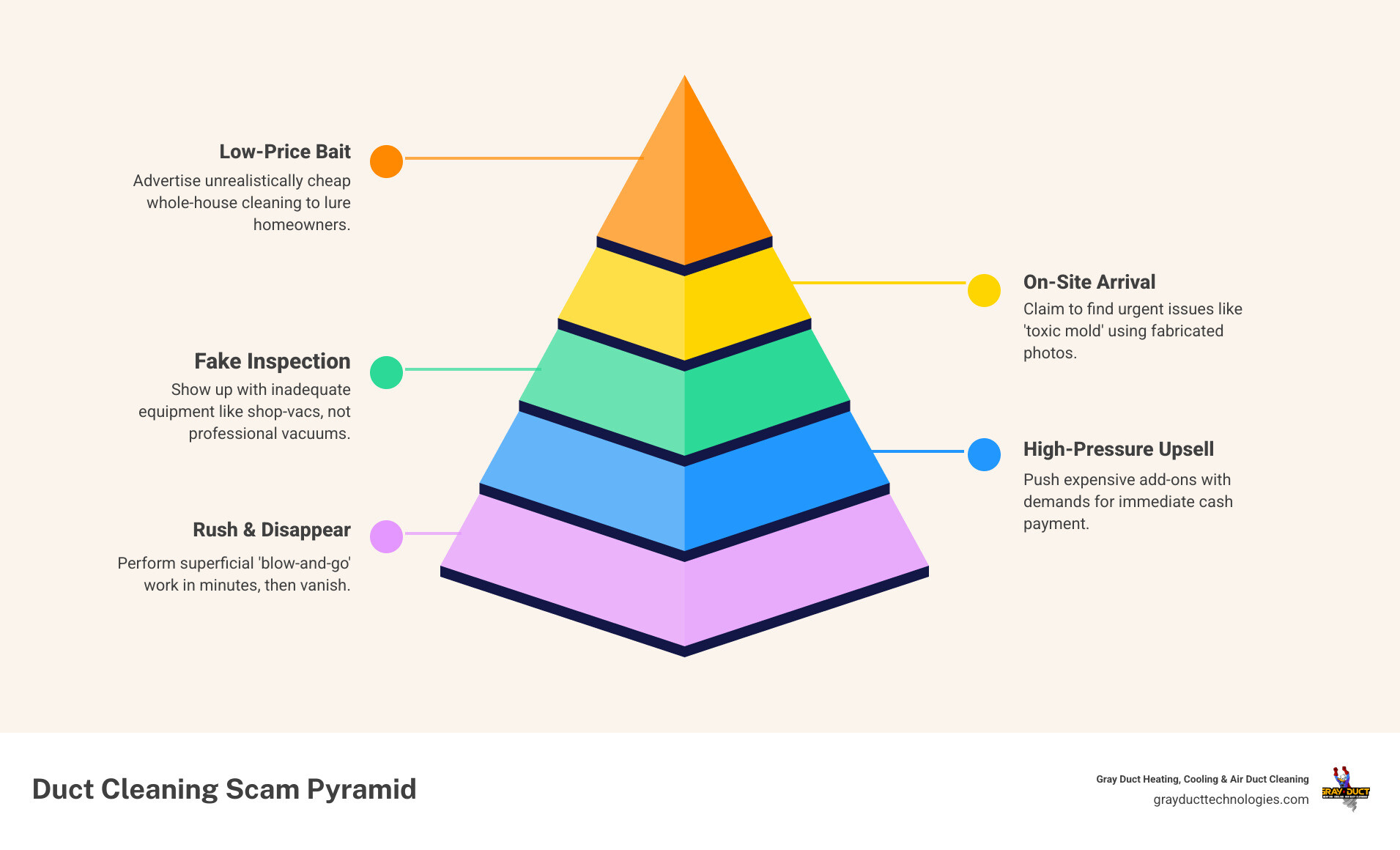
Common Types of Air Duct Cleaning Scams
Understanding the anatomy of a fraud is the first step in protection. In our experience serving the Twin Cities metro, we’ve seen these four common tactics used to separate homeowners from their hard-earned money.
Bait-and-Switch
This is perhaps the most persistent scam in the industry. It starts with an advertisement for an impossibly low rate for “whole-house duct cleaning.” Once the technician arrives at your home in Eagan or Woodbury, they suddenly discover “unforeseen issues.” They might claim your system is larger than expected, or that you have “extra” returns that weren’t included. Before you know it, that small initial price has ballooned into a bill for hundreds or even thousands of dollars.
“Blow-and-Go” Tactics
A “blow-and-go” company is one that charges a low fee but performs a completely inadequate service. These crews often use subpar equipment, like a standard shop vacuum or a low-powered portable unit, rather than professional-grade negative pressure systems. They might spend only 20 to 30 minutes at your house, cleaning only the visible parts of the vents while leaving the deep interior of your ductwork untouched. This doesn’t just waste your money; it can actually worsen your air quality by stirring up dust without removing it.
Mold Scare Tactics
This is the most predatory tactic. A technician may show you a blurry photo on a tablet—often a stock photo or a picture from a different house—and claim you have “toxic black mold.” They use fear to pressure you into immediate, expensive “remediation” or “sanitization” treatments. Legitimate mold claims require laboratory confirmation, not just a visual guess by a technician who arrived thirty minutes ago.
Unsolicited Offers
Be wary of “storm chasers” or companies that knock on doors in neighborhoods like Minnetonka or Plymouth claiming they are “just in the area.” Reputable companies in the Twin Cities stay busy through referrals and established reputations; they rarely need to solicit door-to-door or make cold calls. For more details on what a real service looks like, you can read more about air duct cleaning.
Common Scam Platforms:
- Facebook Community Groups: Often filled with “neighbors” recommending a “great deal” that is actually a bot or a fake profile.
- Craigslist/Classified Ads: High-risk areas where unlicensed operators hide behind anonymity.
- Door-to-Door Flyers: Often lack a physical local address or a verifiable license number.
Identifying Duct Cleaning Scams How to Avoid Them on Social Media
Social media has become a breeding ground for duct cleaning scams how to avoid them. You might see a post in a local Bloomington or Lakeville group from someone claiming their “husband’s business” is offering a special discount.
These profiles are often fake, using stolen photos of professional equipment to look legitimate. A key red flag is a profile that was created recently or has no local connections. If you see the same “special offer” posted in groups across five different states, it’s a scam. Always look for a professional air duct and dryer vent cleaning Minneapolis St Paul Mn provider with a verified Google Business Profile and local history.
Red Flags: Duct Cleaning Scams How to Avoid Them
Spotting a scammer often starts before they even turn off their engine. Here are the primary warning signs that you might be dealing with a dishonest operator.
Unmarked Vehicles and Lack of Uniforms
Professional companies take pride in their brand. If a technician pulls up to your home in an unmarked white van or a personal pickup truck with no company logo, proceed with extreme caution. Legitimate local businesses like ours ensure our teams are easily identifiable for your safety and peace of mind.
High-Pressure Sales and Cash-Only Requests
If a technician tells you that your family is in immediate danger due to air quality or that a “special price” is only available if you sign right this second, they are using pressure tactics. Additionally, be suspicious of any company that insists on cash-only payments or demands the full amount before the work is finished.
Lack of Written Contracts
Never allow work to begin without a signed, itemized estimate. A professional contract should list exactly which parts of the HVAC system will be cleaned (supply ducts, return ducts, air handler, coils, etc.). If the “contract” is just a vague note on a piece of paper, you have no protection if the work is done poorly. To learn more about how to vet these companies, visit our page on how to avoid scams.
| Feature | Professional Standard | Scammer Behavior |
|---|---|---|
| Pricing | Transparent, based on system size | Vague “specials” that change on-site |
| Equipment | Truck-mounted or HEPA-filtered vacuums | Shop-vacs or handheld blowers |
| Duration | 2 to 6 hours for a full house | 20 to 45 minutes (“Blow-and-go”) |
| Certification | NADCA Certified (ASCS) | No verifiable credentials |
| Documentation | Before-and-after photos/videos | Stock photos of “mold” |
Warning Signs During the Service Call
Even if you’ve booked the appointment, you can still stop a scam in its tracks. Watch the technician’s equipment. If they are only using a shop-vac, they are not actually cleaning your ducts; they are just vacuuming the floor vents.
If they claim to find mold within minutes of arriving, ask for a sample to be sent to an independent lab. Many scammers carry “test kits” that are designed to show a positive result regardless of what they touch. If you’re wondering if the process is even necessary, check out our blog post: is air duct cleaning worth it.
How to Verify a Legitimate Service Provider
Verification is your best defense. Don’t take a company’s word for it—check the facts yourself.
NADCA Certification
The National Air Duct Cleaners Association (NADCA) is the gold standard in our industry. A NADCA-certified company must have at least one Air Systems Cleaning Specialist (ASCS) on staff, maintain liability insurance, and follow a strict code of ethics. You can verify any company’s membership directly on the NADCA website. If they aren’t on that list, they aren’t certified.
Professional Equipment Requirements
A legitimate cleaning requires two main components: Agitation and Extraction.
- Agitation: Tools like air whips, brushes, or “skipper balls” must be used to dislodge dust from the duct walls.
- Extraction: A high-powered vacuum system (ideally truck-mounted or a specialized HEPA-filtered portable unit) must create “negative pressure.” This ensures that once the dust is loose, it is pulled out of your home and into a containment system, rather than floating into your living room.
Written Scope of Work
A pro will explain the “Source Removal” method. This involves cleaning the entire HVAC system, including the blower motor, the coils, and the drain pan, not just the registers. Without cleaning the “heart” of the system (the air handler), your ducts will just get dirty again immediately. This level of detail is also important for other services; for example, see our guide on diy vs professional dryer vent cleaning which option is best for your home.
When is Professional Cleaning Actually Necessary?
We believe in honesty. You do not need your ducts cleaned every month, and anyone telling you otherwise is likely looking for a quick sale. According to the EPA and industry standards, here is when you should actually consider professional service:
- The 3 to 5 Year Cycle: For most homes in the Twin Cities, a thorough cleaning every few years is sufficient to maintain system efficiency and air quality.
- Visible Mold Growth: If you see “fuzzy” growth on the inside of your hard-surface ducts or on other components of your HVAC system. Note: Mold on fiberglass duct board is often impossible to clean and may require replacement.
- Pest Infestations: If rodents or insects have made a home in your ductwork, a professional cleaning is required to remove droppings and nesting materials.
- Excessive Debris: If your registers are releasing visible puffs of dust or if you notice a thick coating of debris inside the vents.
- Post-Renovation Dust: Construction projects create a massive amount of fine dust (drywall dust, sawdust) that settles deep in the return vents. This should be cleaned before you turn on your AC or furnace for the season.
While some homeowners attempt a light cleaning themselves, it’s important to understand the limitations. You can read our tips on how to clean hvac ducts yourself, but without professional negative pressure equipment, you can’t reach the debris deep inside the system.
Conclusion
Protecting your home from duct cleaning scams how to avoid them comes down to research and trust. As a family-owned business deeply rooted in the Twin Cities, we’ve seen how these scams hurt our neighbors in communities from Minneapolis and St. Paul to Rochester and Owatonna.
At Gray Duct Heating, Cooling & Air Duct Cleaning, we don’t use third-party contractors. Our in-house, certified technicians use high-powered equipment and follow NADCA standards to ensure your indoor air quality actually improves. We believe in transparent service—no hidden fees, no “bait-and-switch” pricing, and no manufactured mold scares.
Whether you are in Apple Valley, Maple Grove, or Woodbury, your home deserves a service provider that values integrity as much as you do. If you have questions about your system or want to ensure you are getting a legitimate service, we are here to help. Protect your home and avoid scams by choosing a local partner you can verify.
Frequently Asked Questions about Duct Cleaning Scams How to Avoid Them
1. What should I do if a technician claims to find toxic mold? Stay calm and do not sign anything. Ask the technician to show you the mold inside the ductwork using a camera or by looking through an access panel. Take your own photo of what they are showing you. Then, insist on a second opinion from a licensed mold remediator or an independent lab test. Scammers rely on the “fear factor” of mold to get a quick signature; a professional will welcome a second opinion.
2. How long does a legitimate whole-house duct cleaning take? For a standard single-family home with one furnace, a proper cleaning typically takes between 2 and 4 hours. Larger homes or systems with significant contamination can take up to 6 hours or more. If a crew claims they can clean your entire house in 45 minutes, they are likely only cleaning the register covers and ignoring the rest of the system.
3. Why do scammers target homeowners through door-to-door flyers? Flyers are a low-cost way for “fly-by-night” operations to blanket a neighborhood like Eden Prairie or Lakeville. These flyers often feature a generic name and a burner phone number, making it easy for the scammers to disappear once they’ve collected enough money or if the authorities start looking for them. Always cross-reference a flyer with an established local address and a NADCA certification.
<div class="elementor-element elementor-element-b5c55cb elementor-position-left elementor-widgetwidth-initial elementor-widget-tabletwidth-initial elementor-vertical-align-top elementor-widget elementor-widget-image-box" data-id="b5c55cb" data-elementtype="widget" data-e-type="widget" id="post-call-text" data-widgettype="image-box.default">Need HVAC Help?
Our NADCA-certified technicians are ready to help with all your heating, cooling, and air quality needs.
Get Free EstimateMore Articles
 HVAC Tips
What to Do When Your AC and Furnace Share the Same Air Filter
 HVAC Tips
Addressing Drafty Rooms Before Winter: Duct Sealing vs. Window Replacement
 HVAC Tips
Dryer Vent Routing: Rigid Metal vs. Flexible Foil in Cold Climates
 HVAC Tips
Why We Inspect the Heat Exchanger So Closely During Fall Maintenance
 HVAC Tips
Upgrading to a Two-Stage Furnace: Is the Investment Worth It in Minnesota?
Related Articles
Ready to Get Started?
Whether you need a repair, maintenance, or a new system installation, our expert team is here to help.