Why Your Home Needs Better Duct Insulation Right Now
Gray Duct

Why Duct Insulation Benefits for Homeowners Matter More Than You Think Duct insulation benefits for homeowners include lower energy bills, more consistent indoor temperatures,…
Why Duct Insulation Benefits for Homeowners Matter More Than You Think
Duct insulation benefits for homeowners include lower energy bills, more consistent indoor temperatures, reduced HVAC wear, better indoor air quality, and a quieter home — all from one relatively straightforward upgrade.
Here’s a quick summary:
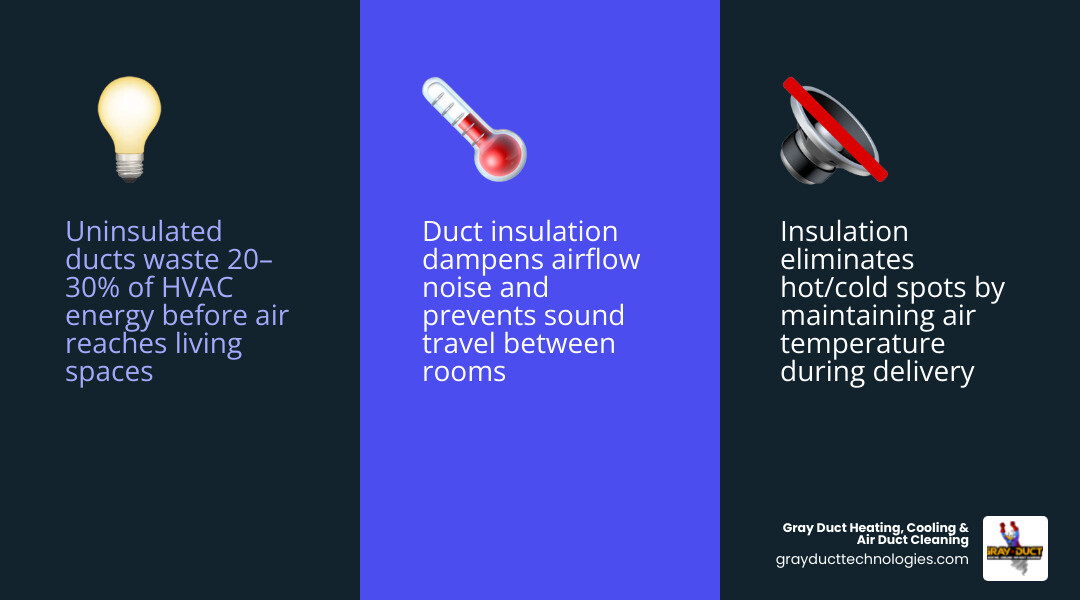
- Lower energy bills — Uninsulated ducts can waste 20–30% of your HVAC system’s energy before conditioned air ever reaches your rooms
- Consistent comfort — Insulated ducts maintain air temperature throughout delivery, eliminating hot and cold spots
- Extended HVAC lifespan — Less energy loss means your system works less and lasts longer
- Better air quality — Sealed, insulated ducts reduce the chance of pollutants, allergens, and moisture entering your air supply
- Noise reduction — Insulation dampens sound from airflow and prevents noise from traveling between rooms
- Environmental impact — Less wasted energy means a smaller carbon footprint
Most homeowners in the Twin Cities don’t think much about their ductwork — it’s hidden in attics, crawl spaces, and behind walls. But according to the U.S. Department of Energy, poorly sealed or uninsulated ducts are one of the biggest sources of energy waste in a home. In fact, more than 7 out of 10 buildings in America have ducts with inadequate insulation. In a Minnesota climate, where winters push temperatures well below zero and summers bring real heat and humidity, that energy loss isn’t just inconvenient — it’s expensive.
If your utility bills have been creeping up, or if some rooms in your home never seem to reach the right temperature no matter how long the furnace runs, your ductwork insulation could be the root cause.
I’m Jason Giandalia, founder of Gray Duct Heating, Cooling & Air Duct Cleaning, and over the years I’ve seen how much of a difference proper insulation makes — it’s one of the most impactful and underappreciated duct insulation benefits for homeowners I consistently identify during HVAC inspections across the Twin Cities. In this guide, I’ll walk you through exactly what insulated ductwork does for your home, where it matters most, and how to know if it’s time for an upgrade.
Top Duct Insulation Benefits for Homeowners
When we talk about upgrading your home, people often think of new windows or a high-tech thermostat. While those are great, the “unsung hero” of home efficiency is often the material wrapped around your pipes in the attic. The duct insulation benefits for homeowners are multifaceted, touching everything from your monthly budget to your family’s daily comfort.
The most immediate impact is on your wallet. Air duct systems can lose up to 40% of heating and cooling energy through a combination of leakage and heat transfer. By adding proper insulation, many homeowners report energy savings of 10% to 30% on their utility bills. In a city like Minneapolis or Saint Paul, where we spend an average of $700 per year just on climate control, those savings add up to hundreds of dollars annually.
Beyond the money, there is the matter of energy efficiency in Minneapolis, MN. When your ducts are bare, your furnace or air conditioner has to work significantly harder to achieve the temperature you set on the wall. Research shows that energy losses of just 20% can force an HVAC system to work 50% harder. By insulating, you reduce that strain and contribute to a lower carbon footprint. Learning how to save energy with HVAC optimization starts with ensuring the air you’ve already paid to heat or cool actually makes it to your bedroom.
How Duct Insulation Benefits for Homeowners Improve Indoor Comfort
Have you ever walked from a cozy living room into a bedroom that feels like a walk-in freezer? Or perhaps your upstairs office is sweltering while the basement is chilly? These “hot and cold spots” are classic signs of poor duct insulation.
As conditioned air travels through uninsulated metal ducts located in a freezing attic or a damp crawl space, it loses its thermal energy. By the time the air reaches the furthest rooms in your house, it’s no longer at the temperature you intended. Proper insulation acts like a thermos for your home’s air, ensuring that the 72-degree air leaving your furnace arrives at the register still feeling like 72 degrees. This is a critical component of air balancing in Minneapolis, MN, creating a uniform environment where every room feels exactly the same.
Noise Reduction and Home Privacy
One benefit people rarely expect from duct insulation is peace and quiet. Metal ducts are excellent conductors of sound. Without insulation, you might hear the “popping” or “creaking” of metal expanding and contracting as the heat kicks on. You might also hear the whistling of air rushing through the vents.
Thick insulation, such as fiberglass blankets or foam wraps, acts as a sound dampener. It absorbs the vibrations of the HVAC unit and the movement of air. Furthermore, uninsulated ducts can act like a “speaking tube” between rooms, carrying private conversations or the sound of a loud TV from one end of the house to the other. Insulating your ductwork provides an added layer of acoustic privacy that makes your home feel more solid and serene.
Strategic Locations for Ductwork Protection
Not every foot of ductwork in your home needs the same level of protection. If a duct is running through a “conditioned” space—like a finished basement or a heated hallway—it is already surrounded by air that is close to the temperature you want. The real trouble starts in “unconditioned” spaces.
These are the areas that are exposed to the elements, such as:
- Attics: The most common area for massive heat loss in the winter and heat gain in the summer.
- Crawl Spaces: These areas are often damp and cold, leading to rapid thermal transfer.
- Garages: Attached garages can reach extreme temperatures that steal the energy right out of your ducts.
- Unfinished Basements: While slightly more stable than an attic, an uninsulated basement can still be 20 degrees colder than your living room.
We specialize in duct insulation in Minneapolis, MN, focusing specifically on these high-risk zones. Our insulation services in Minneapolis, MN are designed to target the areas where your home is losing the most energy, ensuring your system doesn’t have to fight the Minnesota elements just to keep you comfortable.
Protecting Ducts in Extreme Minnesota Temperatures
Living in the Twin Cities means preparing for the “Polar Vortex” and humid 90-degree July afternoons. In the winter, uninsulated ducts in an attic can cause a “cold blow” effect, where the air coming out of your vents feels chilly for the first few minutes because the duct itself is frozen. This forces your heating services in Minneapolis, MN to work overtime to warm up the metal before it can warm up your family.
In the summer, the opposite happens. An attic can easily reach 130 degrees. Without insulation, your cooling in Minneapolis, MN struggles because the cold air is being heated up by the attic’s ambient temperature before it ever reaches your vents. Insulation prevents this “thermal bridge,” keeping the cold air cold and the hot air hot.
The Connection Between Sealing and Insulating
It is important to note that insulation and sealing are two halves of the same whole. If you wrap a leaky duct in insulation, you might keep the air warm, but you’re still losing air volume through the cracks. Conversely, if you seal the leaks but don’t insulate, you’re losing the temperature.
Before we apply insulation, we recommend professional duct sealing in Minneapolis, MN. Using specialized mastic or foil tape (never standard “duct tape,” which actually fails quite quickly), we ensure the system is airtight. Once you detect and fix ductwork leaks, the insulation can do its job at 100% efficiency.
Enhancing System Lifespan and Air Quality
Duct insulation isn’t just about comfort; it’s about the “health” of your home’s mechanical systems. Your furnace and air conditioner are expensive investments. When they have to work 50% harder because of poor insulation, they wear out 50% faster.
By reducing the workload, you are directly investing in residential HVAC services in Minneapolis, MN that focus on longevity rather than constant repairs. When a system runs in shorter, more efficient cycles, there is less mechanical wear on the blower motor and the compressor. If you want to know how to improve air conditioner efficiency, looking at the ducts is often more effective than just looking at the unit itself.
Preventing Condensation and Mold Growth
One of the most dangerous side effects of uninsulated ducts is condensation. When cold air travels through a metal duct in a warm, humid crawl space, moisture forms on the outside of the duct—much like a glass of ice water on a summer day.
This moisture can lead to:
- Mold and Mildew: Damp environments are breeding grounds for spores that can eventually enter your air stream.
- Structural Damage: Water dripping from ducts can rot wooden floor joists and support beams.
- Rust: Over time, condensation will corrode metal ductwork, leading to holes and structural failure.
Proper insulation with an integrated vapor barrier is essential for indoor air quality services in Minneapolis, MN. It keeps the metal surface temperature above the “dew point,” preventing moisture from ever forming.
Improving Breathability and Filtration
Leaks in uninsulated ducts don’t just let air out; they can also pull air in. If your return ducts are leaky and uninsulated in a dusty attic or a moldy crawl space, they can “suck in” pollutants, allergens, and even insulation particles, circulating them throughout your home.
In some cases, leaky ducts can even cause “back-drafting,” where combustion gases like carbon monoxide from a water heater or furnace are pulled into the living space instead of being vented outside. Ensuring your ducts are properly sealed and insulated is a core part of our comprehensive HVAC services in Minneapolis, MN, protecting your family’s health and safety.
Selecting Materials and R-Values for Minnesota Climates
Not all insulation is created equal. The type of material we choose depends on where the ducts are located and what your specific goals are.
| Insulation Type | Best For | Key Advantage |
|---|---|---|
| Fiberglass Blanket | Attics & Basements | Excellent thermal resistance and noise dampening. |
| Foam Wrap | Tight Spaces | Moisture resistant and great for preventing condensation. |
| Reflective Foil | Hot Climates/Attics | Reflects radiant heat away from the ducts. |
We offer all of Gray Duct Technologies services with a focus on selecting the right material for our unique Minnesota climate.
Understanding R-Values and Duct Insulation Benefits for Homeowners
In insulation, “R-value” stands for thermal resistance. The higher the R-value, the better the material is at stopping heat from moving through it. For most ductwork, the industry standard is between R-4 and R-8.
However, in Minnesota, we often recommend the higher end of that scale—especially for ducts in attics. An R-8 rating provides significantly better protection against our sub-zero winters than an R-4 rating. When we perform inspections, we look at the climate-specific needs of your home to ensure you aren’t under-insulated for our harsh winters.
Professional vs. DIY Installation
While some homeowners attempt to wrap their own ducts, it is often a project best left to the pros. Why?
- Accessibility: Most ducts are located in cramped, dark, and dangerous areas like attics or crawl spaces.
- Safety: Handling fiberglass requires specific protective gear to avoid skin and lung irritation.
- Precision: If insulation is compressed or has gaps, its R-value drops significantly. A professional ensures a “snug but not tight” fit.
- Hidden Issues: A pro can identify mold, rust, or disconnected joints that a homeowner might miss.
Investing in energy audits in Minneapolis, MN can help you determine exactly where your money is being wasted before you start the work.
Frequently Asked Questions about Duct Insulation
How do I know if my ducts need better insulation?
Common signs include a sudden spike in utility bills, rooms that are consistently different temperatures than the rest of the house, or visible damage (like sagging or torn wrap) on the ducts in your attic or basement. If your home was built more than 20 years ago, there’s a high chance the insulation has degraded or was never up to modern R-8 standards.
Can duct insulation help reduce my carbon footprint?
Absolutely. By reducing the amount of energy required to heat and cool your home, you are lowering the demand on power plants and reducing the burning of fossil fuels. It is one of the most sustainable upgrades a homeowner can make because it lasts for 15 to 25 years.
Does insulating ducts help with noise?
Yes. Insulation is one of the best ways to dampen the “booming” sound of air moving through metal pipes and the “vibration” of the HVAC blower. It also acts as a muffler for sounds traveling between different rooms in the house.
Conclusion
At Gray Duct Technologies, we believe that a comfortable home starts with the systems you can’t see. As a family-owned business serving the Twin Cities and South Metro area, we take pride in our in-house certified team. We don’t use third-party contractors; we use our own experts who understand the specific challenges of Minnesota weather.
Whether you are in Minneapolis, Saint Paul, or suburbs like Eden Prairie and Plymouth, we are here to help you maximize your home’s efficiency. Don’t let your hard-earned money leak out of your attic. Schedule professional duct sealing and insulation in Minneapolis, MN today and start feeling the difference in every room of your home.
<div class="elementor-element elementor-element-b5c55cb elementor-position-left elementor-widgetwidth-initial elementor-widget-tabletwidth-initial elementor-vertical-align-top elementor-widget elementor-widget-image-box" data-id="b5c55cb" data-elementtype="widget" data-e-type="widget" id="post-call-text" data-widgettype="image-box.default">Need HVAC Help?
Our NADCA-certified technicians are ready to help with all your heating, cooling, and air quality needs.
Get Free EstimateMore Articles
 HVAC Tips
What to Do When Your AC and Furnace Share the Same Air Filter
 HVAC Tips
Addressing Drafty Rooms Before Winter: Duct Sealing vs. Window Replacement
 HVAC Tips
Dryer Vent Routing: Rigid Metal vs. Flexible Foil in Cold Climates
 HVAC Tips
Why We Inspect the Heat Exchanger So Closely During Fall Maintenance
 HVAC Tips
Upgrading to a Two-Stage Furnace: Is the Investment Worth It in Minnesota?
Related Articles
Ready to Get Started?
Whether you need a repair, maintenance, or a new system installation, our expert team is here to help.