Understanding the Science of Mold Growth in Ductwork
Gray Duct

The Science Behind How Mold Grows Inside Your Air Ducts How mold grows inside your air ducts comes down to five conditions that your HVAC system quietly satisfies every day:…
The Science Behind How Mold Grows Inside Your Air Ducts
How mold grows inside your air ducts comes down to five conditions that your HVAC system quietly satisfies every day: moisture, organic material, darkness, warmth, and stagnant air. When even one of these factors goes unchecked, mold spores — which are always present in the air — can germinate and form visible colonies in as little as 24 to 48 hours.
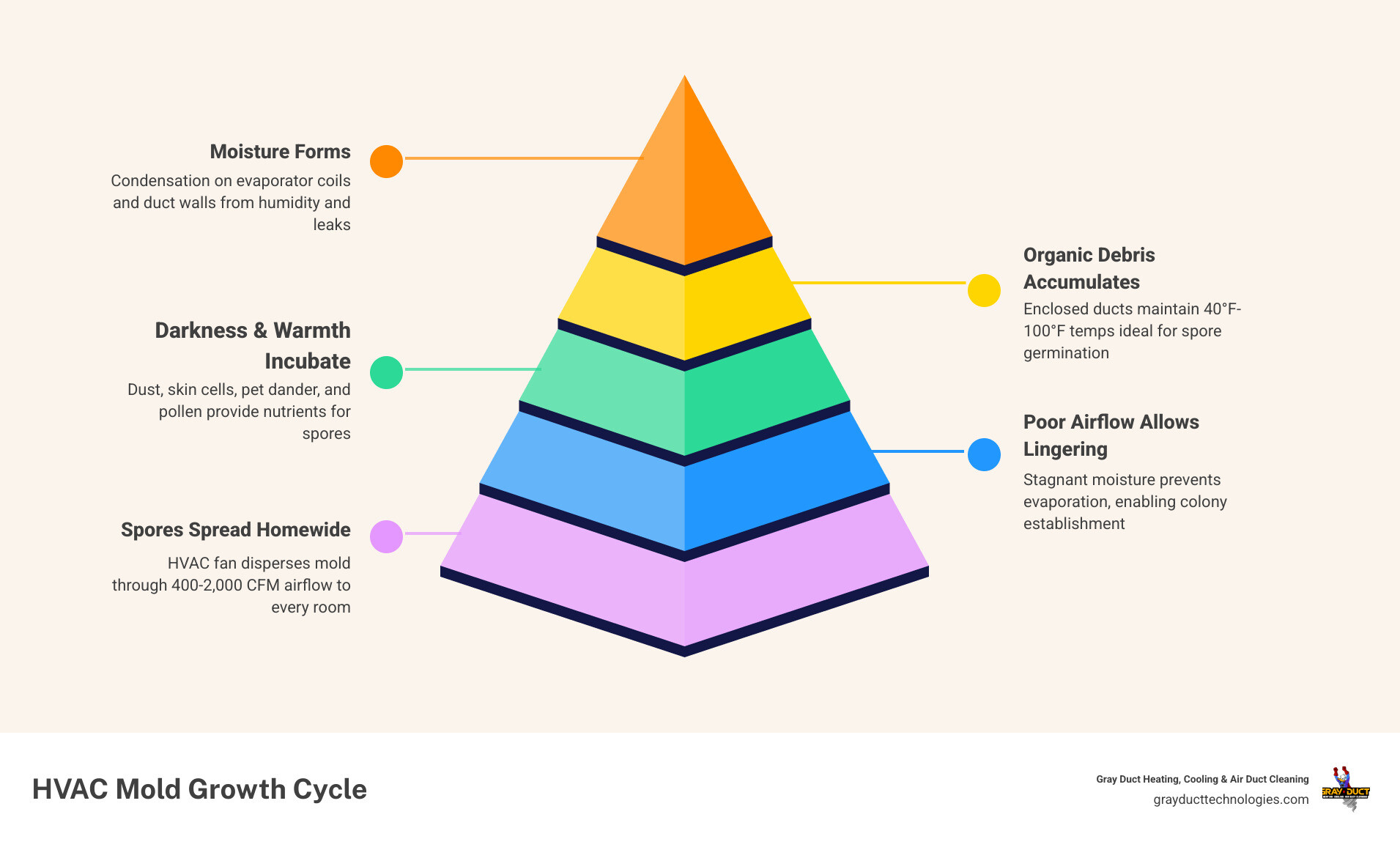
Here is a quick breakdown of how it happens:
- Moisture forms on cool surfaces like evaporator coils and duct walls through condensation, or enters through leaky ductwork
- Organic debris accumulates — dust, dead skin cells, pet dander, and pollen collect inside ducts and serve as a food source for mold
- Darkness and warmth inside enclosed ductwork create ideal incubation conditions (mold thrives between 40°F and 100°F)
- Poor airflow allows moisture to linger rather than evaporate, giving spores the time they need to establish colonies
- Spores spread throughout your home every time the HVAC fan runs, reaching every connected room
This is not a rare problem. More than 45 million buildings in the U.S. have unhealthy mold levels, and a significant portion of that contamination originates inside HVAC systems — often hidden from plain sight.
For Twin Cities homeowners, where humidity levels and seasonal temperature swings put extra stress on HVAC systems, understanding this process is the first step toward protecting your family’s health and your home’s air quality.
I’m Jason Giandalia, founder of Gray Duct Heating, Cooling & Air Duct Cleaning, and through years of hands-on work in Minnesota homes I’ve seen how mold grows inside your air ducts and the real impact it has on indoor air quality and family health. In this guide, I’ll walk you through the science, the warning signs, and the practical steps that actually work.
The Role of Humidity and Condensation in How Mold Grows Inside Your Air Ducts
Moisture is the single most critical “ingredient” in the mold recipe. Without it, spores remain dormant. However, in our humid Minnesota summers, your air conditioner acts as a giant dehumidifier. As warm air passes over the cold evaporator coils, moisture condenses into liquid water. If your system isn’t draining perfectly, or if your ducts aren’t properly insulated, this water creates a “splash zone” for mold.
Indoor relative humidity (RH) should ideally stay between 30% and 50%. Once humidity levels climb above 60%, the air reaches a “dew point” where it can no longer hold moisture, leading to “sweating” inside your metal ducts. We often see this in homes where owners Detect and Fix Ductwork Leaks too late; those leaks allow unconditioned, moist air to meet cold duct surfaces, triggering immediate condensation. Understanding this link is why AC Duct Cleaning Prevent Mold Growth is so effective—it addresses the environment before the spores take root.
Why Organic Debris Influences How Mold Grows Inside Your Air Ducts
Mold is a living organism that needs to eat. In a laboratory, scientists use Petri dishes; in your home, mold uses the layer of dust lining your vents. This dust isn’t just “dirt”—it’s a buffet of organic matter including skin cells, fabric fibers, and pollen.
For our neighbors with furry friends, Air Duct Cleaning for Pet Owners is especially important because pet dander provides a high-protein nutrient source that allows mold colonies to expand rapidly. When you combine moisture with these Dirty Ductwork Common Problems, you aren’t just looking at a dusty house; you’re looking at a biological breeding ground.
Identifying the Warning Signs of HVAC Contamination
Because your ductwork is hidden behind walls and ceilings, you usually won’t see the mold first—you’ll smell it. Mold releases Microbial Volatile Organic Compounds (mVOCs) as it grows. These are the gases responsible for that unmistakable “earthy” or “musty” odor that greets you when the AC kicks on.
If you suspect an issue, Identifying Dirty Home Ductwork starts with a simple flashlight. Look for dark spotting on the backside of your vent covers or around the edges of your registers. Ignoring these signs can lead to a significant Dirty Ductwork Impact on HVAC, as microbial buildup on coils forces the system to work harder, increasing your energy bills and leading to premature mechanical failure.
Recognizing “Dirty Sock Syndrome” in Modern Systems
In the HVAC industry, we have a specific term for a common microbial problem: “Dirty Sock Syndrome.” This typically happens in high-efficiency heat pumps and AC units when bacteria and mold grow on the moisture-retaining dust of the evaporator coils.
The smell is exactly as described—a pungent, locker-room odor. This occurs when stagnant water sits in the drain pan or when the coils don’t dry out completely between cycles. This is why Regular AC Duct Cleaning Importance cannot be overstated; cleaning the coils is just as vital as cleaning the ducts themselves to eliminate the source of the stench.
Visual Cues Near Supply and Return Vents
Keep an eye on the surfaces where air enters and exits your rooms.
- Black Specks: These often look like soot but are actually small colonies of mold clinging to the vent’s metal louvers.
- Fuzzy Textures: If the “dust” on your vents looks hairy or thick, it’s likely a mature mold colony.
- Rust and Pooling: Moisture shouldn’t be visible. If you see water droplets or rust on your registers, your ducts are “sweating” internally.
Knowing What Happens If You Don’t Clean Your Air Ducts when these signs appear is scary—the mold will eventually penetrate porous materials like drywall or carpet near the vents, making remediation much more expensive.
Health Risks and Biological Impacts of Duct Mold
The danger of mold in a duct system is its delivery method. Unlike a patch of mold on a basement wall that stays put, duct mold is hooked up to a high-speed distribution network. A standard residential air handler moves between 400 and 2,000 cubic feet of air per minute (CFM). This airflow constantly detaches microscopic spores and mycotoxins, blowing them directly into your breathing zone.
For many families, Air Duct Cleaning for Allergy Relief is the only way to stop persistent sneezing and itchy eyes that seem to “only happen at home.” Understanding Air Duct Cleaning Neglect Dangers is vital because long-term exposure can lead to chronic respiratory issues that persist even after the mold is gone.
Vulnerable Populations and Indoor Air Quality
While healthy adults might experience mild irritation, certain groups are at much higher risk. Mold is a major asthma trigger, and studies show that dampness and mold exposure can nearly triple an infant’s chance of developing asthma later in life.
We prioritize Air Duct Cleaning for Indoor Air Quality because we serve many families in the Twin Cities with seniors or immunocompromised members. This is Why It’s Important to Have Your Air Ducts Cleaned: it’s not just about a clean house; it’s about protecting the most vulnerable people under your roof from airborne biological threats.
Professional Remediation vs. Standard Duct Cleaning
There is a big difference between a routine “dusting” of your ducts and true mold remediation. If a company just sticks a vacuum in your vent without addressing the mold biology, the spores will be back in a week.
| Feature | Standard Duct Cleaning | Professional Mold Remediation |
|---|---|---|
| Primary Goal | Remove dust and loose debris | Eliminate biological growth and spores |
| Equipment | Standard vacuum/brushes | HEPA-filtered negative pressure units |
| Containment | Minimal | Specialized zones to prevent cross-contamination |
| Treatments | None or basic deodorizer | EPA-registered antimicrobial agents |
| Verification | Visual check | Spore count testing (if requested) |
The Air Duct Cleaning Process we use involves high-powered negative pressure, ensuring that no dust or spores escape into your living space during the cleaning. This is the Importance of Regular Air Duct Cleaning: it keeps the microbial load low enough that full remediation is rarely needed.
Handling Porous vs. Non-Porous Materials
The strategy for cleaning depends entirely on what your ducts are made of.
- Sheet Metal: This is non-porous and can be effectively cleaned and sanitized with EPA-registered antimicrobials.
- Fiberglass Duct Board: Because this material is porous, mold can grow inside the fibers. Often, if this material is heavily contaminated, the EPA recommends replacement rather than cleaning.
- Flex Duct: These plastic-lined tubes are easily damaged. If mold has taken root in a flex duct, we often recommend replacing that specific run to ensure the problem is truly gone.
Addressing these Clogged Air Ducts Issues correctly the first time saves you from recurring health problems and wasted money.
When to Call a Professional for Inspection
You don’t always need a full cleaning, but you should call us for an inspection if you experience:
- Persistent Musty Smells: Even if you don’t see mold, the smell is a chemical “fingerprint” of growth.
- Post-Flooding: If your basement or home experienced water damage, mold can start in your floor ducts within 48 hours.
- Visible Colonies: If you see green, black, or white “fuzz” on your vents.
The Regular Air Duct Cleaning Benefits include peace of mind, knowing that a certified eye has checked the dark corners of your system where mold likes to hide.
How to Prevent Mold from Returning to Your Twin Cities Home
Once your system is clean, the goal is to make it a hostile environment for mold. As of April 2026, the industry standard for moisture control is more advanced than ever. The primary rule: Keep your humidity low. By maintaining your home between 30% and 50% relative humidity, you effectively “starve” mold of the water it needs to survive.
To Prevent Long-Term Ductwork Issues, you must also maintain proper airflow. When air moves quickly, moisture evaporates. When you Air Duct Cleaning Reduce HVAC Repairs, you’re ensuring the blower motor and coils are clean enough to maintain that critical velocity.
Essential Maintenance for Moisture Control
Homeowners can take several proactive steps to keep their systems dry:
- Clear Condensate Lines: Flush your drain line with white vinegar quarterly to prevent “sludge” (algae and mold) from backing up into your house.
- Check the Drain Pan: Ensure it slopes toward the drain so water doesn’t sit and stagnate.
- Insulate Attic Ducts: If you live in areas like Lakeville or Minnetonka where attics get incredibly hot, ensure your ducts are well-insulated to prevent “sweating” on the outside of the metal.
How often you do this depends on your home’s specific needs, but How Often Should Air Ducts Be Cleaned? usually falls every 3 to 5 years for most Minnesota families.
Advanced IAQ Solutions for Long-Term Protection
If your home is prone to moisture, we recommend three advanced upgrades:
- UV-C Lights: Installed near the evaporator coil, these lights destroy the DNA of mold spores so they cannot reproduce.
- Whole-Home Dehumidifiers: These integrate with your HVAC to keep the entire house at that “sweet spot” of 45% humidity.
- High-Efficiency Filtration: Using MERV 11 or higher filters traps the organic “food” (dust and dander) before it can enter the ductwork.
These investments in Air Duct Cleaning for Improved Indoor Air Quality pay for themselves through better health and a longer-lasting HVAC system.
Frequently Asked Questions about Duct Mold
Can I clean mold out of my air ducts myself?
We strongly advise against DIY mold cleaning in ducts. When you scrub mold without professional containment and HEPA-filtered negative pressure, you actually “seed” the rest of your home. You’ll disturb millions of spores that will settle into your carpets and furniture, often making the indoor air quality worse than before you started.
How quickly does mold grow after a moisture event?
Mold is incredibly fast. Germination begins within 24 to 48 hours of spores meeting moisture. By the third or fourth day, hyphal extension (the “roots” of the mold) can begin penetrating porous materials like duct liners or insulation.
Does standard duct cleaning kill mold spores?
Standard mechanical cleaning removes the visible growth and the dust it feeds on, but it doesn’t necessarily “kill” microscopic spores. To truly eliminate the risk, we use EPA-registered antimicrobial sanitizers after the mechanical cleaning is complete. This ensures that any remaining spores are neutralized and cannot regrow.
Conclusion
Understanding how mold grows inside your air ducts is the first step toward a healthier home. At Gray Duct Heating, Cooling & Air Duct Cleaning, we’ve dedicated ourselves to helping families across the Twin Cities—from Minneapolis and Saint Paul to Bloomington and Woodbury—breathe easier. As a family-owned business, we don’t use third-party contractors; our in-house certified team handles every inspection and cleaning with the same care we’d use in our own homes.
Don’t let hidden mold compromise your family’s health. Investing in Air Duct Cleaning for Improved Indoor Air Quality is one of the best things you can do for your home’s longevity and your peace of mind.
Ready to clear the air? Schedule your professional air duct cleaning today and let our experts ensure your HVAC system is clean, dry, and mold-free.
<div class="elementor-element elementor-element-b5c55cb elementor-position-left elementor-widgetwidth-initial elementor-widget-tabletwidth-initial elementor-vertical-align-top elementor-widget elementor-widget-image-box" data-id="b5c55cb" data-elementtype="widget" data-e-type="widget" id="post-call-text" data-widgettype="image-box.default">Need HVAC Help?
Our NADCA-certified technicians are ready to help with all your heating, cooling, and air quality needs.
Get Free EstimateMore Articles
 HVAC Tips
What to Do When Your AC and Furnace Share the Same Air Filter
 HVAC Tips
Addressing Drafty Rooms Before Winter: Duct Sealing vs. Window Replacement
 HVAC Tips
Dryer Vent Routing: Rigid Metal vs. Flexible Foil in Cold Climates
 HVAC Tips
Why We Inspect the Heat Exchanger So Closely During Fall Maintenance
 HVAC Tips
Upgrading to a Two-Stage Furnace: Is the Investment Worth It in Minnesota?
Related Articles
Ready to Get Started?
Whether you need a repair, maintenance, or a new system installation, our expert team is here to help.