Safety First: Essential Benefits of Regular Dryer Vent Maintenance
Gray Duct

The Real Dryer Vent Cleaning Fire Prevention Benefits Twin Cities Homeowners Need to Know Dryer vent cleaning fire prevention benefits are more significant than most homeowners…
The Real Dryer Vent Cleaning Fire Prevention Benefits Twin Cities Homeowners Need to Know
Dryer vent cleaning fire prevention benefits are more significant than most homeowners realize — and ignoring this single maintenance task puts your home at serious risk. According to the National Fire Protection Association, roughly 15,000 residential fires are linked to clothes dryers every year in the U.S., causing around $200 million in property damage annually. The U.S. Fire Administration identifies failure to clean dryer vents as one of the leading contributing factors in those fires.
Here is a quick summary of the core fire prevention benefits of regular dryer vent cleaning:
- Removes flammable lint buildup that accumulates deep inside the vent duct beyond what the lint trap catches
- Restores proper airflow so heat does not concentrate and reach ignition temperatures
- Reduces overheating of the dryer’s internal components and exhaust system
- Eliminates hidden fire pathways — a clogged vent can spread a fire through walls and ceilings before you know it
- Lowers carbon monoxide risk in homes with gas dryers by keeping exhaust moving safely outside
- Extends appliance life by reducing the strain that restricted airflow places on motors and heating elements
- Catches duct damage early — professional cleaning includes inspection for crushed, disconnected, or deteriorating venting materials
The bottom line: a clean dryer vent is one of the simplest and most effective ways to prevent a house fire.
That risk is real in every Minnesota home, whether you run two loads a week or two loads a day. I’m Jason Giandalia, founder of Gray Duct Heating, Cooling & Air Duct Cleaning, and with certifications including ASCS from NADCA and C-Det from CSIA, I’ve seen how compacted lint in Twin Cities homes creates exactly the conditions that make dryer vent cleaning fire prevention benefits so critical. In this guide, I’ll walk you through everything you need to know to protect your home.
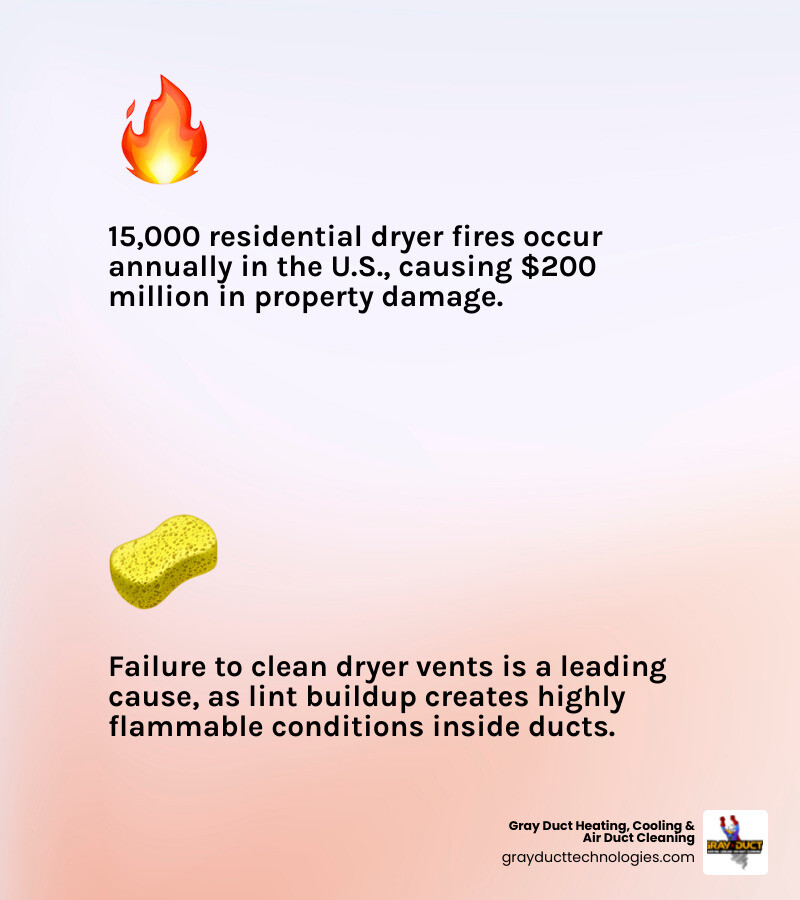
Dryer Vent Cleaning Fire Prevention Benefits: Protecting Your Twin Cities Home
In April 2026, home safety is more advanced than ever, yet the humble clothes dryer remains one of the most common fire starters in American households. When we look at the statistics, the numbers are sobering. The National Fire Protection Association (NFPA) reports that nearly 15,000 home fires are caused by dryers each year. These incidents aren’t just minor mishaps; they result in approximately $200 million in property damage, hundreds of injuries, and tragic loss of life.
The U.S. Fire Administration points to a specific culprit: the failure to clean dryer vents. This is why understanding Dryer Vent Cleaning for Fire Safety is so vital for families from Minneapolis to Rochester. When lint—a highly combustible material—accumulates in the dark, hidden recesses of your ventilation duct, it acts like a fuse waiting for a spark. By prioritizing Preventing Dryer Vent Fires through routine maintenance, you aren’t just checking a box on a chore list; you are actively removing a primary ignition source from your home.
Maximizing Dryer Vent Cleaning Fire Prevention Benefits Through Airflow
The mechanics of a dryer fire are surprisingly simple. Your dryer works by blowing hot air through a tumbling drum to evaporate moisture from your clothes. That hot, moist air needs a clear exit path. When lint clogs the vent, it creates an exhaust restriction.
Think of your dryer vent like an artery. When it’s “clogged,” the heart (the dryer motor and heating element) has to work much harder. This restriction causes heat to accumulate within the machine and the ductwork. Since lint is essentially a collection of tiny, dry fibers, it has a very low ignition point. When the internal temperature of a restricted vent climbs too high, that lint can spontaneously ignite. This is why a Dryer Vent Cleaning Prevent Fire Hazard strategy is the most effective way to keep your laundry room safe. Proper airflow ensures that heat is carried away quickly, keeping temperatures well below the danger zone.
Long-Term Dryer Vent Cleaning Fire Prevention Benefits for Appliances
While safety is our number one priority, the secondary dryer vent cleaning fire prevention benefits include significant financial perks. A dryer struggling against a blockage is an inefficient machine. We often see homeowners in the South Metro area wondering why their energy bills are spiking. Often, it’s because a clogged vent forces the dryer to run for two or even three cycles just to dry a single load of towels.
By restoring airflow, you reduce the strain on the dryer’s motor and heating element. This not only lowers your monthly utility costs but also significantly extends the lifespan of your appliance. Replacing a high-end dryer in 2026 can be a major expense; regular maintenance is a much smarter investment. There are many reasons Why Dryer Vent Cleaning Saves You Money, from preventing premature motor burnout to avoiding the catastrophic costs of fire restoration.
How a Clogged Vent Transforms Into a Fire Hazard
It starts small—just a few stray fibers that make it past the lint screen. But over months and years, these fibers layer upon themselves, especially in areas with sharp bends or long horizontal runs. This is where the real danger lies. Research shows that a shocking 34% of dryer fire incidents are directly caused by lint buildup in the duct.
When the airflow is restricted, the dryer’s high-limit thermostat may fail or cycle too frequently, eventually leading to a mechanical failure that sparks the lint. Once the lint in the duct ignites, the vent acts like a chimney, drawing the flames through the walls or floor joists of your home. This makes the fire incredibly difficult to detect until it has already spread to the structure of the house.
Furthermore, for our neighbors with gas dryers, a clog creates a secondary silent killer: carbon monoxide (CO). If the exhaust can’t escape outside, it can backdraft into your living space. So, Can a Clogged Dryer Vent Cause a Fire? Absolutely—and it can also compromise your indoor air quality in dangerous ways.
Red Flags: When to Schedule an Inspection in the South Metro
Living in Minnesota, we use our dryers heavily, especially during the winter months when bulkier blankets and heavy coats produce massive amounts of lint. You shouldn’t wait for a fire to start before taking action. Your dryer will usually give you several “warning flares” that a blockage is reaching a critical level.
If you notice any of the following, it’s time to call in the professionals:
- The Burning Smell: This is the most urgent sign. If you smell something acrid or “toasty” while the dryer is running, it likely means lint is already charring or scorching inside the heating chamber.
- Long Drying Cycles: If a load that used to take 45 minutes now takes 90 minutes or multiple cycles, your vent is likely restricted.
- The “Hot to the Touch” Exterior: If the top of your dryer feels unusually hot or your laundry room feels like a sauna, the heat isn’t escaping where it should.
- Excessive Humidity: Finding moisture on the walls or windows of the laundry room indicates that the moist exhaust air is leaking back into the house rather than exiting the vent.
- Visible Lint at the Exit: If the exterior vent flap doesn’t open when the dryer is on, or if you see lint poking out of the exterior wall cap, you have a major blockage.
Recognizing these 5 Signs Your Dryer Vent Needs Cleaning Before It Becomes a Fire Hazard can save your home. Especially during the colder months, you should Avoid a Dryer Fire This Winter by checking these signs frequently.
Professional vs. DIY: Ensuring Total System Clearance
Many homeowners attempt to clean their own vents using “as seen on TV” brush kits. While we appreciate the DIY spirit, these kits often fall short—and can sometimes make the problem worse. DIY brushes are often too short to reach the full length of a vent that runs through a roof or a long basement crawlspace. Even worse, if a DIY brush gets stuck or breaks off in a bend, it creates an even larger obstruction that is nearly impossible for a homeowner to remove.
At Gray Duct Technologies, we use industrial-grade equipment designed to navigate the complex ductwork found in modern Twin Cities homes.
| Feature | DIY Cleaning Kits | Professional Service (Gray Duct) |
|---|---|---|
| Reach | Usually limited to 10-12 feet | Can clear runs up to 50+ feet |
| Tools | Basic nylon brushes | High-torque rotary brushes & HEPA vacuums |
| Inspection | Visual only (ends of the pipe) | Airflow testing and diagnostic checks |
| Risk | High risk of brush breakage/clogging | Guaranteed clearance with no damage |
| Results | Removes loose surface lint | Clears compacted, “felted” lint masses |
Our process involves a “pull” system using specialized agitation tools and high-powered vacuums that ensure the lint is actually removed from the home, not just pushed further down the line. We also perform airflow testing to provide measurable proof that your system is back to peak safety standards. For a truly deep clean, Dryer Vent Cleaning requires specialized training and tools that go far beyond a standard household vacuum.
Frequently Asked Questions about Dryer Safety
How often should I clean my dryer vent to prevent fires?
For most households in the Twin Cities, we recommend a professional cleaning at least once a year. However, if you have a large family, pets that shed heavily, or a dryer located in the center of the house (requiring a long, winding vent run), you should consider cleaning every 6 to 9 months. With 2,900 residential fires annually specifically linked to dryers, staying ahead of the buildup is the best defense.
Can a lint trap prevent all dryer fires?
No. While cleaning your lint trap after every load is essential, it is not a “fail-safe.” Research indicates that as much as 25% of lint bypasses the screen and enters the internal ductwork. Over time, this “bypass lint” accumulates in the elbows and transitions of your vent system, creating a secondary fire hazard that the lint trap simply cannot address.
Is a burning smell always a sign of a fire risk?
Yes. A burning smell should always be treated as an emergency. It often indicates that lint has made its way into the heating element housing and is beginning to ignite. If you detect this smell, shut off the dryer immediately, unplug it, and do not use it again until a professional has inspected the entire system. This is a clear ignition warning that should never be ignored.
Conclusion
The dryer vent cleaning fire prevention benefits are clear: a safer home, a more efficient appliance, and peace of mind for your family. At Gray Duct Heating, Cooling & Air Duct Cleaning, we are a family-owned business dedicated to serving our neighbors across the Twin Cities and South Metro area. From Plymouth to Woodbury and down to Lakeville, our in-house certified technicians treat every home as if it were our own.
Don’t let a hidden hazard put your property at risk. Whether you are in Minneapolis, Edina, or Burnsville, we are here to ensure your dryer runs safely and efficiently. If you haven’t had your vents inspected in the last year, now is the time to act.
Ready to protect your home? Dryer Vent Cleaning is a small step that makes a massive difference in your family’s safety. Contact us today to schedule your professional maintenance and breathe easier knowing your home is protected.
<div class="elementor-element elementor-element-b5c55cb elementor-position-left elementor-widgetwidth-initial elementor-widget-tabletwidth-initial elementor-vertical-align-top elementor-widget elementor-widget-image-box" data-id="b5c55cb" data-elementtype="widget" data-e-type="widget" id="post-call-text" data-widgettype="image-box.default">Need HVAC Help?
Our NADCA-certified technicians are ready to help with all your heating, cooling, and air quality needs.
Get Free EstimateMore Articles
 HVAC Tips
What to Do When Your AC and Furnace Share the Same Air Filter
 HVAC Tips
Addressing Drafty Rooms Before Winter: Duct Sealing vs. Window Replacement
 HVAC Tips
Dryer Vent Routing: Rigid Metal vs. Flexible Foil in Cold Climates
 HVAC Tips
Why We Inspect the Heat Exchanger So Closely During Fall Maintenance
 HVAC Tips
Upgrading to a Two-Stage Furnace: Is the Investment Worth It in Minnesota?
Related Articles
Ready to Get Started?
Whether you need a repair, maintenance, or a new system installation, our expert team is here to help.