Improving Allergy Symptoms Through Cleaner Air Ducts
Gray Duct

Does Duct Cleaning Help with Allergies? What Twin Cities Homeowners Should Know First Does duct cleaning help with allergies? The short answer is: it can — but only under…
Does Duct Cleaning Help with Allergies? What Twin Cities Homeowners Should Know First
Does duct cleaning help with allergies? The short answer is: it can — but only under the right conditions, and it works best as part of a broader indoor air quality strategy.
Quick answer for allergy sufferers:
- Yes, in specific situations — if your ducts contain visible mold, heavy dust buildup, pest activity, or post-renovation debris, professional cleaning can meaningfully reduce the allergens circulating through your home.
- Not a guaranteed cure — the EPA notes there is no definitive clinical proof that duct cleaning prevents health problems on its own.
- Backed by some evidence — a 2018 study found professional duct cleaning reduced airborne particulate concentrations by 30–50%, including mold spores, dust mite fragments, and pet dander.
- Most effective when combined with regular filter changes, humidity control, and HEPA filtration.
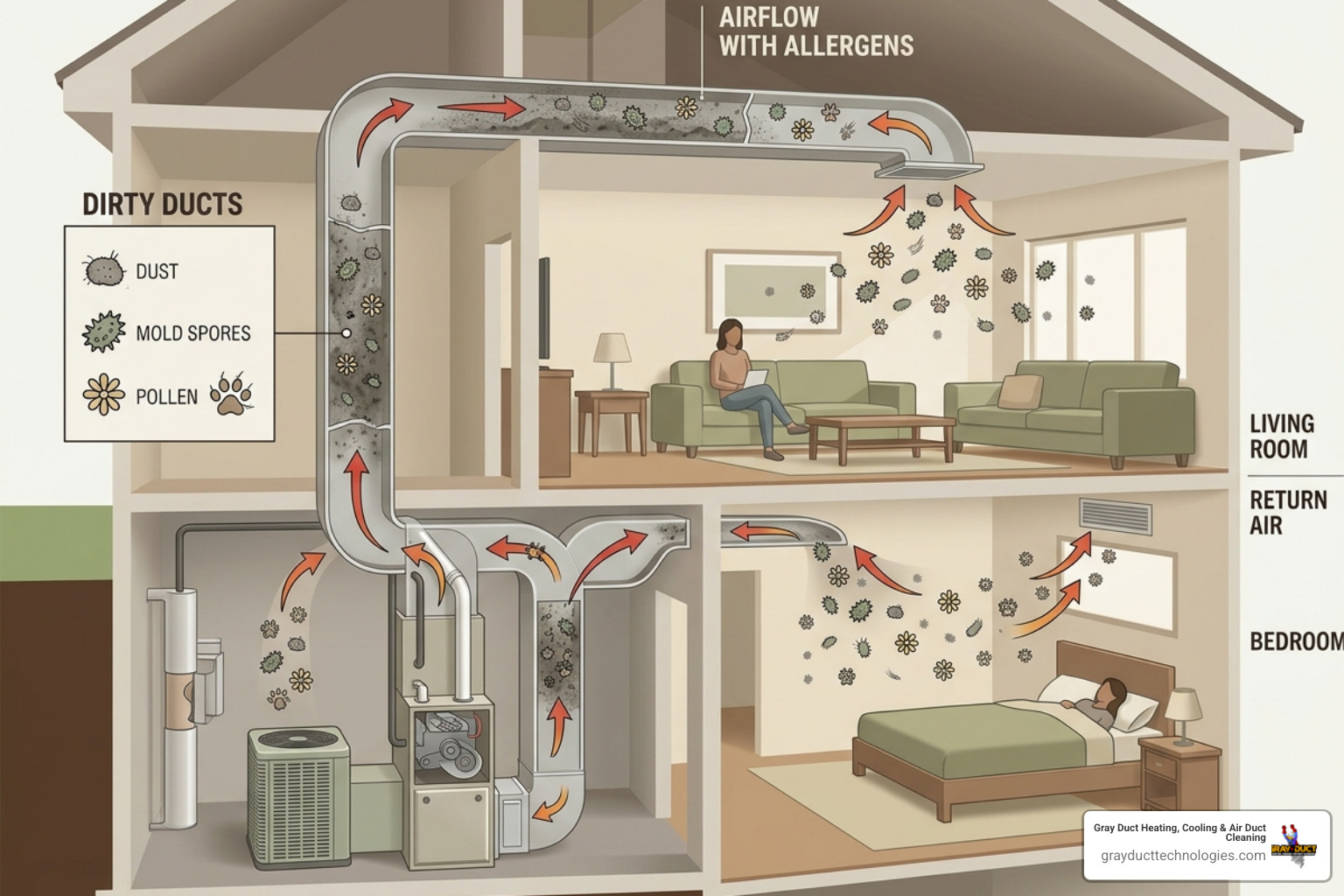
If you live in the Twin Cities, this matters more than you might think. Americans spend roughly 90% of their time indoors and breathe around 15,000 liters of air every single day. During Minnesota’s long winters — when windows stay shut for months — your HVAC system recirculates that same indoor air repeatedly, and anything living in your ducts comes along for the ride. Dust mite debris, pet dander, mold spores, and pollen all accumulate inside ductwork over time. When the system kicks on, those particles get pushed right back into the rooms where your family breathes, eats, and sleeps.
That’s the core reason so many allergy sufferers in the Minneapolis–Saint Paul metro start asking whether their ducts might be part of the problem — and it’s a fair question worth answering carefully.
I’m Jason Giandalia, founder of Gray Duct Heating, Cooling & Air Duct Cleaning and a NADCA-certified ASCS professional who has inspected and cleaned thousands of duct systems across the Twin Cities area, giving me a ground-level view of exactly when and how duct cleaning genuinely helps with allergies. In this guide, I’ll walk you through what the evidence actually says, what to look for in your own home, and how to build a strategy that gives you real, lasting relief.
Understanding the Evidence: Does Duct Cleaning Help with Allergies?
When homeowners in places like Bloomington or Plymouth ask us, “does duct cleaning help with allergies,” they are often looking for a definitive “yes” or “no.” The reality is a bit more nuanced, but there is compelling data to consider.
A significant 2018 study provided some of the most concrete evidence we have today. Researchers found that professional duct cleaning could reduce airborne particulate concentrations by 30% to 50% in treated homes. Specifically, the cleaning was effective at removing particles in the 1 to 10-micron range—which is the exact size of most mold spores, bacteria, dust mite fragments, and pet dander.
While the “lungs of the home” (as the NADCA often calls your ductwork) aren’t the source of allergies, they act as a massive reservoir. If that reservoir is full of triggers, every time your furnace or AC kicks on, it’s like a tiny dust storm is being released into your living room. For more on how this works, check out our guide on Air Duct Cleaning for Allergy Relief or learn how to Prep Your HVAC for Allergy Season.
Scientific Perspectives: Does Duct Cleaning Help with Allergies?
The EPA takes a cautious stance, noting that duct cleaning has not yet been conclusively proven to prevent health problems in a clinical setting. This is partly because it is difficult to isolate the ducts from other allergen sources like carpets, upholstery, and outdoor air.
However, from a common-sense perspective, many experts agree that if you are sensitive to dust, removing the accumulation is a logical move. This is known as “surrogate measures”—while we might not have a double-blind clinical trial for every home in Minneapolis, we can measure the reduction of physical pollutants. When you remove the physical material that triggers a reaction, the environment becomes objectively cleaner. We discuss this further in our article on Air Duct Cleaning for Indoor Air Quality.
Why Allergy Sufferers Ask: Does Duct Cleaning Help with Allergies?
The numbers explain why this is such a hot topic in April 2026. According to the CDC, allergies are the 6th leading cause of chronic illness in the U.S. Nearly 25 million Americans live with asthma, and approximately 50 million suffer from allergic rhinitis (hay fever).
In our local service areas, from Edina to Woodbury, indoor air pollutants are often 2 to 5 times higher than outdoor concentrations. For someone whose immune system is already on high alert, that extra load of recirculated dust can be the tipping point between feeling okay and experiencing a full-blown flare-up. Understanding How Indoor Air Quality Affects Health is the first step toward reclaiming your home’s comfort.
Common Triggers Found Inside Your Ventilation System
Your HVAC system is designed to move air, but it also acts as a collection point for microscopic debris. Over time, several specific allergens settle into the low-velocity sections of your ductwork.
- Dust Mite Debris: These microscopic pests thrive on human skin cells. Their waste and body fragments are potent triggers for asthma and sneezing.
- Pet Dander: Even if you don’t have a pet, dander from previous owners can linger in ducts for years. These tiny protein flakes are “re-entrainable,” meaning they easily catch the breeze and fly back into your breathing zone.
- Mold Spores: If there is any moisture in your system—often from a dirty A/C coil or a leaky humidifier—mold can amplify.
- Pollen Grains: During a Minnesota spring, pollen enters through open doors or your clothes and eventually gets sucked into the return vents.
- Cockroach Allergens: Often found in older urban homes or multi-family buildings, these can accumulate in the dark, quiet spaces of a ventilation system.
For a deeper dive into these triggers, read about Alleviating Allergies: Vent Cleaning and why these issues often get worse during the winter months.
When to Schedule Professional Service in the Twin Cities
Not every home needs its ducts cleaned every year. However, if you or a family member suffers from respiratory issues, there are clear signs that it’s time to call in the experts.
We recommend scheduling a professional inspection if you notice any of the following:
- Visible Mold: If you see a “fuzz” or black spots on your vent covers or inside the registers, it’s a major red flag. (Note: Lab verification of mold samples usually costs around $50 and is a smart move before starting remediation).
- Vermin Infestation: If rodents or insects have made a home in your ducts, they leave behind droppings and nesting materials that are highly allergenic.
- Excessive Debris: If you pull off a vent cover and see more than half an inch of settled dust, or if dust puffs out every time the fan starts, the system is overloaded.
- Musty Odors: A “dirty sock” smell when the AC or heat turns on often indicates biological growth somewhere in the system.
- Post-Construction Dust: If you’ve recently remodeled your home in St. Paul or Lakeville, fine drywall dust and sawdust have likely infiltrated the system.
For most allergy sufferers, a 2 to 3-year cleaning frequency is a solid rule of thumb. This prevents the “reservoir” from ever getting full enough to cause a major problem. Learn more about Air Duct Cleaning for Improved Indoor Air Quality.
The Professional Process for Effective Allergen Removal
There is a massive difference between a “blow and go” scammer and a professional NADCA-certified cleaning. Simply sticking a shop-vac hose down a vent won’t do much for your allergies; in fact, it might make them worse by stirring up dust without capturing it.
| Feature | DIY / Low-Cost “Value” Cleaning | Professional HEPA Extraction |
|---|---|---|
| Equipment | Standard vacuum or small portable unit | Truck-mounted high-powered vacuum |
| Pressure | Positive pressure (blows dust around) | Negative pressure (pulls dust out of home) |
| Agitation | None or very limited | Mechanical brushes and air whips |
| Filtration | Basic bags (may leak fine dust) | Medical-grade HEPA filtration |
| Scope | Just the vents you can see | Entire system: ducts, coils, and fans |
Our process involves sealing off all registers to create a vacuum (negative pressure) throughout the entire system. We then use mechanical agitation tools to dislodge the “stuck” dust, which is then sucked directly out of your home into our specialized containment system. This ensures that the allergens we remove don’t just end up on your sofa. You can see the full details of our Air Duct Cleaning service or explore our specific Indoor Air Quality Services in Minneapolis MN.
A Holistic Strategy for Respiratory Wellness
While we are experts in duct cleaning, we always tell our neighbors in Eagan and Chanhassen that cleaning is just one piece of the puzzle. Think of your HVAC system as the “lungs of the home.” Cleaning the lungs is great, but you also need a good “mask” (filters) and a healthy “environment” (humidity control).
To truly tackle allergies, we recommend a layered approach:
- Upgrade your filters: Use a MERV 13 filter if your system can handle it. These are designed to catch the tiny particles (0.3 to 1 micron) that duct cleaning dislodges.
- Control Humidity: Keep your home between 30% and 50% humidity. Too high, and you get mold and dust mites; too low, and your nasal passages dry out, making you more sensitive to triggers.
- Clean the Coils: Your A/C evaporator coil is often the wettest part of the system. If it’s dirty, it becomes a breeding ground for mold.
- HEPA Vacuums: Use a vacuum with a HEPA filter for your carpets and rugs to prevent floor-level allergens from being sucked back into the HVAC system.
Many allergists suggest that while duct cleaning isn’t a “cure,” it is a proactive step that “can’t hurt” and often provides the “common sense” relief patients need when medicine alone isn’t enough. Read more about the Health Benefits of Clean Air Ducts.
Frequently Asked Questions about Duct Cleaning and Allergies
What does the EPA recommend regarding air duct cleaning for allergy sufferers?
The EPA recommends duct cleaning on an “as-needed” basis rather than a routine schedule. They specifically suggest it if there is visible mold, a pest infestation, or if ducts are clogged with excessive amounts of dust and debris that are being released into the home.
How often should air ducts be cleaned in homes with pets?
In homes with pets, dander and fur accumulate much faster. For allergy sufferers with furry friends, we typically suggest a professional cleaning every 2 years. If you have multiple pets or high-shedding breeds, an annual inspection is a smart way to stay ahead of the buildup.
Can duct cleaning alone cure my seasonal allergies?
No, duct cleaning is not a cure for allergies. Seasonal allergies are often triggered by outdoor pollen. However, duct cleaning helps by removing the “indoor reservoir” of those same pollens and other irritants, which reduces the total “allergen load” your body has to deal with while you are inside.
Conclusion
At Gray Duct Heating, Cooling & Air Duct Cleaning, we’ve seen how much of a difference a clean system can make for families across the Twin Cities. Whether you’re in Minneapolis, Rochester, or any of our surrounding suburbs, your home should be a sanctuary where you can breathe easily.
As a family-owned business, we don’t believe in high-pressure sales or “scare tactics.” We believe in providing high-quality, certified service that solves real problems. Our in-house team is dedicated to improving your indoor air quality and ensuring your HVAC system runs efficiently all year long.
If you’re tired of sneezing every time the furnace kicks on, or if you’ve noticed an uptick in dust despite constant cleaning, it might be time to look inside your vents. Schedule your professional air duct cleaning today and take the first step toward a cleaner, more comfortable home.
<div class="elementor-element elementor-element-b5c55cb elementor-position-left elementor-widgetwidth-initial elementor-widget-tabletwidth-initial elementor-vertical-align-top elementor-widget elementor-widget-image-box" data-id="b5c55cb" data-elementtype="widget" data-e-type="widget" id="post-call-text" data-widgettype="image-box.default">Need HVAC Help?
Our NADCA-certified technicians are ready to help with all your heating, cooling, and air quality needs.
Get Free EstimateMore Articles
 HVAC Tips
What to Do When Your AC and Furnace Share the Same Air Filter
 HVAC Tips
Addressing Drafty Rooms Before Winter: Duct Sealing vs. Window Replacement
 HVAC Tips
Dryer Vent Routing: Rigid Metal vs. Flexible Foil in Cold Climates
 HVAC Tips
Why We Inspect the Heat Exchanger So Closely During Fall Maintenance
 HVAC Tips
Upgrading to a Two-Stage Furnace: Is the Investment Worth It in Minnesota?
Related Articles
Ready to Get Started?
Whether you need a repair, maintenance, or a new system installation, our expert team is here to help.