How to Maintain Your Heating and Cooling System Without Losing Your Cool
Gray Duct

Discover HVAC maintenance tips for Minnesota homeowners: seasonal checklists, DIY tasks & expert advice to combat extreme temps & boost efficiency.
Why Minnesota’s Climate Demands Specific HVAC Care
Minnesota is beautiful, but our weather is essentially a stress test for mechanical equipment. When we discuss hvac maintenance tips for minnesota homeowners, we have to start with the sheer range of temperatures our systems endure. We live in a state where it can be -30°F in January and 95°F with 80% humidity in July. That is a 125-degree variance that most HVAC systems in milder states like Florida or California simply never encounter.
Because our heating season spans roughly six to seven months, your furnace isn’t just a comfort feature; it’s a life-safety device. During a typical Twin Cities winter, a furnace might cycle thousands of times. This constant expansion and contraction of metal components leads to material fatigue. Furthermore, Minnesota often experiences “shoulder seasons” where we might need the heat in the morning and the air conditioning by 3:00 PM. This rapid switching puts immense pressure on relays, capacitors, and compressors.
Without Hvac Maintenance In Minneapolis Mn, these stressors lead to premature system failure. We’ve found that systems receiving regular professional attention typically operate 10-15% more efficiently than neglected equipment. In a state where heating and cooling account for more than half of the average household’s energy use, that efficiency translates directly into lower monthly bills.

The impact of sub-zero design temperatures on system wear
In the HVAC industry, “design temperature” refers to the lowest temperature a system is engineered to handle while still maintaining indoor comfort. For the Twin Cities area, that design temperature is a staggering -16°F. When the mercury drops below that point—which it frequently does—your system is running at 100% capacity just to keep up.
This “redlining” of your furnace leads to accelerated wear on the blower motor and the heat exchanger. If the heat exchanger develops even a hairline crack due to this stress, it can allow carbon monoxide to leak into your home’s airflow. This is why Blog/The Importance Of Regular Hvac Maintenance is so critical; a professional can spot these microscopic failures before they become life-threatening emergencies.
Essential HVAC Maintenance Tips for Minnesota Homeowners
Proactive care is the difference between a cozy winter evening and a frantic midnight call for emergency repairs. We always recommend starting with a baseline of safety. Every home in our service area, from Burnsville to Maple Grove, should have functioning carbon monoxide detectors on every level, especially near sleeping areas. Minnesota Statute §299F.50 actually requires these in all dwellings.
When we perform Hvac Diagnostic Maintenance In Minneapolis Mn, we look for the “silent killers” of efficiency. This includes testing the burner ignition sequence and calibrating the thermostat to ensure it’s communicating correctly with the unit. Regular Hvac Inspections allow us to catch small issues—like a failing capacitor or a frayed fan belt—before they cause a total system shutdown during a blizzard.
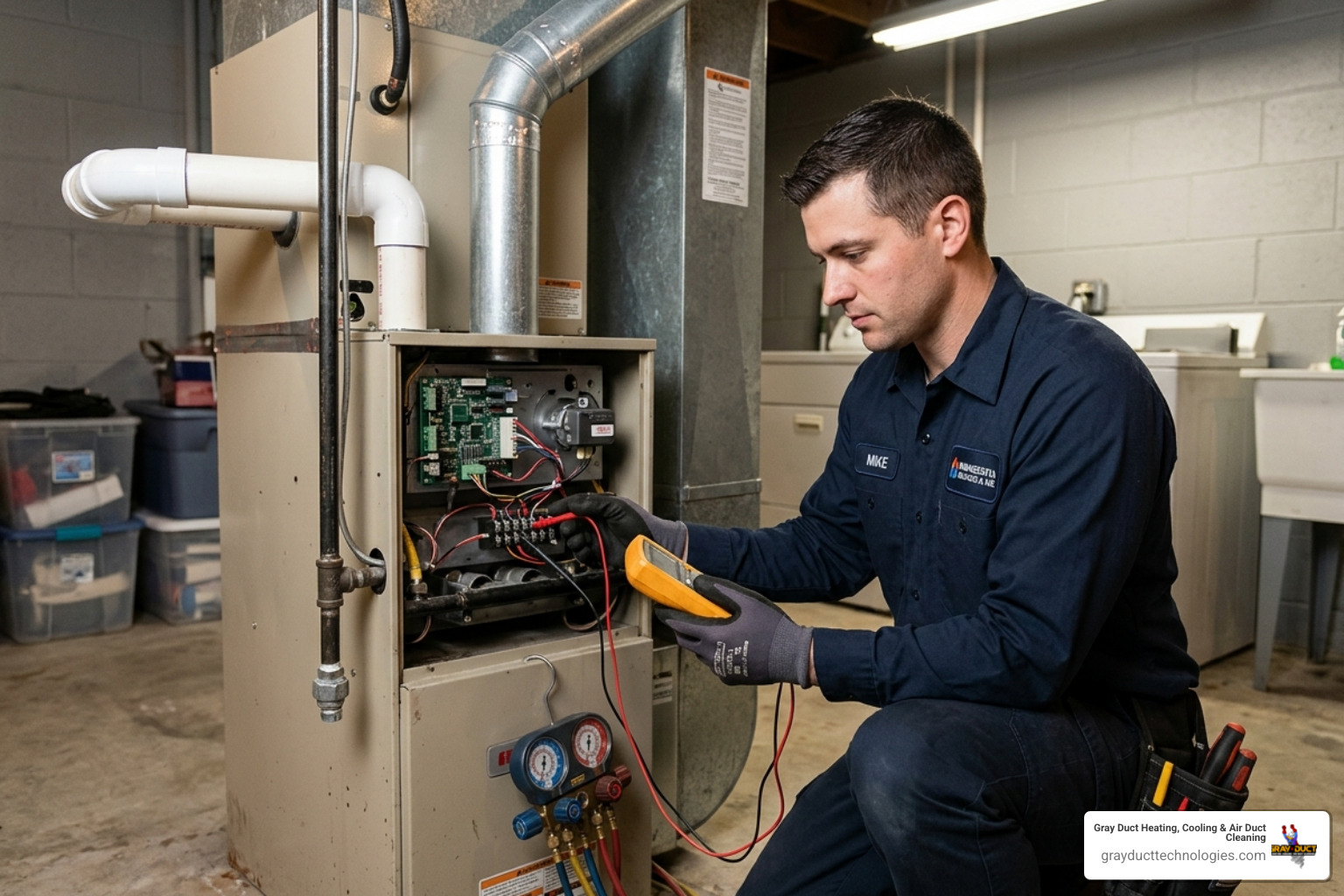
Essential hvac maintenance tips for minnesota homeowners to combat extreme cold
One of the most unique challenges we face in Minnesota is the “Frozen Exhaust Trap.” High-efficiency furnaces (90% AFUE and above) produce moisture as a byproduct of combustion. This moisture travels out through PVC exhaust vents. When temperatures drop well below zero, that moisture can flash-freeze at the vent opening, creating an ice blockage.
If the vent is blocked, the furnace’s pressure switch will trigger a safety shutdown. To prevent this, homeowners should:
- Visually inspect exterior vents: After every heavy snowfall or prolonged cold snap, ensure your intake and exhaust pipes are clear of snow drifts and ice rings.
- Clear ice carefully: Use warm water or a gentle tool to remove ice buildup. Never bang on the PVC pipes, as they become brittle in the cold and can crack.
- Follow a winter plan: Referencing a Blog/Winter Furnace Maintenance Checklist can help you stay ahead of these issues.
Consistent Furnace Maintenance In Minneapolis Mn ensures that the internal drainage system of your high-efficiency furnace is clear, so water doesn’t back up and freeze inside the cabinet.
Spring and summer hvac maintenance tips for minnesota homeowners
As the snow melts, a new set of challenges emerges. In the Twin Cities, “Cottonwood Season” usually peaks around late June and ends by July 4th. These fluffy white seeds act like a blanket for your outdoor air conditioner’s condenser coils. When coils are clogged with cottonwood and dust, the system can consume 10-30% more electricity because it can’t shed heat effectively.
For effective Hvac Services/Air Conditioning Maintenance In Minneapolis Mn, you should:
- Maintain clearance: Keep at least two feet of clear space around your outdoor unit. Trim back shrubs and remove tall grass or weeds.
- Clean the coils: After the cottonwood stops falling, gently rinse the outdoor coils with a garden hose (using low pressure, never a power washer) to wash away the “fuzz.”
- Check the checklist: Our Blog/The Ultimate Hvac Spring Tune Up Checklist For Homeowners provides a step-by-step guide to waking up your AC after its long winter nap.
Seasonal Checklist: Preparing for the Four-Phase Climate Cycle
Minnesota doesn’t just have seasons; it has a cycle of demands that require different responses from your HVAC system. By breaking your maintenance into four phases—Pre-heating, Active heating, Pre-cooling, and Active cooling—you ensure nothing falls through the cracks.
Fall transitions and winterizing your heating system
September and October are the most critical months for Heating Maintenances In Minneapolis Mn. Before you flip the switch to “Heat” for the first time, a professional should inspect the heat exchanger for cracks and ensure the flue venting is unobstructed. Birds or squirrels often build nests in chimneys over the summer, which can lead to dangerous exhaust backups.
During this transition, we also focus on Hvac Services/Furnace Maintenance In Minneapolis Mn by checking the burner ignition. A delayed ignition can cause a small “boom” when the gas finally lights, which stresses the entire cabinet. This is also the time to seal drafts. Stopping drafts around windows and baseboards can cut your heating bills by up to 10%, making it one of the best hvac maintenance tips for minnesota homeowners for those on a budget. Using Blog/Hvac Maintenance Prevent Breakdowns as a guide, you can ensure your home is a fortress against the coming cold.
Managing indoor air quality during the dry season
Minnesota winters are notoriously dry. When cold outdoor air is heated, its relative humidity drops significantly—often below 15%, which is drier than the Sahara Desert. This dry air pulls moisture from your skin, your nasal passages, and even your home’s woodwork and hardwood floors.
We recommend installing or maintaining a whole-home humidifier integrated into your HVAC system.
- Target Humidity: Aim for 30-40% relative humidity. Any higher can cause frost on windows; any lower leads to static shocks and respiratory irritation.
- Maintenance: Replace the humidifier water panel (evaporator pad) annually to prevent mineral buildup and mold.
- Benefits: Properly humidified air feels warmer, allowing you to set your thermostat a few degrees lower without losing comfort.
Critical DIY Tasks to Keep Your System Running Efficiently
While we handle the technical heavy lifting, there are several critical tasks you can do yourself. The most important of these is managing your air filters. Dirty air filters are the leading cause of HVAC failures in Minnesota. In the summer, a clogged filter causes the AC coils to freeze into a block of ice; in the winter, it causes the furnace to overheat and shut down.
Understanding Air Filters and MERV Ratings
Not all filters are created equal. The MERV (Minimum Efficiency Reporting Value) rating tells you how small of a particle the filter can catch.
| Filter Type | MERV Rating | Best For… | Replacement Frequency |
|---|---|---|---|
| Standard Fiberglass | 1–4 | Large lint and dust; basic protection | Every 30 days |
| Pleated Paper | 5–8 | Dust mites, pollen, and mold spores | Every 60–90 days |
| High-Efficiency | 11–13 | Pet dander, fine dust, and some bacteria | Every 3–6 months |
| HEPA | 17–20 | Hospitals; usually requires system modification | Varies |
For most Twin Cities homes, a MERV 8 to 11 filter provides a great balance of air filtration without putting too much strain on the blower motor. If you have pets or allergies, check the filter monthly. If it looks gray or “fuzzy,” it’s time for a change. You can find more details on what we look for during these checks in our post on Blog/Whats Included In Hvac Maintenance.
Troubleshooting common performance issues
Before you call for service, there are a few “quick fixes” that solve a surprising number of issues:
- Check the Thermostat Batteries: If your screen is blank or the system isn’t responding, fresh AA or AAA batteries are often the cure.
- Inspect the Breaker Panel: Sometimes a power surge can trip the HVAC circuit. Flip it all the way to “Off” and then back to “On.”
- Clear the Returns: Ensure that rugs, furniture, or curtains aren’t blocking the large “return air” grilles in your home. Your system needs to “breathe” in as much air as it blows out.
- Listen for Duct Leaks: Duct leaks can waste up to 30% of your energy. If you hear whistling or feel air blowing in the attic or crawlspace, those joints need to be sealed with foil tape or mastic.
Frequently Asked Questions about Minnesota HVAC Care
How often should I change my air filter during a Minnesota winter? During the peak of winter (December through February), your furnace runs almost constantly. We recommend checking your filter every 30 days. If you have pets that shed or a dusty home, you’ll likely need to replace it every month. At a minimum, never go longer than 90 days without a fresh filter.
What should I do if my furnace exhaust vent is blocked by ice? First, turn off the furnace at the thermostat. Go outside and carefully clear the snow and ice from the PVC pipes. You can pour warm (not boiling) water over the ice to melt it. Once the pipe is clear, head back inside and flip the power switch on the side of the furnace off and then back on to reset the pressure switch.
When should I consider replacing my system instead of repairing it? We suggest the “$5,000 Rule”: multiply the cost of the repair by the age of the system. If the result is more than $5,000, replacement is usually the smarter financial move. For example, a $600 repair on a 10-year-old system ($6,000) suggests replacement, whereas a $300 repair on an 8-year-old system ($2,400) is worth fixing. Most air conditioners last 10–12 years, and furnaces last 15–20 years in Minnesota.
Conclusion
Maintaining your home’s comfort shouldn’t be a source of stress. By following these hvac maintenance tips for minnesota homeowners, you can protect your investment and ensure your family stays safe and warm regardless of what the weather does outside. At Gray Duct Heating, Cooling & Air Duct Cleaning, we are a family-owned team of Twin Cities experts dedicated to high-quality, in-house service. We don’t use third-party contractors; we use our own certified team to handle everything from air duct cleaning to full system replacements.
Whether you’re in Minneapolis, Woodbury, or Lakeville, we understand the unique demands of the South Metro climate. Don’t wait for the next record-breaking cold snap or heat wave to find out if your system is up to the task. Schedule your hvac maintenance in minneapolis mn today and let us help you keep your cool—and your heat—all year long.
Need HVAC Help?
Our NADCA-certified technicians are ready to help with all your heating, cooling, and air quality needs.
Get Free EstimateMore Articles
 HVAC Tips
What to Do When Your AC and Furnace Share the Same Air Filter
 HVAC Tips
Addressing Drafty Rooms Before Winter: Duct Sealing vs. Window Replacement
 HVAC Tips
Dryer Vent Routing: Rigid Metal vs. Flexible Foil in Cold Climates
 HVAC Tips
Why We Inspect the Heat Exchanger So Closely During Fall Maintenance
 HVAC Tips
Upgrading to a Two-Stage Furnace: Is the Investment Worth It in Minnesota?
Related Articles
Ready to Get Started?
Whether you need a repair, maintenance, or a new system installation, our expert team is here to help.