Duct Cleaning vs Duct Sealing Comparison for a Healthier Home
Gray Duct

“I’m Looking for a Duct Cleaning vs Duct Sealing Comparison — Which Service Does My Minneapolis Home Actually Need?” A duct cleaning vs duct sealing…
“I’m Looking for a Duct Cleaning vs Duct Sealing Comparison — Which Service Does My Minneapolis Home Actually Need?”
A duct cleaning vs duct sealing comparison comes down to one core question: is your duct system dirty, leaky, or both?
Here’s a quick breakdown:
| Duct Cleaning | Duct Sealing | |
|---|---|---|
| What it fixes | Internal contamination (dust, mold, debris, allergens) | Structural leaks and gaps that waste conditioned air |
| Main benefit | Improved indoor air quality and airflow | Lower energy bills and consistent room temperatures |
| When you need it | Dusty vents, allergy symptoms, musty odors, post-renovation | High energy bills, hot/cold spots, uneven heating or cooling |
| How long it lasts | Every 3–5 years (more often with pets or allergies) | 10–40 years depending on method |
| Key methods | HEPA vacuums, negative pressure, agitation tools | Mastic sealant, metal tape, Aeroseal technology |
| DIY-friendly? | No — risk of damage and missed contamination | No — most leaks are hidden and inaccessible |
The short answer: cleaning removes what’s already inside your ducts. Sealing stops air from escaping through gaps and cracks. Many Twin Cities homes — especially those 15 or more years old — need both.
If you’ve noticed your home feeling dustier than it should, your energy bills creeping up without explanation, or certain rooms that never seem to reach the right temperature, your ductwork is likely telling you something. The tricky part? A dirty duct system and a leaky duct system can cause nearly identical symptoms — higher bills, excess dust, and uneven airflow — which makes it genuinely difficult to know which service you need without a professional eye on the problem.
According to the U.S. Department of Energy, typical homes lose 20–30% of conditioned air through duct leaks before it ever reaches your living spaces. At the same time, ducts clogged with dust, pet dander, mold spores, or post-renovation debris restrict airflow and circulate contaminants through every room in your home. In Minnesota’s climate — where your HVAC system runs hard through both frigid winters and humid summers — the stakes for getting this right are higher than in more moderate regions.
I’m Jason Giandalia, founder of Gray Duct Heating, Cooling & Air Duct Cleaning and a NADCA-certified Air Systems Cleaning Specialist (ASCS) with hands-on experience helping Twin Cities homeowners navigate exactly this kind of duct cleaning vs duct sealing comparison. In the sections below, I’ll walk you through how to identify which problem you’re dealing with, why the order of services matters, and how to get the most out of whichever solution your home needs.
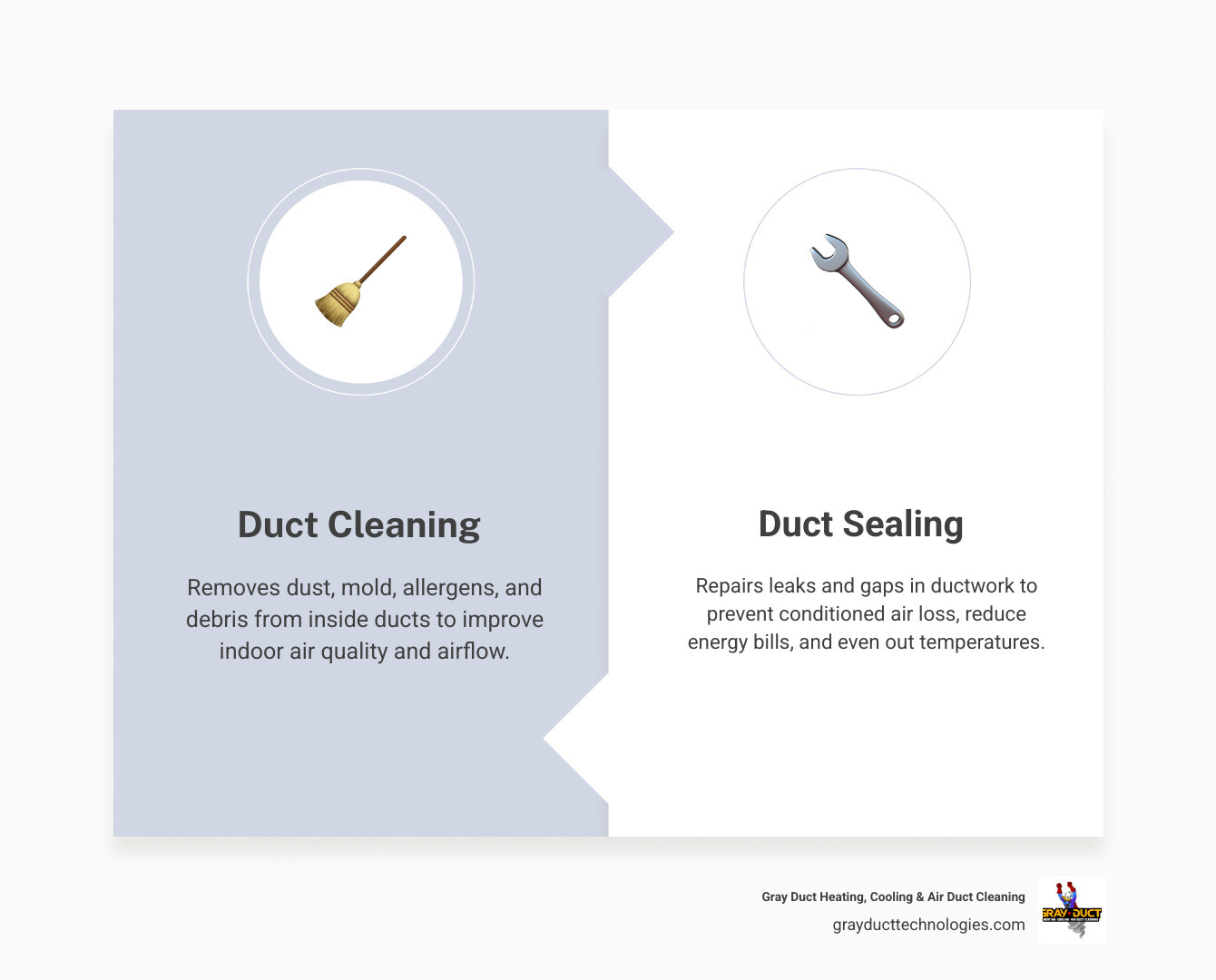
“I’m looking for a duct cleaning vs duct sealing comparison. Which service is right for my Minneapolis home?”
When we look at the duct cleaning vs duct sealing comparison, we are essentially looking at the health versus the efficiency of your home’s “circulatory system.” In a place like Minneapolis or Saint Paul, your HVAC system is the lungs of your home. If those lungs are full of dust, you breathe that dust. If those lungs have holes in them, your furnace has to work twice as hard to keep you warm during a January blizzard.
The main difference lies in the objective. Air Duct Cleaning is a maintenance task focused on hygiene. We use high-powered, truck-mounted vacuums and specialized agitation tools to scrub the interior walls of your vents. This removes the “source” of indoor pollutants.
On the other hand, Duct Sealing in Minneapolis, MN is a structural repair. Over time, the joints in your metal ductwork can loosen, or the tape used during original construction can fail. Sealing involves closing those gaps so that 100% of the air you pay to heat or cool actually makes it to your bedroom, kitchen, and living room.
Which one is right for you?
- Choose Cleaning if: You see dust bunnies on your vent covers, smell a musty “dirty sock” odor when the AC kicks on, or have recently finished a basement remodel in Woodbury or Eagan.
- Choose Sealing if: You have one room that is always five degrees colder than the rest of the house, or if your utility bills are skyrocketing despite your furnace being relatively new.
- Choose Both if: Your home is over 15 years old and hasn’t had professional duct maintenance in a decade. In our experience, older homes in the Twin Cities often suffer from “dirty-leaky duct syndrome,” where leaks in the return ducts actually suck in dust from attics and crawlspaces, making the cleaning necessary and the sealing essential to prevent the dust from coming right back.
“Why is my house so dusty?” Identifying when you need professional air duct cleaning
It’s a common frustration for homeowners in Bloomington and Lakeville: you spend all Saturday dusting, only to see a fine gray film return to your coffee table by Tuesday. This is often a sign that your ductwork has become a reservoir for debris.
There are several red flags that indicate it’s time to stop comparing and start cleaning:
- Visible Debris: If you pull off a floor register and see “dust bunnies,” pet hair, or construction debris (like drywall dust or wood shavings), your system is compromised.
- Mold Growth: In our humid Minnesota summers, moisture can sometimes condense inside ducts. If you see dark spotting around your vents, professional remediation and cleaning are required.
- Pest Infestations: Rodents and insects love the warmth of ductwork. If they’ve left behind droppings or nesting materials, that biological waste is being blown into your breathing air.
- Allergy Flare-ups: If your family’s asthma or seasonal allergies seem worse indoors than outdoors, your ducts are likely circulating pollen and dander.
Understanding Why It’s Important to Have Your Air Ducts Cleaned goes beyond just aesthetics. It’s about removing the triggers that affect your health. We often get asked, How Often Should Air Ducts Be Cleaned? For most homes in the South Metro, every 3 to 5 years is the “sweet spot.” However, if you have three golden retrievers or just finished a massive renovation in Minnetonka, you might need it every 2 to 3 years.
How does a duct cleaning vs duct sealing comparison impact my home’s air quality?
When we perform a duct cleaning vs duct sealing comparison through the lens of air quality, cleaning is the undisputed champion for removing existing pollutants. Professional cleaning utilizes the “positive-negative” pressure method. We seal your entire system and attach a high-powered HEPA vacuum to the main trunk line. While that vacuum creates a massive “pull,” we use compressed air tools to agitate every inch of the duct walls. This ensures that dust, pollen, and pet dander are sucked out of your home and into our collection system, not just moved around.
However, sealing plays a surprising role in air quality too. Did you know that leaky return ducts (the vents that suck air in) often pull air from “unconditioned” spaces? If you have a leak in a return duct located in a dusty attic or a damp crawlspace in Eden Prairie, your HVAC system is literally vacuuming up insulation fibers and mold spores from those areas and distributing them into your living room.
By utilizing comprehensive HVAC Services in Minneapolis, MN, you ensure that your air stays clean because you’ve removed the dirt (cleaning) and blocked new dirt from being sucked in (sealing).
“Why are my energy bills so high?” The benefits of duct sealing in the Twin Cities
In April 2026, energy efficiency isn’t just a buzzword; it’s a financial necessity. If you feel like you’re “heating the neighborhood,” you probably are. Statistics show that the average U.S. home loses 20–30% of its conditioned air through leaks. Imagine going to the gas station, paying for 20 gallons of gas, and watching 6 gallons spill onto the pavement. That is exactly what leaky ducts do to your monthly budget.
Duct sealing provides an immediate boost to Energy Efficiency in Minneapolis, MN. When your ducts are airtight, your furnace or air conditioner doesn’t have to run as long to reach the temperature set on your thermostat. This reduces wear and tear on your equipment, potentially extending its lifespan by several years.
Common signs of leakage include:
- Skyrocketing Utility Bills: An unexplained jump in your gas or electric bill often points to air escaping before it hits the registers.
- Excessive Dust: As mentioned, leaks in return ducts suck in “outside” dust.
- HVAC System Constantly Running: If your system never seems to take a break, it’s struggling to keep up with the loss of air.
To truly fix the issue, you must Detect and Fix Ductwork Leaks using professional methods. While some homeowners try to use “duct tape” (which, ironically, is terrible for ducts), professionals use much more durable solutions.
I’m noticing uneven temperatures. Does this duct cleaning vs duct sealing comparison help identify leaks?
Uneven temperatures are the “smoking gun” of duct leaks. If your kitchen in Plymouth is a sauna but your home office is an icebox, your ductwork is likely failing to deliver the air where it’s needed.
In a duct cleaning vs duct sealing comparison, sealing is the solution for “hot and cold spots.” We use several advanced techniques to solve this:
- Mastic Sealant: A thick, gooey substance that we paint onto accessible joints. It hardens into a flexible, permanent seal that moves with the expansion and contraction of the metal.
- Aeroseal: This is the gold standard for modern homes. We pressurize your duct system and inject a specialized mist of sticky polymer particles. These particles are drawn to the leaks by the escaping air, where they cling to the edges of the holes and build up until the leak is completely blocked.
- Durability: Modern sealing solutions like Aeroseal can last up to 40 years. It is essentially a one-time investment that pays for itself through utility bill reductions of 15–20% or more.
By sealing these gaps, we ensure consistent comfort across every floor of your home, whether you’re in a historic Saint Paul brownstone or a new build in Lakeville.
“Should I clean or seal my ducts first?” Why the order of operations matters
If you have decided that your home needs both services, the order in which they are performed is critical. At Gray Duct Heating, Cooling & Air Duct Cleaning, we always recommend cleaning before sealing.
Why does the sequence matter?
- Sealant Adhesion: For mastic or Aeroseal to bond properly to the ductwork, the surface needs to be clean. If you apply sealant over a thick layer of dust, the bond will be weak and may fail prematurely.
- Contaminant Encapsulation: If you seal the ducts first, you might “lock in” existing debris, pet dander, or mold. Once the system is sealed, it becomes much harder to remove heavy buildup that is now stuck behind new seals.
- Efficiency: Cleaning the ducts first ensures that when we perform a leakage test, we are testing the actual structural integrity of the ducts, not measuring airflow restricted by a clog of old filters or debris.
A professional inspection is the only way to determine the current state of your system. We use high-definition cameras to look deep into your vents, identifying both the level of contamination and the location of major structural gaps. By combining these services into a single maintenance plan, you maximize the “health” of your air and the “wealth” of your bank account.
Conclusion
At Gray Duct Heating, Cooling & Air Duct Cleaning, we believe that a healthy home starts with the air you breathe. Whether you’re in Minneapolis, Rochester, or anywhere in the South Metro, our family-owned business is dedicated to providing honest, high-quality solutions. We don’t use third-party contractors; our certified, in-house team handles every step of your HVAC maintenance, from the initial inspection to the final HEPA-filtered vacuuming.
The duct cleaning vs duct sealing comparison isn’t about choosing one over the other—it’s about understanding which “tool” is right for your specific home “ailment.” Cleaning restores air quality, while sealing restores efficiency. Together, they create a home environment that is comfortable, affordable, and safe for your family.
If you’re ready to breathe easier and lower those monthly bills, Air Duct Cleaning is the perfect place to start.
How often should I schedule these services for my home?
Maintenance schedules vary based on your lifestyle, but here are our general guidelines for Twin Cities residents:
- Duct Cleaning: Schedule this every 3 to 5 years. If you have multiple pets, family members with severe allergies, or if you’ve recently completed a home renovation, we recommend moving that up to every 2 to 3 years.
- Duct Sealing: This is typically a “one-and-done” service. High-quality sealing like Aeroseal can last up to 40 years. You should only need to re-evaluate sealing if you add an addition to your home or experience a major event like a flood or fire that requires ductwork repair.
Can I perform duct sealing or cleaning as a DIY project?
We always encourage a “can-do” spirit, but ductwork is one area where DIY can lead to expensive disasters.
- Risks of DIY Cleaning: Consumer-grade shop vacs lack the “negative pressure” required to actually remove dust. Often, DIYers just stir up the dust, making the air quality worse for several days. Furthermore, improper use of brushes can puncture flexible ductwork or dislodge joints.
- Risks of DIY Sealing: Most duct leaks are located in “hidden” areas—behind drywall, under insulation, or inside floor joists. You can only reach about 20% of your system manually. Professional equipment is required to seal the 80% you can’t see.
- Safety: In older homes, there is always a risk of disturbing asbestos insulation or lead paint. Our certified technicians are trained to identify and navigate these hazards safely.
Will sealing my ducts really lower my monthly utility bills?
Yes, and the numbers are backed by the U.S. Department of Energy and Energy Star. Homeowners who invest in professional duct sealing typically see a 15–20% reduction in their heating and cooling costs.
In the Twin Cities, where the temperature can swing from -20°F in January to 95°F in July, your HVAC system is under constant pressure. Sealing the leaks reduces the “runtime” of your furnace and AC. Not only do you save money on your monthly bill, but you also delay the need for a multi-thousand dollar system replacement by reducing the mechanical strain on your equipment. It is one of the few home improvements that truly pays for itself in a relatively short period.
<div class="elementor-element elementor-element-b5c55cb elementor-position-left elementor-widgetwidth-initial elementor-widget-tabletwidth-initial elementor-vertical-align-top elementor-widget elementor-widget-image-box" data-id="b5c55cb" data-elementtype="widget" data-e-type="widget" id="post-call-text" data-widgettype="image-box.default">Need HVAC Help?
Our NADCA-certified technicians are ready to help with all your heating, cooling, and air quality needs.
Get Free EstimateMore Articles
 HVAC Tips
What to Do When Your AC and Furnace Share the Same Air Filter
 HVAC Tips
Addressing Drafty Rooms Before Winter: Duct Sealing vs. Window Replacement
 HVAC Tips
Dryer Vent Routing: Rigid Metal vs. Flexible Foil in Cold Climates
 HVAC Tips
Why We Inspect the Heat Exchanger So Closely During Fall Maintenance
 HVAC Tips
Upgrading to a Two-Stage Furnace: Is the Investment Worth It in Minnesota?
Related Articles
Ready to Get Started?
Whether you need a repair, maintenance, or a new system installation, our expert team is here to help.