Detailed Guide to NADCA Certification and Why It Matters
Gray Duct

Learn why NADCA certification and why it matters for protecting your home from scams and ensuring professional air duct cleaning standards.
Why NADCA Certification and Why It Matters for Twin Cities Homeowners
Understanding NADCA certification and why it matters starts with one simple fact: the air duct cleaning industry is largely unregulated in most states, including Minnesota. That means almost anyone can show up with a vacuum, call themselves a professional, and leave your home’s HVAC system in worse shape than before.
Here’s a quick breakdown of why NADCA certification matters for homeowners:
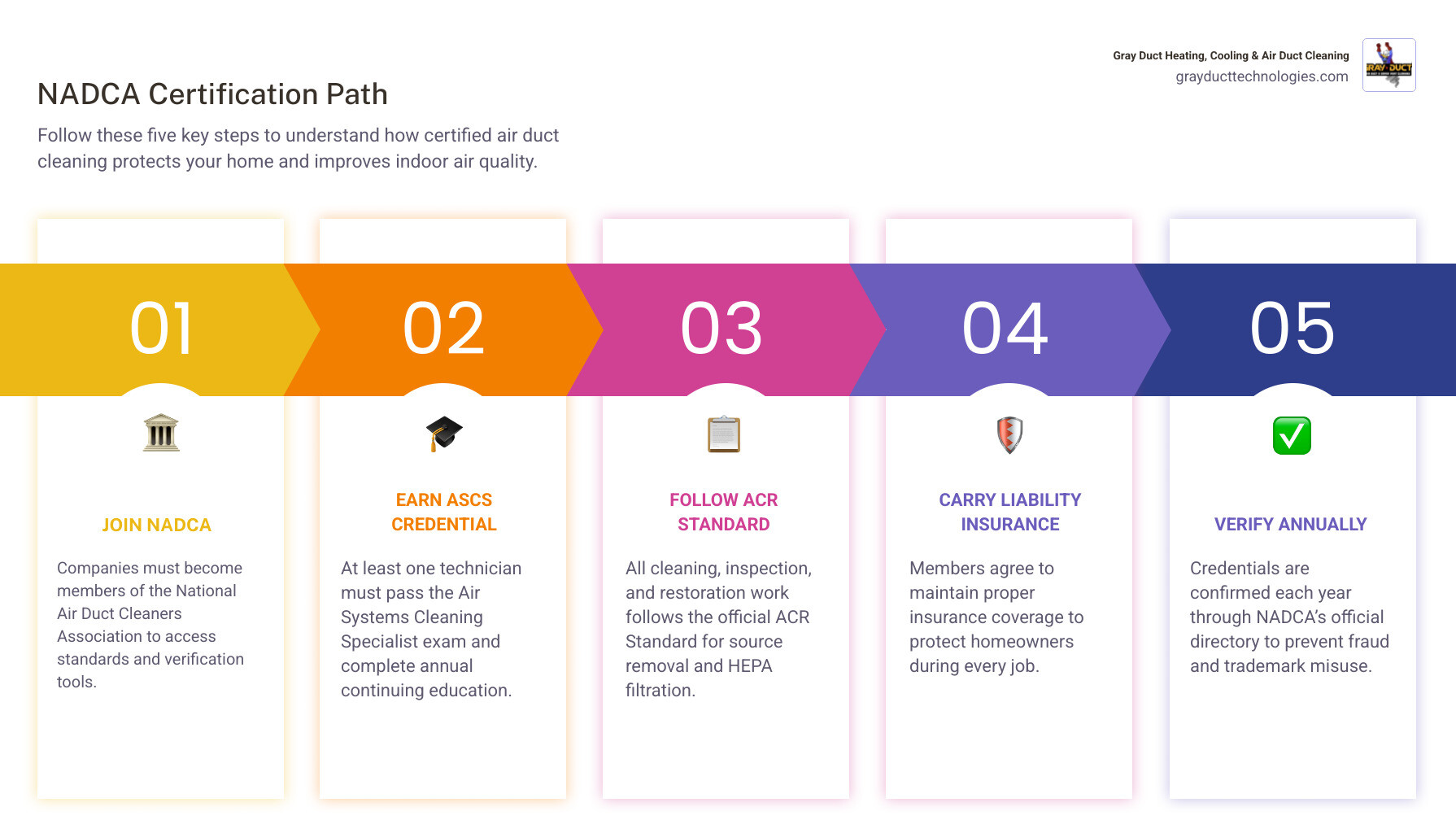
- Trained specialists on staff – Every NADCA member company must employ at least one Air Systems Cleaning Specialist (ASCS), a credential that requires passing a rigorous exam and completing continuing education every year.
- Adherence to a real standard – NADCA members follow the ACR Standard, which defines the proper methods for inspecting, cleaning, and restoring HVAC systems.
- Protection from scams – NADCA actively investigates and shuts down companies that falsely claim membership or use fraudulent tactics.
- Accountability and ethics – Members must carry liability insurance and agree to NADCA’s Code of Ethics.
- Government-backed credibility – The U.S. Department of Labor’s Division of Occupational Health and Safety recommends using NADCA-certified HVAC professionals.
- Verifiable credentials – You can confirm any company’s membership status directly through NADCA’s official Find a Professional directory at nadca.com.
The bottom line: NADCA certification is the closest thing the air duct cleaning industry has to a quality benchmark, and knowing what it means puts you in control when hiring someone to work inside your home.
If you’ve ever wondered whether the company cleaning your ducts actually knows what they’re doing — or if they’re just going through the motions — this guide is for you. We’ll walk through what NADCA certification actually requires, what standards certified companies must follow, how to spot scams, and how to verify credentials before you let anyone near your ductwork.
I’m Jason Giandalia, founder of Gray Duct Heating, Cooling & Air Duct Cleaning, and as an ASCS-certified technician serving the Twin Cities metro, I’ve built my business around the very standards that make nadca certification and why it matters so relevant for health-conscious homeowners. That hands-on experience shapes everything you’ll read in this guide.
Easy nadca certification and why it matters glossary:
- duct cleaning scams to avoid in minnesota
- how to choose a reputable duct cleaning company
- how to verify duct cleaning credentials
Understanding NADCA Certification and Why It Matters for Your Home
The National Air Duct Cleaners Association (NADCA) was formed in 1989 as a non-profit association to advocate for high standards of HVAC system cleaning. Over the decades, it has evolved into the global authority on HVAC inspection, maintenance, and restoration.
When we talk about indoor air quality, the stakes are incredibly high. The air circulating through your home’s vents is the same air your children, pets, and family members breathe all day long. If your ductwork is coated in dust, pet dander, drywall debris from a recent remodel in Bloomington, or microbial growth, a low-quality cleaning won’t fix the issue—it will likely just stir those particles up and dump them directly into your living spaces.
By establishing strict benchmarks for cleaning and restoration, NADCA provides a layer of essential consumer protection. When you choose a certified company, you aren’t just getting someone with a vacuum; you’re hiring an expert trained to clean the entire HVAC system safely. This level of care directly influences your home’s environment, which is why understanding Why Professional Air Duct Cleaning Matters is so important.
Hiring a certified professional helps answer a question many local homeowners ask when looking to improve their indoor climate: Is Air Duct Cleaning Worth It? When done according to certified standards, the answer is a resounding yes.
Why NADCA Certification and Why It Matters in an Unregulated Industry
It surprises many homeowners in communities like Plymouth and Woodbury to learn that the duct cleaning industry is completely unregulated in most states, including Minnesota. There is no state-level licensing exam, no mandatory safety training, and no official oversight body checking the work of local vent cleaners.
In an unregulated market, anyone can buy a cheap shop vacuum, wrap a magnetic sign on the side of a pickup truck, and advertise themselves as a “professional duct cleaner.” This lack of oversight leaves the door wide open for poor workmanship, damaged HVAC equipment, and outright fraud.
This is exactly where nadca certification and why it matters becomes your shield as a consumer. Because there are no government regulations, NADCA has stepped in to create self-imposed industry regulations.
To maintain membership, companies must:
- Agree to a strict, legally binding Code of Ethics that puts consumer safety and honesty first.
- Maintain comprehensive general liability insurance to protect your property in the rare event of an accident.
- Employ at least one certified Air Systems Cleaning Specialist (ASCS) to supervise and guide all cleaning operations.
When you hire a NADCA-certified company, you are opting out of the unregulated Wild West of duct cleaning and opting into a system of strict standards, accountability, and professional ethics.
How to Verify NADCA Certification and Why It Matters for Fraud Prevention
Unfortunately, because NADCA’s reputation is so strong, dishonest companies often try to ride its coattails. It is common for uncertified, fly-by-night operations to plaster fake NADCA logos on their websites, flyers, and social media ads to trick homeowners.
To combat this, NADCA operates an active Anti-Fraud Task Force. This division is dedicated to hunting down and taking legal action against companies that falsely claim membership or misuse NADCA trademarks. In fact, NADCA’s Anti-Fraud Task Force successfully closed out 98% of the 288 trademark infringement cases it handled between 2014 and 2018.
This aggressive policing protects the integrity of the credential, but homeowners still need to know how to verify these claims themselves. Protecting your home from dishonest operators requires a proactive approach. You can read more about keeping your household secure in our guide on The Homeowner’s Shield: Using Certification to Avoid Shady Service Scams.
The Technical Standards of a Certified Air Duct Cleaning
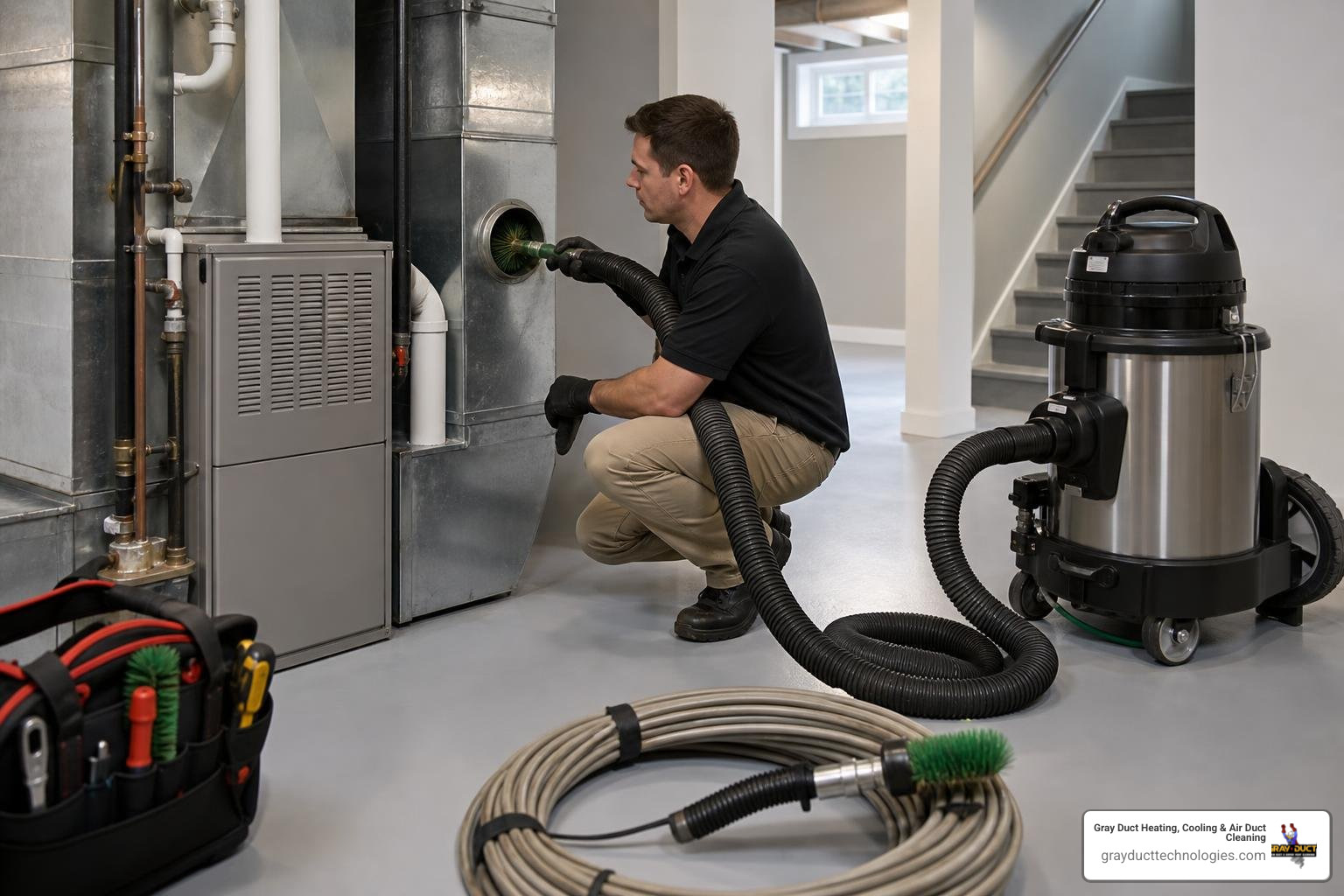
A certified duct cleaning is highly technical and relies on physics, specialized engineering, and strict procedural rules. It is not just about brushing out the registers you can see.
At the core of NADCA’s technical requirements is the ACR Standard (Assessment, Cleaning, and Restoration). This standard dictates that true duct cleaning must achieve complete source removal of all contaminants. To do this safely without contaminating your home’s living areas, certified technicians must establish continuous negative pressure using powerful vacuum equipment.
The process works like this:
- System Isolation: The supply and return duct systems are isolated so that dust cannot bypass the filtration.
- Negative Pressure Hookup: A high-powered collection device is connected to the main trunk lines. This creates a powerful vacuum pull throughout the entire system.
- Agitation and Extraction: Technicians use specialized whipping tools, air snakes, and brushes to dislodge dust and debris from the metal walls of your ducts. Because the system is under negative pressure, every speck of dust is pulled directly into the vacuum collection unit rather than escaping into your rooms.
- HEPA Filtration: The vacuum systems used by certified professionals utilize High-Efficiency Particulate Air (HEPA) filtration, ensuring that the exhausted air is completely clean.
Choosing a certified provider changes the entire scope of the job. For a deeper look at how these technical differences play out in real-world homes, check out our article on Choosing Between NADCA and Non-Certified Cleaners for Your Home.
To help visualize the difference, here is a side-by-side comparison of certified versus non-certified cleaning methods:
| Feature | NADCA-Certified Standards | Non-Certified “Blow-and-Go” Services |
|---|---|---|
| Primary Method | Source removal under continuous negative pressure | Handheld shop vacs or basic blowers without containment |
| Equipment Used | High-volume negative air machines with HEPA filtration | Standard utility vacuums or unrated portable blowers |
| Scope of Work | Full system cleaning (ducts, coils, blower motor, plenum) | Only cleaning registers and easy-to-reach vents |
| Time Spent | 3 to 5 hours for a standard 2,000 sq. ft. home | 60 to 90 minutes |
| Containment | Dust and debris are fully captured and sealed | Dust often blows back into the home’s living spaces |
| Oversight | Supervised by an on-staff certified ASCS | No certified supervision or standard verification |
Protecting Your Home from Common Industry Scams
Because the industry lacks official licensing, it is a prime target for scammers. The most common scheme is the “bait-and-switch” or “coupon scam.”
You might see an ad on social media or receive a flyer offering a full-house duct cleaning for an unbelievably low price. Once the technicians arrive at your home in Eagan or Roseville, they will perform a quick, superficial cleaning that takes about an hour. Then, they will suddenly claim to have found “toxic black mold” or severe contamination deep in your system, demanding hundreds or thousands of dollars more to “sanitize” it.
In reality, these uncertified services are often “blow-and-go” operations. They use weak equipment that merely stirs up dust, redistributing allergens throughout your home and potentially damaging your sensitive HVAC components, like the blower wheel or A/C coils.
A proper, certified cleaning of a standard 2,000-square-foot home cannot be done in an hour. It requires specialized setup, system isolation, and meticulous cleaning of every component, which typically takes 3 to 5 hours.
Learning to spot these warning signs early is the best way to safeguard your property. You can read our detailed resources on how to Protect Your Home from Dishonest Duct Cleaners and explore the mechanics of these schemes in Common Duct Cleaning Scams and How to Spot Them Early.
How to Verify a Contractor’s Credentials
You don’t have to take a contractor’s word for it when they claim to be certified. In fact, verifying their paperwork is simple if you know what to look for. Think of it as doing a quick background check to ensure your home and family stay safe.
To verify a contractor’s credentials like a pro, follow these straightforward steps:
- Search the Official Directory: Go to nadca.com and use their “Find a Professional” tool. You can search by your zip code or the company’s name to see if they are an active member in good standing.
- Ask for the ASCS Certificate: Every certified company must have an on-staff Air Systems Cleaning Specialist. Ask the company for the name of their certified specialist and request to see their current certificate.
- Check for the Live Verification Logo: Legitimate NADCA members often display a live verification logo on their website. This digital badge links directly to their active profile on the official NADCA directory.
- Request Proof of Insurance: Before any work begins, ask the contractor to provide physical proof of general liability and worker’s compensation insurance.
Taking five minutes to run these checks protects you from scammers and ensures you are working with a legitimate professional. For a step-by-step breakdown of how to perform this vetting process, check out our guide on How to Verify Duct Cleaning Credentials Like a Private Investigator.
Frequently Asked Questions About Certified Duct Cleaning
How often should I schedule a certified air duct cleaning in the Twin Cities?
We generally recommend scheduling a professional air duct cleaning every 3 to 5 years. However, certain factors in your Minnesota home might mean you should schedule cleanings more frequently.
For example, if you have shedding pets, family members who suffer from severe allergies or asthma, or if you have recently completed a major home renovation in areas like Minnetonka or Woodbury, dust and debris can build up much faster. Similarly, if you are moving into a newly built home or a previously owned property, a thorough cleaning is an excellent way to clear out construction dust or the biological footprint of the previous occupants.
Does NADCA certification guarantee every technician on-site is certified?
No, NADCA certification does not mean every single technician who enters your home holds an individual ASCS credential. NADCA’s membership rules require that at least one employee at each member company holds the ASCS certification and directly oversees the company’s training, quality control, and field operations.
This structure ensures that the company’s processes, equipment, and cleaning protocols strictly adhere to the ACR Standard. At Gray Duct Heating, Cooling & Air Duct Cleaning, we take this a step further by ensuring our in-house, family-owned team is thoroughly trained and directly supervised under these strict guidelines, never relying on uncertified third-party subcontractors.
What is the Air Systems Cleaning Specialist (ASCS) credential?
The Air Systems Cleaning Specialist (ASCS) credential is a world-wide recognized professional benchmark that recognizes an individual’s deep knowledge and practical skills regarding HVAC system hygiene. To earn this credential, a professional must pass a comprehensive, proctored exam that covers HVAC system components, safety standards, contamination limits, and proper source removal techniques.
Furthermore, the credential is not a “one-and-done” certificate. To maintain active ASCS status, the certified individual must earn at least six Continuing Education Credits (CECs) each year before the annual June 30 renewal deadline. This ensures that certified professionals stay up-to-date with the latest industry advancements, tools, and safety protocols.
Conclusion
When it comes to the air you breathe inside your home, shortcuts simply aren’t worth the risk. Understanding nadca certification and why it matters empowers you to make informed decisions, protect your household from predatory scams, and ensure your heating and cooling system operates at peak efficiency.
At Gray Duct Heating, Cooling & Air Duct Cleaning, we are proud to serve families across the Twin Cities metro—from Minneapolis and Saint Paul to Bloomington, Plymouth, Lakeville, and Woodbury. As a local, family-owned business, we don’t believe in cutting corners, and we never farm our work out to third-party contractors. Our certified, in-house team handles every job with the care, honesty, and technical expertise your home deserves.
Ready to experience the difference of a true, certified clean? Schedule Professional Air Duct Cleaning Services with our family-owned team today, and breathe easier knowing your indoor air quality is in expert hands.
Need HVAC Help?
Our NADCA-certified technicians are ready to help with all your heating, cooling, and air quality needs.
Get Free EstimateMore Articles
 HVAC Tips
What to Do When Your AC and Furnace Share the Same Air Filter
 HVAC Tips
Addressing Drafty Rooms Before Winter: Duct Sealing vs. Window Replacement
 HVAC Tips
Dryer Vent Routing: Rigid Metal vs. Flexible Foil in Cold Climates
 HVAC Tips
Why We Inspect the Heat Exchanger So Closely During Fall Maintenance
 HVAC Tips
Upgrading to a Two-Stage Furnace: Is the Investment Worth It in Minnesota?
Related Articles
Ready to Get Started?
Whether you need a repair, maintenance, or a new system installation, our expert team is here to help.