Choosing Between System Fogging and Traditional Duct Cleaning
Gray Duct

Discover system fogging vs standard duct cleaning comparison: benefits, differences, and tips for better IAQ in Minnesota homes. Choose wisely!
Why the System Fogging vs Standard Duct Cleaning Comparison Matters for Your Home’s Air Quality
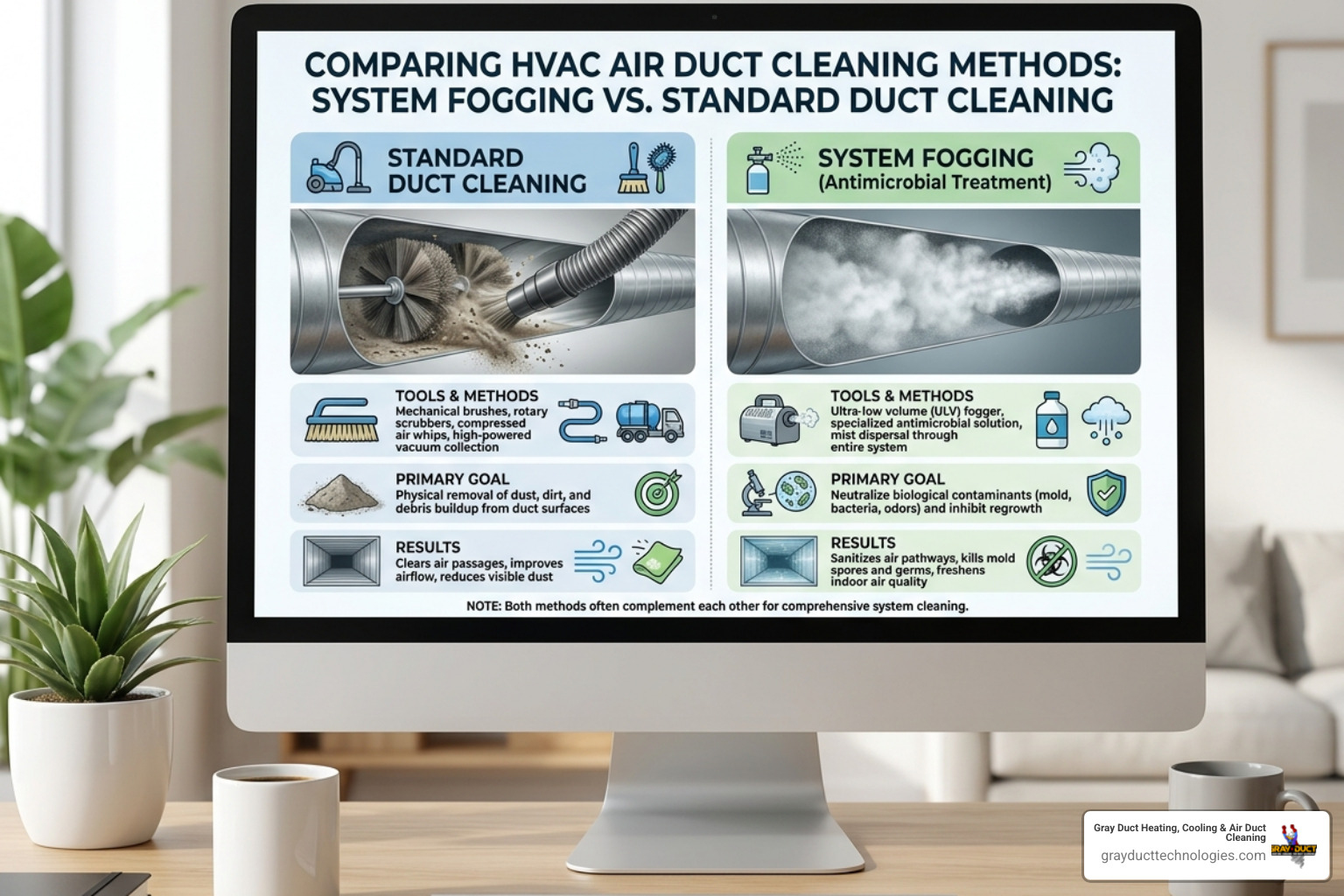
A system fogging vs standard duct cleaning comparison comes down to one core distinction: traditional duct cleaning physically removes debris from your ductwork, while system fogging disperses an antimicrobial mist throughout your HVAC system to neutralize mold, bacteria, and odors at the surface level.
Here is a quick breakdown to help you decide:
| Factor | Traditional Duct Cleaning | System Fogging |
|---|---|---|
| Primary goal | Remove physical debris and dust | Kill mold, bacteria, and neutralize odors |
| Method | Mechanical brushes, vacuums, negative pressure | Fine antimicrobial mist (2–50 micron particles) |
| Best for | Visible dust buildup, airflow issues, post-construction | Musty smells, mold spores, microbial contamination |
| Reaches inaccessible areas | Limited | Yes |
| Protection duration | Ongoing (debris reaccumulates) | Up to 12–14 months |
| Ductwork risk | Possible damage to flex ducts | Minimal when proper agents are used |
| Recommended sequence | First step | Best after cleaning, or when ducts are debris-free |
Consider this: the EPA estimates indoor air quality is frequently two to five times worse than outdoor air — and nearly nine out of ten calls about a “musty” smell in a home trace back to mold somewhere in the HVAC system. Your HVAC system is essentially the lungs of your home, and what lives inside those ducts directly affects what your family breathes every day.
I’m Jason Giandalia, founder of Gray Duct Heating, Cooling & Air Duct Cleaning and a NADCA-certified ASCS technician with years of hands-on experience helping Twin Cities homeowners navigate exactly this kind of system fogging vs standard duct cleaning comparison. In this guide, I’ll walk you through both methods clearly so you can make the right call for your home and your family’s health.
Understanding Traditional HVAC Duct Cleaning Methodology
When we talk about Air Duct Cleaning, we are referring to a mechanical process known as “source removal.” Think of it as the heavy-duty vacuuming and scrubbing of your home’s internal ventilation system. As we provide Professional Air Duct And Dryer Vent Cleaning Minneapolis St Paul Mn, our goal is to physically extract every bit of dust, pet dander, and construction debris that has settled in your vents over the years.
The process typically involves several key steps:
- Negative Pressure: We hook up a high-powered, HEPA-filtered vacuum system to your main trunk line. This creates a powerful suction throughout the entire system, ensuring that once dust is loosened, it travels directly into our containment system rather than floating into your living room.
- Mechanical Agitation: Using tools like motorized brushes, air whips, and compressed air “skipper balls,” we knock loose the stubborn dust and debris stuck to the duct walls.
- HEPA Filtration: All air pulled from your ducts passes through high-efficiency particulate air (HEPA) filters, which trap 99.97% of particles as small as 0.3 microns.
Benefits and Drawbacks of Mechanical Cleaning
The primary benefit of traditional cleaning is the immediate restoration of airflow and the visible reduction of dust in your home. It is the gold standard for cleaning up after a home renovation in Lakeville or clearing out years of accumulated pet hair in a Minneapolis bungalow.
However, mechanical cleaning has its limitations. Traditional brushes and whips can occasionally be too aggressive for older “flex duct” (the slinky-like plastic ducting often found in attics), potentially causing tears if not handled by a certified professional. Furthermore, while brushes remove the “dirt,” they don’t necessarily kill the microscopic mold spores or bacteria that might be clinging to the surfaces. This is where the system fogging vs standard duct cleaning comparison becomes truly interesting.
What is System Fogging and How Does it Work?
If traditional cleaning is the “vacuuming,” system fogging is the “sanitizing.” This process uses a specialized machine called a ULV (Ultra-Low Volume) fogger to atomize an antimicrobial solution into tiny droplets between 2 and 50 microns in size. These particles are so light that they travel through the air just like a mist, following the same path your heated or cooled air takes.
As explained in our Guide To System Fogging Services, this mist coats 100% of the interior surfaces of your HVAC system, including the bends, seams, and corners that mechanical brushes simply cannot reach. By using System Fogging Solutions, we can effectively neutralize biological threats that standard cleaning might leave behind.
Safety Considerations and Product Approvals
In the past, some homeowners were wary of “chemicals” in their ducts. However, by April 2026, the industry has shifted heavily toward plant-based and non-toxic solutions. At Gray Duct, we prioritize safety for your family and pets.
- Thyme Oil (Thymol): This plant-derived powerhouse is EPA-registered and has been shown in studies to fight bacteria like MRSA and fungal threats like Candida. It even shows antiviral effects against serious viruses.
- Hypochlorous Acid (HOCl): This is a 100% non-toxic substance that is actually produced by our own white blood cells to fight infection. It is up to 80 times more powerful than bleach at killing pathogens, yet it is so safe it’s often used in food preservation and wound care.
These agents are residue-free and do not require you to wash your dishes or clothes after a treatment. They simply do their job—neutralizing microbes—and then dissipate.
System Fogging vs Standard Duct Cleaning Comparison: Key Differences
To truly understand the system fogging vs standard duct cleaning comparison, we need to look at how they function side-by-side.
| Feature | Standard Duct Cleaning | System Fogging |
|---|---|---|
| Tool Set | Vacuums, brushes, air whips | ULV Foggers, atomizers |
| Target | Large debris, dust, hair, dander | Mold spores, bacteria, viruses, odors |
| Reach | Main runs and accessible branches | 100% coverage, including deep crevices |
| Downtime | Several hours | 45–60 minutes |
| IAQ Goal | Particle reduction | Biological decontamination |
Mechanical cleaning is labor-intensive and focuses on the “bulk” of the mess. Fogging is a precision strike against the “invisible” mess. As we note in the Benefits Of System Fogging, fogging is particularly essential for System Fogging For Commercial Hvac where large, complex duct networks make manual cleaning of every square inch nearly impossible.
Methodology Differences in a System Fogging vs Standard Duct Cleaning Comparison
The most significant difference in methodology is how we handle “inaccessible areas.” Standard cleaning relies on physical contact. If a brush can’t get around a 90-degree turn in a tight crawlspace in Saint Paul, that dust might stay put. Fogging, however, relies on airflow. If air can move through it, the fog can reach it. This ensures that the entire “envelope” of your HVAC system is treated, not just the parts we can reach with a hose.
Long-Term IAQ Impact: System Fogging vs Standard Duct Cleaning Comparison
While duct cleaning removes the current buildup, it doesn’t prevent new dust from settling. Fogging provides a layer of protection that can last between 12 and 14 months. It works by killing the microbes that create “biofilms”—sticky layers that act like flypaper for dust. By keeping the interior of your ducts biologically clean, they stay physically cleaner for longer. This is The Importance Of System Fogging: it breaks the cycle of microbial growth and dust accumulation.
Industry Standards and Safety for Minnesota Homeowners
In the Twin Cities, we face unique challenges. Our humid summers and frigid winters mean our HVAC systems work overtime, often creating condensation inside the ducts. This moisture is a breeding ground for mold.
Industry organizations like NADCA (National Air Duct Cleaners Association) emphasize “source removal” as the primary requirement for a clean system. However, the EPA and NADCA also recognize that in cases of fire, flood, or mold contamination, antimicrobial treatments are a vital secondary step.
For our neighbors in places like Plymouth or Woodbury, we have to be especially careful with flex ducting. Because these ducts are held together by zip ties and mastic, they can be vulnerable to the high-pressure vacuuming used by untrained “blow-and-go” companies. Our in-house certified team understands these vulnerabilities and uses a calibrated approach to ensure your system’s integrity remains intact. We also provide System Fogging For Commercial Spaces to help local businesses maintain the same high standards for their employees.
Choosing the Right Method for Your HVAC System
How do you choose? It often depends on the “symptoms” your home is showing:
- Choose Traditional Duct Cleaning if: You’ve just finished a renovation, you’ve moved into a pre-owned home, you see dust puffing out of vents, or it has been more than 5 years since your last cleaning.
- Choose System Fogging if: You smell a “musty” or “dirty sock” odor when the AC kicks on, you suffer from unexplained allergies or respiratory issues, or you want a quick, proactive sanitization between deep cleanings.
- Choose Both (The “Gold Standard”): For the best results, we recommend fogging immediately after a traditional cleaning. Removing the debris allows the fogging agent to bond directly to the duct walls, creating a long-lasting antimicrobial barrier.
When looking for Professional System Fogging Services, always ask if the technicians are in-house or third-party contractors. At Gray Duct, our family-owned team handles everything. We also recommend checking other areas of your home’s “breathing” system, such as Dryer Vent Cleaning, to ensure maximum safety and efficiency.
Frequently Asked Questions
Is system fogging safe for households with pets and children?
Yes, provided the right products are used. We use EPA-registered, non-toxic solutions like Thymol (derived from the thyme plant) or Hypochlorous Acid. These are safe for children and pets. We do ask that family members and pets vacate the immediate area during the 45-minute treatment and allow for a short ventilation period afterward, but there are no caustic residues or off-gassing poisons to worry about.
Should fogging be used as a standalone service or after cleaning?
While fogging is a fantastic “shock treatment” for odors and mold, it works best when the ducts are clear of heavy debris. If your ducts are filled with thick dust, the fog will settle on the dust rather than the duct walls. For the most effective system fogging vs standard duct cleaning comparison result, we suggest a full cleaning followed by fogging. However, if your ducts were recently cleaned and you’ve developed a musty smell, fogging is an excellent standalone solution.
How does climate influence the choice between cleaning and fogging?
In the Twin Cities, humidity is our biggest enemy. High humidity levels in the summer can lead to condensation in attic ducts, which quickly turns into mold. This makes fogging an essential tool for Minnesota homeowners. While a homeowner in a desert climate might only need dust removal, our local climate practically demands the microbial protection that fogging provides.
Conclusion
Deciding between these two methods doesn’t have to be a headache. Whether you are in Eagan, Maple Grove, or right in the heart of Minneapolis, the goal is the same: clean, healthy air for your family. Traditional duct cleaning handles the “heavy lifting” of debris removal, while system fogging provides the “surgical strike” against microbes and odors.
At Gray Duct Heating, Cooling & Air Duct Cleaning, we don’t believe in one-size-fits-all solutions. As a family-owned business, we treat your home like our own. Our certified, in-house team is ready to inspect your system and recommend the perfect balance for your needs. If you’re ready to breathe easier, consider the benefits of System Fogging as part of your home maintenance routine. Give us a call today—we’re proud to serve our neighbors across the entire Twin Cities metro area.
Need HVAC Help?
Our NADCA-certified technicians are ready to help with all your heating, cooling, and air quality needs.
Get Free EstimateMore Articles
 HVAC Tips
What to Do When Your AC and Furnace Share the Same Air Filter
 HVAC Tips
Addressing Drafty Rooms Before Winter: Duct Sealing vs. Window Replacement
 HVAC Tips
Dryer Vent Routing: Rigid Metal vs. Flexible Foil in Cold Climates
 HVAC Tips
Why We Inspect the Heat Exchanger So Closely During Fall Maintenance
 HVAC Tips
Upgrading to a Two-Stage Furnace: Is the Investment Worth It in Minnesota?
Related Articles
Ready to Get Started?
Whether you need a repair, maintenance, or a new system installation, our expert team is here to help.