Choosing Between NADCA and Non-Certified Cleaners for Your Home
Gray Duct
Discover NADCA certified vs non certified duct cleaning differences. Choose certified pros for superior HVAC hygiene, allergy relief & Twin Cities efficiency.
NADCA Certified vs Non Certified Duct Cleaning: What Twin Cities Homeowners Need to Know
NADCA certified vs non certified duct cleaning comes down to one core difference: whether the company follows a verified, industry-standard process — or just shows up with a vacuum and hopes for the best. Here’s a quick breakdown:
| Factor | NADCA Certified | Non-Certified |
|---|---|---|
| Cleaning method | Source removal with negative pressure | Often “blow-and-go” or surface-only |
| Equipment | Commercial-grade HEPA vacuum systems | Typically portable, low-powered units |
| Technician knowledge | ASCS-certified, ongoing education required | No standardized training required |
| Scope of work | Entire HVAC system, including coils and blower | Usually ducts only, if that |
| Standards followed | ACR 2021 Standard (NADCA) | None required |
| Verification | Searchable on nadca.com | Cannot be verified |
| Pre/post inspection | Required per ACR protocol | Rarely performed |
For homeowners in the Twin Cities dealing with dust buildup, allergy symptoms, or reduced HVAC efficiency, that difference matters a lot. Minnesota’s cold winters mean your heating system runs hard for months at a time — and if your ducts weren’t cleaned properly, you’re circulating whatever’s in them through every room in your home.
The duct cleaning industry is largely unregulated in most states, including Minnesota. That means anyone can advertise the service without any training, equipment standards, or accountability. NADCA certification is the closest thing the industry has to a quality benchmark — but even that comes with nuances worth understanding before you hire.
I’m Jason Giandalia, founder of Gray Duct Heating, Cooling & Air Duct Cleaning and a NADCA-certified Air Systems Cleaning Specialist (ASCS) — and understanding the real difference in nadca certified vs non certified duct cleaning is something I’ve built my entire business around. In this guide, I’ll walk you through exactly what that certification means, where it falls short, and how to make a confident decision for your home.
What is NADCA and Why Does Certification Matter for Your HVAC System?
The National Air Duct Cleaners Association (NADCA) was established in 1989 as a non-profit organization dedicated to setting the “gold standard” for the HVAC cleaning industry. Before NADCA, the industry was a bit like the Wild West—there were no universal rules on how to clean a duct or what “clean” even meant.
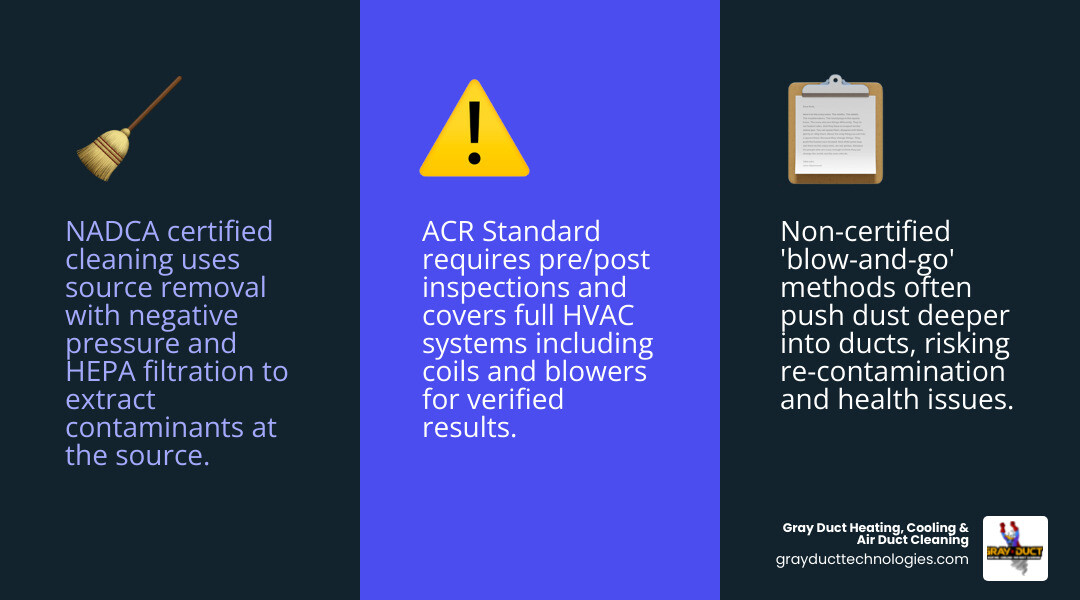
Today, NADCA publishes the ACR Standard (Assessment, Cleaning, and Restoration of HVAC Systems). This is the benchmark document used worldwide to define the proper and safe techniques for HVAC hygiene. When we talk about nadca certified vs non certified duct cleaning, we are really talking about whether a company commits to the ACR Standard’s primary requirement: source removal.
Source removal is the only method NADCA recognizes as acceptable. It involves putting the entire duct system under continuous negative pressure (a powerful vacuum) while using agitation tools to physically loosen debris. If a company isn’t following these steps, they aren’t just failing a “test”—they are likely leaving a significant amount of dust and allergens behind in your vents.
Checking for proper Certifications is the first step in ensuring your home’s air quality is handled by professionals who understand the complexities of modern HVAC systems.
Understanding the ASCS and CVI Credentials
When comparing nadca certified vs non certified duct cleaning, it’s important to look at the specific credentials held by the team. NADCA offers two primary professional certifications:
- Air Systems Cleaning Specialist (ASCS): This is the flagship certification. To earn it, an individual must pass a rigorous 200-question exam covering HVAC design, cleaning protocols, safety standards, and indoor air quality. It isn’t a “one-and-done” deal; it requires annual continuing education credits to renew.
- Certified Ventilation Inspector (CVI): This is an advanced credential for those who specialize in the inspection of HVAC systems. A CVI-certified pro has mastered the art of identifying contamination, understanding airflow and pressure, and providing detailed reports on system health.
At Gray Duct Technologies, we believe in these standards so much that NADCA Welcomes Gray Duct Technologies as a member committed to these high-level benchmarks. This ensures that the knowledge-based competency required for these exams is applied directly to every home we service in the Minneapolis-St. Paul area.
Requirements for Professional Membership
Being a NADCA member company involves more than just passing an exam. To maintain membership, a company must:
- Have at least one ASCS-certified employee on staff at all times.
- Maintain general liability insurance (protecting you, the homeowner).
- Agree to the NADCA Code of Ethics, which promotes honesty and integrity in bidding and service.
- Clean according to the ACR Standard.
This commitment to excellence is why we were Voted Minnesota’s 2nd Best Air Duct Cleaning Company from the Star Tribune. It shows that when you choose a certified provider, you aren’t just getting a service; you’re getting a company that has been vetted by the industry’s leading authority.
Key Differences: NADCA Certified vs Non Certified Duct Cleaning Methods
The most visible difference in nadca certified vs non certified duct cleaning is the actual work performed inside your home. Non-certified “blow-and-go” companies often use what we call “showmanship” tools—small shop vacs or portable units that look busy but lack the power to actually clean the entire system.
| Method Feature | NADCA Certified (Source Removal) | Non-Certified (Standard Cleaning) |
|---|---|---|
| System Pressure | High-volume negative pressure pulls debris out. | Often uses positive pressure (blowing) only. |
| Agitation | Mechanical brushes, air whips, and scrubbers. | May skip agitation or use manual brushes only. |
| Filtration | HEPA-filtered collection to prevent dust leaks. | Standard filters that may let fine dust back in. |
| Scope | Includes supply, return, coils, and blower. | Often ignores the furnace “guts” and returns. |
Our Air Duct Cleaning process follows the source removal mandate strictly. We don’t just “sweep” the vents; we hook up commercial-grade vacuums that move thousands of cubic feet of air per minute, ensuring that once dust is loose, it leaves your house forever.
How NADCA certified vs non certified duct cleaning impacts health
The Twin Cities area, including cities like Bloomington and Plymouth, often deals with high pollen counts. In fact, areas with high seasonal changes are frequently ranked as allergy capitals. If a non-certified cleaner uses weak equipment, they might actually make your allergies worse by stirring up settled dust mites, pet dander, and pollen without successfully extracting them.
This “redistribution” of allergens is a major risk. A NADCA-certified team uses containment strategies to ensure that the air inside your home stays clean while the “gunk” inside the ducts is removed. This is critical for families in Saint Paul or Eagan who suffer from asthma or seasonal sensitivities.
Equipment and Scope of Work Standards
The equipment used is a major differentiator. While NADCA doesn’t “enforce” specific brands, they mandate that the equipment must be capable of achieving the ACR Standard’s goals. This usually requires truck-mounted vacuums or high-output portable HEPA units.
Furthermore, a certified cleaning isn’t just about the “tubes” in your walls. A proper job includes:
- A/C Coil Cleaning: Dirty coils force your system to work harder and can harbor mold.
- Blower Motor Decontamination: Dust on the fan blades reduces airflow and efficiency.
- Internal Cabinet Cleaning: The area around your furnace filter and heat exchanger.
Our commitment to this comprehensive scope is a big reason why we were Voted Best Air Duct Cleaning Company from the Best of Savage Awards 2022. We don’t cut corners because we know those corners are exactly where the dust likes to hide.
Risks and Limitations of Non-Certified Services
Hiring a non-certified company in an unregulated industry like ours is a gamble. The biggest risk is the “scam” factor. You’ve likely seen the ads on social media offering whole-home cleaning for a suspiciously low, flat rate. These companies often use “bait-and-switch” tactics, where they get in the door and then claim you have “black mold” that requires an expensive chemical treatment.
Other risks include:
- Duct Damage: Using improper tools (like high-pressure air on flexible ductwork) can tear the liners, leading to expensive repairs and energy loss.
- Inadequate Equipment: If the vacuum isn’t strong enough, the dust just moves from one part of the duct to another.
- No Insurance: Many fly-by-night operations don’t carry the liability insurance required for NADCA membership, leaving you on the hook if they damage your furnace.
Verifying a company’s nadca certified vs non certified duct cleaning status
Don’t just take a company’s word for it. It’s common for non-certified companies to illegally use the NADCA logo on their websites. Here is how you can verify the truth:
- Search the Directory: Go to nadca.com and use the “Find a Professional” tool. Search by zip code or company name. If they aren’t there, they aren’t members.
- Ask for the Certificate: A legitimate member will have a certificate showing their name and a current expiration date.
- Check for an ASCS: Ask, “Who is the ASCS on your staff?” Every member company must have at least one.
As a local, family-owned provider of Professional Air Duct and Dryer Vent Cleaning Minneapolis St Paul MN, we encourage our customers to verify our credentials. Transparency is the best way to build trust in our community.
Frequently Asked Questions about Professional Duct Cleaning
How often should I schedule a certified cleaning in the Twin Cities?
In the Minneapolis-St. Paul area, we generally recommend a professional cleaning every 3 to 5 years. However, you should consider it sooner if you’ve recently completed a home renovation (drywall dust is a major culprit), if you have shedding pets, or if you notice visible dust buildup on your supply registers.
Does certification guarantee the technician on-site is an ASCS?
This is a common misconception. NADCA requires the company to have at least one ASCS on staff to oversee operations and training, but it doesn’t strictly mandate that the individual technician at your house must be the one who passed the exam. However, at Gray Duct Technologies, we prioritize having our in-house team trained to these exact standards to ensure consistency on every job.
What specific questions should I ask a contractor before they start?
- “Do you use source removal and negative pressure?”
- “Will you clean the coils and the blower motor as part of the service?”
- “Can you provide a visual inspection (like a camera check) to show the results?”
- “Are your technicians in-house employees or third-party contractors?” (We always use our own in-house team!)
Conclusion
When it comes to the air your family breathes, the choice between nadca certified vs non certified duct cleaning is clear. While non-certified services might seem like a way to save time or money, they often leave behind the very contaminants you’re trying to remove—or worse, they can damage your expensive HVAC system.
Gray Duct Heating, Cooling & Air Duct Cleaning is proud to be a family-owned business serving the Twin Cities South Metro and surrounding areas. From Lakeville to Maple Grove, we bring a certified, in-house team to every home. We don’t just clean ducts; we provide comprehensive indoor air quality solutions, including A/C coil cleaning and HVAC maintenance, to ensure your home is a healthy, efficient sanctuary.
If you’re ready to experience the difference that a certified, professional clean can make, reach out to us for Professional Air Duct and Dryer Vent Cleaning Minneapolis St Paul MN. We’re here to help you breathe easier in the Twin Cities.
Need HVAC Help?
Our NADCA-certified technicians are ready to help with all your heating, cooling, and air quality needs.
Get Free EstimateMore Articles
 HVAC Tips
What to Do When Your AC and Furnace Share the Same Air Filter
 HVAC Tips
Addressing Drafty Rooms Before Winter: Duct Sealing vs. Window Replacement
 HVAC Tips
Dryer Vent Routing: Rigid Metal vs. Flexible Foil in Cold Climates
 HVAC Tips
Why We Inspect the Heat Exchanger So Closely During Fall Maintenance
 HVAC Tips
Upgrading to a Two-Stage Furnace: Is the Investment Worth It in Minnesota?
Related Articles
Ready to Get Started?
Whether you need a repair, maintenance, or a new system installation, our expert team is here to help.