

Why Minnesota Homeowners Are Leaving Money on the Table in 2026
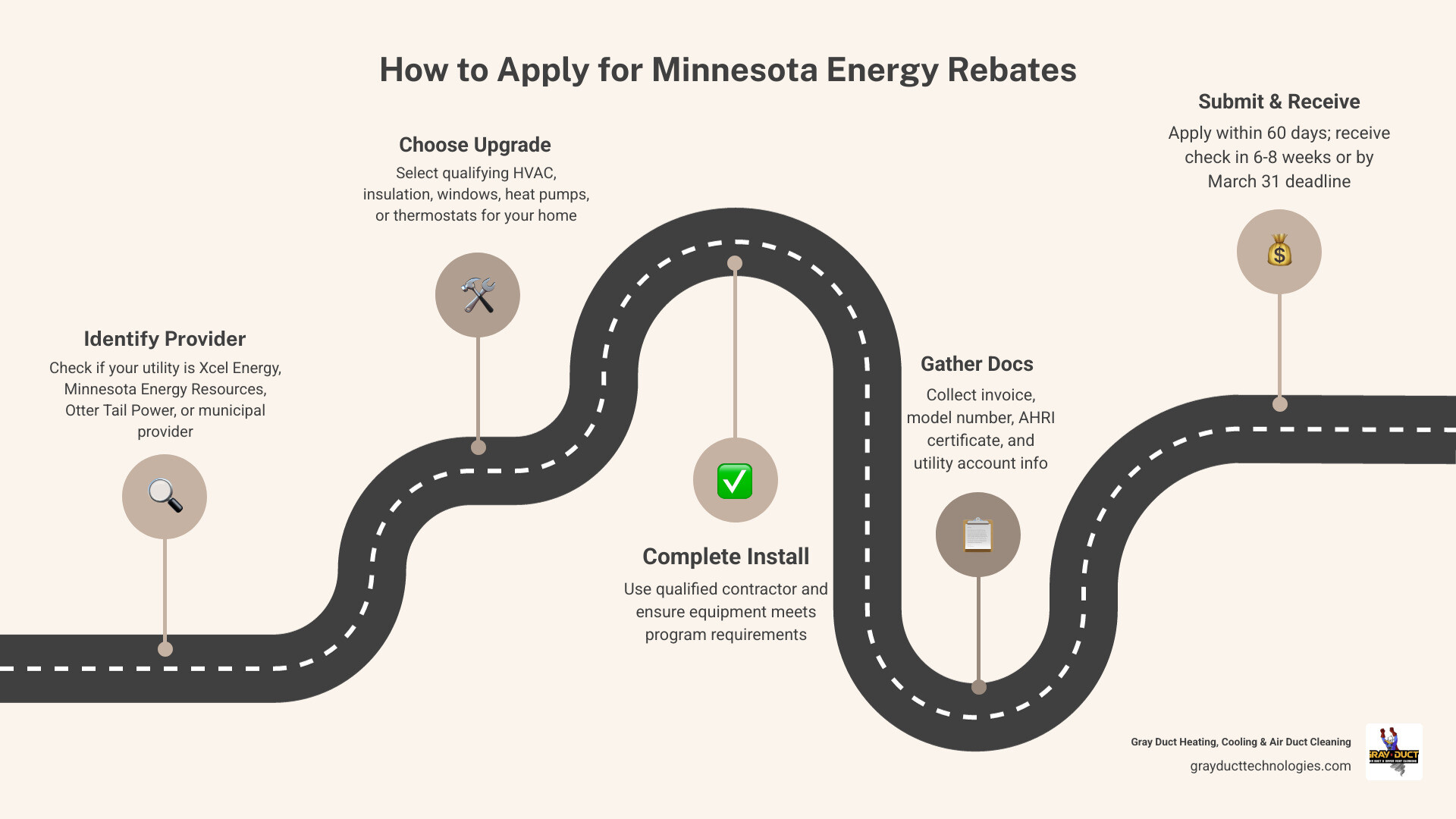
Knowing how to apply for energy rebates in Minnesota can put real money back in your pocket — here’s a quick overview of the process:
- Identify your utility provider (Xcel Energy, Minnesota Energy Resources, Otter Tail Power, or your local municipal utility).
- Choose a qualifying upgrade — heating systems, insulation, windows, water heaters, thermostats, or heat pumps.
- Install eligible equipment using a participating or qualified contractor.
- Gather your documentation — dated invoice, model number, AHRI certificate, and utility account number.
- Submit your application within 60 days of installation (some utilities require submission by March 31 of the following year).
- Wait for your rebate check — most programs mail payment within 6 to 8 weeks of a completed application.
Minnesota homeowners have access to a surprisingly wide range of energy efficiency rebates — from utility-sponsored programs covering heating systems and insulation, to city-level programs like Minneapolis’s Green Cost Share, to state and federal incentives tied to the Inflation Reduction Act. Yet many homeowners either don’t know these programs exist or assume the process is too complicated to bother with. The reality is that most rebate programs follow a straightforward path: buy qualifying equipment, submit a simple application with proof of purchase, and receive a check in the mail.
The challenge is knowing which programs apply to your home, what the deadlines are, and how to avoid leaving money on the table by missing a step. As of June 2026, some programs — like the federally funded Save Energy Minnesota — are still awaiting formal approval from the U.S. Department of Energy before launching, while others are already open and processing applications on a first-come, first-served basis with limited funding.
I’m Jason Giandalia, founder of Gray Duct Heating, Cooling & Air Duct Cleaning, and I’ve helped Twin Cities homeowners navigate how to apply for energy rebates in Minnesota as part of our work diagnosing inefficiencies, replacing HVAC systems, and improving indoor air quality across the metro. In this guide, I’ll walk you through every major rebate pathway available to Minnesota homeowners right now so you can act before funding runs out.
Utility-Sponsored and City-Specific Rebate Programs
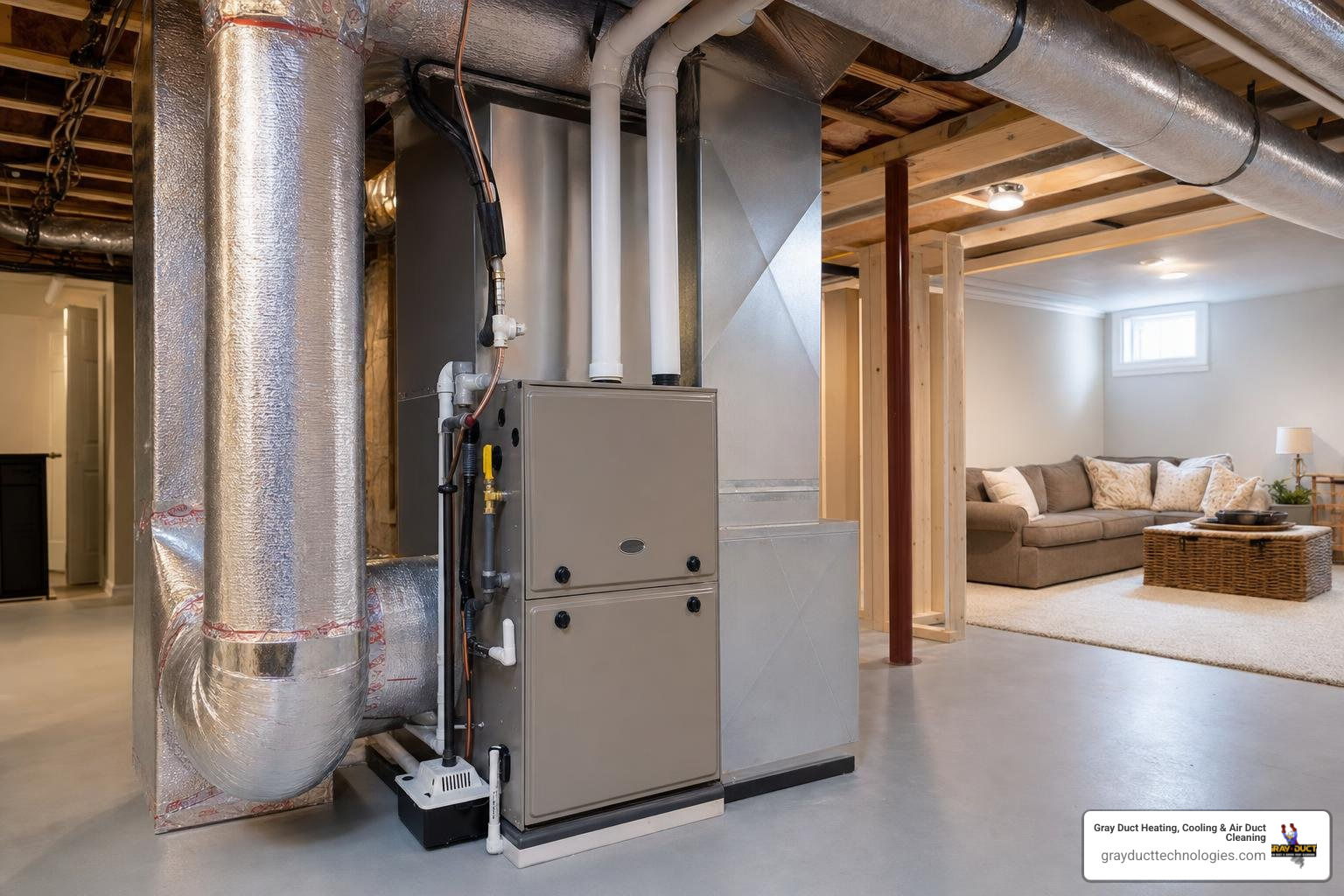
When looking for immediate financial relief on home efficiency upgrades, your local utility provider is almost always the best place to start. For existing homes, utilities across the Twin Cities metro offer substantial rebates to offset the cost of upgrading to high-efficiency heating systems, water heating, and smart thermostats. They also incentivize projects that address the home envelope, such as air sealing, professional insulation, duct sealing, and replacing drafty windows with ENERGY STAR V7 certified models.
Improving these fundamental elements of your home not only lowers your utility bills but also protects your mechanical systems from working overtime. If you want to maximize your savings before you even apply for a rebate, understanding the mechanics of home energy loss is key. You can read more about optimizing your current setup in our guide on How to Save Energy with HVAC Optimization.
How to Apply for Energy Rebates in Minnesota Through Your Utility Provider
Applying for utility rebates requires aligning your upgrades with very specific technical thresholds. Major providers in our service areas — including Xcel Energy and Minnesota Energy Resources — have structured tier systems based on equipment efficiency.
For natural gas heating upgrades, the rebates are tiered by the Annual Fuel Utilization Efficiency (AFUE) rating of the system:
- 92% AFUE Gas Furnace: Qualifies for a baseline rebate.
- 94% AFUE Gas Furnace: Qualifies for a moderate rebate.
- 97% AFUE Gas Furnace: Qualifies for the highest tier furnace rebate.
- 90% AFUE Gas Boiler: Qualifies for a standard boiler rebate.
- Heat Recovery Ventilators (HRV) and Energy Recovery Ventilators (ERV): Qualifies for a flat rebate, provided they are certified to provide whole-house ventilation where none previously existed.
- Smart Thermostats: Advanced or Wi-Fi-enabled thermostats qualify for rebates capped at 50% of the total purchase price.
If you are upgrading an electric cooling system or installing a heat pump, the efficiency metrics transition to SEER2 (Seasonal Energy Efficiency Ratio 2) and HSPF2 (Heating Seasonal Performance Factor 2). To understand how these efficiency ratings translate to real-world operational savings, you can use our interactive SEER Calculator to compare systems.
To make sure you don’t miss out on any active utility promotions, we maintain a comprehensive, frequently updated directory. Check out The Big List of Minnesota HVAC Rebates and How to Get Them for a breakdown of current utility offerings.
Navigating Local and New Construction Rebate Applications
Beyond the major utilities, local municipalities offer localized programs designed to support sustainability. A prime example is the Minneapolis Green Cost Share program, funded by the Climate Legacy Initiative. This program is available to property owners of single-family or 2-4 unit residential buildings within Minneapolis.
The Green Cost Share program uses a tiered incentive structure:
- Green Zone Residents: Properties located in designated Minneapolis Green Zones are eligible for the highest tier of funding.
- Non-Green Zone Residents: Properties outside these zones are eligible for a standard, but still highly supportive, rebate tier.
- Eligible Projects: Funding applies to insulation, air sealing, energy-efficient appliances, and window replacements. Projects must be completed, or equipment purchased, within 60 days prior to submitting the application.
For residents in nearby communities like Rosemount, local municipal utilities offer their own residential energy rebates and sustainability programs. To make these upgrades more accessible, many of these local initiatives partner with the Home Energy Squad to offer low-cost or free in-home energy audits. They also provide access to 0% APR financing options, allowing you to spread out the remaining balance of your project without paying interest.
If you are looking to build a new home, the Home Energy Excellence Program and specific new construction utility rebates incentivize builders to surpass standard energy codes. You can learn more about local city initiatives and how they impact your home upgrades in our detailed overview of Energy Efficiency in Minneapolis MN. For those interested in spreading out the upfront cost of these projects, we also provide flexible options through our Financing page.
Income-Eligible and Federal Rebate Programs
For income-qualified households, Minnesota offers robust programs that cover up to 100% of the cost of energy efficiency improvements. The Low Income Weatherization Assistance Program provides free home energy upgrades, including insulation, air sealing, and heating system repairs or replacements for eligible residents. Additionally, utility-administered programs like the 4U2 program and specialized affordable housing rebates ensure that income-eligible customers can access high-efficiency upgrades without financial strain.
Eligibility for these programs is typically determined using the Area Median Income (AMI) look-up table. Households earning at or below 80% of the AMI qualify for the most substantial subsidies, while those up to 150% AMI still qualify for significant moderate-income assistance.
At the federal level, the Inflation Reduction Act (IRA) has introduced two major rebate frameworks:
- Home Efficiency Rebates (HOMES): Provides whole-home rebates based on measured energy savings after retrofits. Rebate amounts can range significantly depending on the percentage of energy saved and household income.
- Home Electrification and Appliance Rebates (HEAR): Focuses on point-of-sale, instant discounts for high-efficiency electric equipment, including heat pumps, heat pump water heaters, and electrical panel upgrades.
Current Program Status (As of June 2026): It is important to note that the state-administered, federally funded Save Energy Minnesota program has not officially launched. Minnesota is currently waiting for formal approval from the U.S. Department of Energy (DOE) to launch the program, and there is no estimated launch date at this time. However, the program is designed to run through 2031 or until all federal funds are exhausted, meaning long-term planning is highly beneficial.
How to Apply for Energy Rebates in Minnesota Using Federal and State Stacking
Even though we are waiting on the official launch of the federal HEAR and HOMES programs, Minnesota’s state-level programs are specifically written into law to allow “stacking” with federal incentives. Under Minnesota Statutes Section 216C.46, the Residential Heat Pump Rebate Program establishes a state-level rebate that integrates directly with federal IRA incentives.
To successfully position your home for stacked rebates when the federal programs go live, you must meet several strict statutory requirements:
- Prior Federal Application: To qualify for the state heat pump rebate, the applicant must provide evidence of having received or applied for a federal heat pump rebate under the Inflation Reduction Act.
- Recent Energy Audit: You must have a home energy audit completed within 18 months prior to the heat pump installation. This audit must be performed by a certified Building Analyst Technician (BPI certification).
- Pre-requisite Weatherization: The energy audit’s recommendations for insulation and air sealing must either be fully completed by a certified contractor or deemed already sufficient by the auditor before the heat pump is installed.
- Equipment Specifications: The installed heat pump must be a cold-climate rated air-source model equipped with an inverter-driven compressor.
- Rebate Cap: Under state law, the maximum state heat pump rebate is the lesser of a set statutory limit or the net cost of the equipment and installation after the federal rebate has been applied.
Step-by-Step Guide: How to Apply for Energy Rebates in Minnesota
To ensure your application is approved without delays, you must follow a precise sequence of steps. Missing a deadline or submitting incomplete paperwork is the most common reason rebates are denied.
- Verify Equipment Eligibility: Before purchasing, check the manufacturer’s specification sheet or the Air-Conditioning, Heating, and Refrigeration Institute (AHRI) directory to ensure the model meets your utility’s exact efficiency requirements (such as AFUE, SEER2, or UEF).
- Choose an Approved Contractor: Ensure your installer is licensed and, where required, listed as a participating trade ally with your utility provider. Self-installed equipment (such as DIY window replacements) often does not qualify for rebates.
- Execute the Installation: Keep the installation date in mind, as this starts the clock for your application deadline.
- Gather Required Documentation: Collect a copy of your utility bill, the itemized contractor invoice, and the AHRI certificate.
- Submit the Application: Most utilities require applications to be submitted within 60 days of the installation date. Additionally, all rebate requests for installations completed during a calendar year must be received no later than March 31st of the following calendar year.
- Processing and Payment: Allow 6 to 8 weeks for the utility to process your application. Once approved, your rebate check will be mailed within six weeks.
| Utility / Program | Key Deadlines | Required Documentation | Processing Time |
|---|---|---|---|
| Xcel Energy | Postmarked by Sept 30th of the year following installation | Utility account number, itemized invoice with model/serial numbers, AHRI/ENERGY STAR certificate | 6 to 8 weeks |
| Minnesota Energy Resources | Received within 60 days of installation | Account number, dated contractor invoice, proof of efficiency (NFRC label for windows) | 4 to 6 weeks |
| Otter Tail Power | Received by March 31st of the following calendar year | Electric bill account number, dated receipt with model numbers, proof of efficiency ratings | 6 to 8 weeks |
| Minneapolis Green Cost Share | Submitted within 60 days of project completion | Dated invoice, proof of property ownership, Green Zone verification (if applicable) | Varies by project |
Frequently Asked Questions about Minnesota Energy Rebates
Because energy rebate programs are funded by a mix of state, federal, and ratepayer dollars, they are subject to strict regulatory rules. Funding is always limited and can change or end at any time, with applications processed on a first-come, first-served basis. Additionally, the rebate amount cannot exceed the total cost of the improvement or service, and customers are limited to one rebate per individual improvement. Lastly, be aware that rebate payments may be subject to federal and/or state income tax reporting.
What documentation is required to qualify for Minnesota energy rebates?
To submit a successful rebate application, you must provide:
- A dated contractor invoice or retail receipt showing the business name, address, and contact information.
- The exact manufacturer, model number, and serial number of the installed equipment.
- An itemized breakdown of the purchase price and installation labor costs (electrical panel upgrades, for example, must be itemized separately from the heat pump cost).
- A valid AHRI certificate or ENERGY STAR certification sheet proving the equipment meets the minimum efficiency thresholds.
- Your active utility account number corresponding to the installation address.
Can I combine utility rebates with federal IRA incentives?
Yes. Utility rebates can be combined (or “stacked”) with federal Energy Efficient Home Improvement Tax Credits. Furthermore, state-level programs like the Minnesota Residential Heat Pump Rebate are legally structured to stack directly on top of the federal HOMES and HEAR rebates once those federal programs officially launch in the state.
How can I avoid energy rebate scams in Minnesota?
With the buzz surrounding federal and state funding, scammers frequently target homeowners. To protect yourself:
- Be highly cautious of unsolicited phone calls, text messages, or door-to-door salespersons claiming to represent “Save Energy Minnesota” or the Department of Energy.
- The state federal rebate programs have not launched yet as of June 2026. Anyone offering “instant federal rebates” at your door today is misrepresenting the program.
- Always verify a contractor’s credentials and check their standing with the Minnesota Department of Labor and Industry.
- Never share your utility account login credentials or social security number with unsolicited solicitors.
Conclusion
Navigating the landscape of energy rebates doesn’t have to be overwhelming. By working with an experienced, local partner, you can ensure your upgrades qualify for every available dollar. At Gray Duct Heating, Cooling & Air Duct Cleaning, we take pride in serving our neighbors across the Twin Cities metro area — from Plymouth and Maple Grove down to Burnsville and Lakeville.
Our certified, in-house team handles everything from diagnostic inspections and system maintenance to complete system replacements without relying on third-party contractors. Whether you need routine HVAC maintenance to keep your system running efficiently, or you are ready for a full system upgrade, we are here to help. If you are located in the south metro and considering a system upgrade, learn how we can help you maximize your home’s comfort and efficiency by visiting our page on HVAC Replacement in Bloomington MN. Ready to take the next step? Contact us today to schedule your service!
