

Why NADCA Certification Matters for Duct Cleaning — And What It Means for Your Home’s Air
Why NADCA certification matters for duct cleaning comes down to one simple fact: the duct cleaning industry is largely unregulated, and virtually anyone can pick up a vacuum and call themselves a professional. Here’s what you need to know at a glance:
NADCA certification matters because it ensures:
- Technicians have passed a rigorous, standardized exam on HVAC hygiene and cleaning methods
- Companies follow the ACR Standard — the industry benchmark for proper source removal and negative pressure cleaning
- At least one certified Air Systems Cleaning Specialist (ASCS) is on staff to oversee every job
- Member companies carry general liability insurance and adhere to a professional Code of Ethics
- Ongoing education keeps certified professionals current on best practices
- Consumers have a verified way to protect themselves from scams and incomplete work
The average six-room home collects up to 40 pounds of dust and allergens in its air ducts every year. For Twin Cities homeowners already dealing with Minnesota’s long heating seasons, seasonal allergies, and aging housing stock, who cleans your ducts — and how — makes a real difference in your family’s health and your HVAC system’s lifespan.
In an industry where fly-by-night operators routinely offer suspiciously cheap services, rush through jobs in under 90 minutes, and leave contaminants scattered deeper into your system, NADCA certification is the closest thing to a verified quality standard that homeowners can actually check before hiring.
I’m Jason Giandalia, founder of Gray Duct Heating, Cooling & Air Duct Cleaning, a Twin Cities-based HVAC and indoor air quality company — and as an NADCA-certified ASCS myself, I’ve seen why NADCA certification matters for duct cleaning and how it separates professionals who do the job right from those who simply go through the motions. In the sections below, I’ll walk you through exactly what certification requires, what it means for the quality of work in your home, and how to verify credentials before you let anyone near your ductwork.
Handy why nadca certification matters for duct cleaning terms:
What is NADCA and Why NADCA Certification Matters for Duct Cleaning
To understand why NADCA certification matters for duct cleaning, we first need to look at the organization behind the acronym. Founded in 1989, the National Air Duct Cleaners Association (NADCA) began as a small group of industry pioneers and has since grown into a global trade association representing over 1,500 member companies worldwide. Its primary mission is to establish reliable, science-backed standards for the assessment, cleaning, and restoration of HVAC systems.
In an industry with zero federal licensing requirements, NADCA stepped in to create the “ACR Standard” (Assessment, Cleaning, and Restoration of HVAC Systems). This internationally recognized document defines exactly how a heating, ventilation, and air conditioning system must be cleaned to protect indoor air quality and prevent mechanical damage.
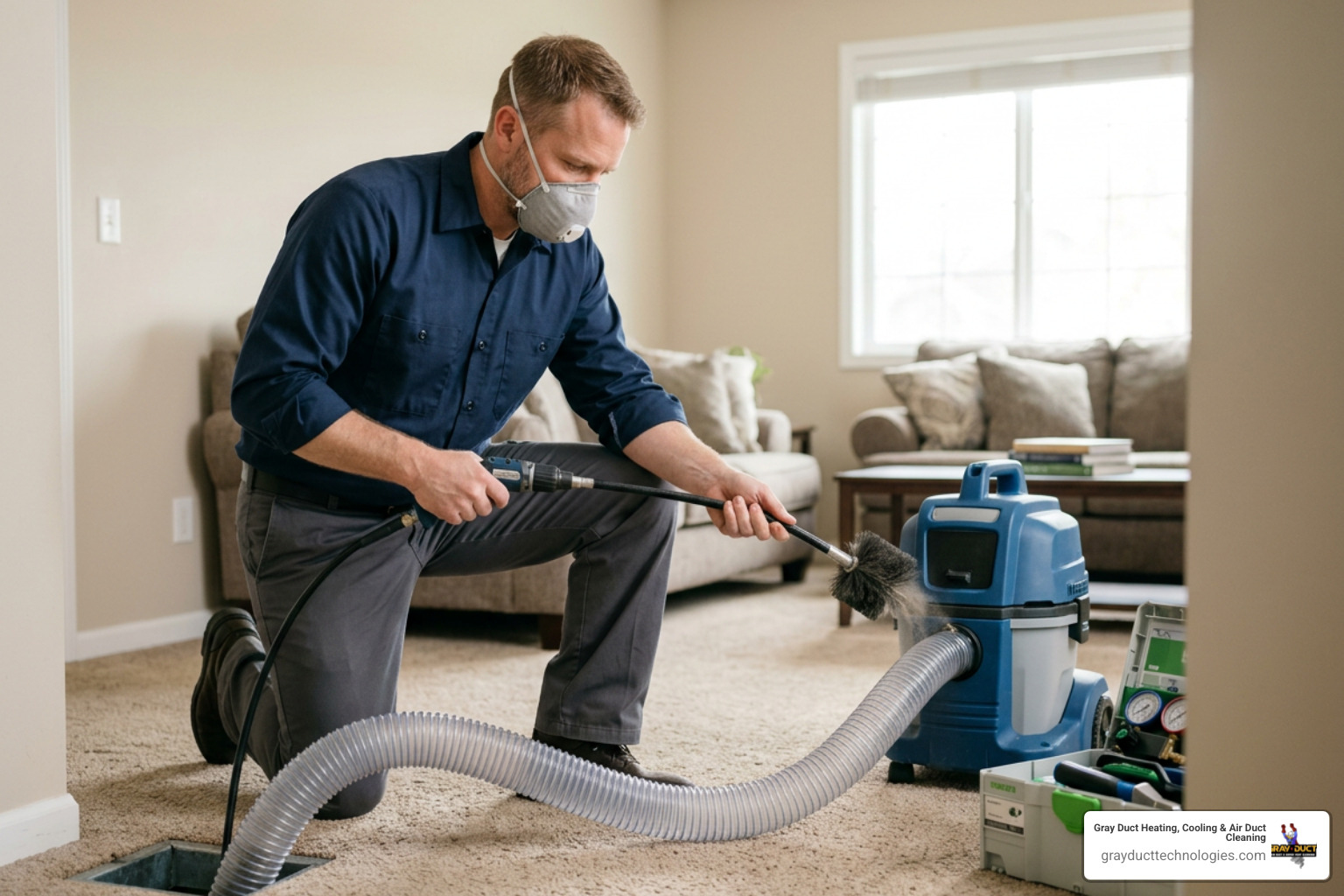
When you hire a company that follows these guidelines, you aren’t just getting someone who vacuums out your floor registers. You are hiring professionals committed to the principles of complete “source removal” and continuous “negative pressure.” This means physically loosening the dust, dander, and mold spores clinging to the interior of your ductwork and drawing them out of your home using high-powered vacuum systems.
This level of detail is exactly why the U.S. Department of Labor’s Division of Occupational Health and Safety explicitly recommends using NADCA-certified HVAC professionals when handling indoor environmental maintenance. To explore the foundational reasons why this level of care is necessary, you can read our detailed breakdown on Why Professional Air Duct Cleaning Matters.
Understanding the ASCS Credential and Why NADCA Certification Matters for Duct Cleaning
At the heart of NADCA’s quality assurance is the Air Systems Cleaning Specialist (ASCS) credential. This is an individual-level certification that technicians must earn by passing a comprehensive, 200-question standardized exam.
This exam isn’t a simple formality. It tests a technician’s deep understanding of:
- HVAC system design, components, and mechanical operations
- Advanced indoor air quality (IAQ) principles and pollutant control
- Safe work practices, including environmental containment and personal protective equipment
- Proper source removal protocols and specialized equipment usage
Furthermore, an ASCS credential is not a one-and-done achievement. To maintain this status, certified specialists must complete ongoing continuing education credits (CECs) and renew their certification. This ensures that the professionals working in your home are always up to date on the latest technological advancements, safety standards, and cleaning methodologies.
When deciding who to trust with your home’s ventilation system, understanding these strict training requirements makes a clear distinction. To learn more about how certified expertise translates to a safer home environment, take a look at our comparison guide on Choosing Between NADCA and Non-Certified Cleaners for Your Home.
Company-Level Membership vs. Individual Certification
A common point of confusion for homeowners is the difference between a company being a “NADCA Member” and a technician holding an “ASCS Certification.”
Here is how the two work together to protect you:
- Individual Certification (ASCS): This credential belongs strictly to the individual technician who studied for and passed the rigorous examination. It proves their personal technical competency and is non-transferable.
- Company-Level Membership: To be recognized as a certified NADCA member company, a business must meet strict organizational requirements. Specifically, the company must:
- Have at least one active, certified ASCS on staff to oversee all cleaning projects.
- Maintain comprehensive general liability insurance to protect homeowners from accidental property damage.
- Sign and adhere to a strict Code of Ethics, which mandates honest marketing, transparent pricing, and a commitment to cleaning according to the ACR Standard.
This dual-layer system ensures that when you hire a certified company, you are protected by both the technical skill of the technicians on-site and the ethical, insured business practices of the company itself.
The Technical Difference: Certified vs. Non-Certified Cleaning Methods
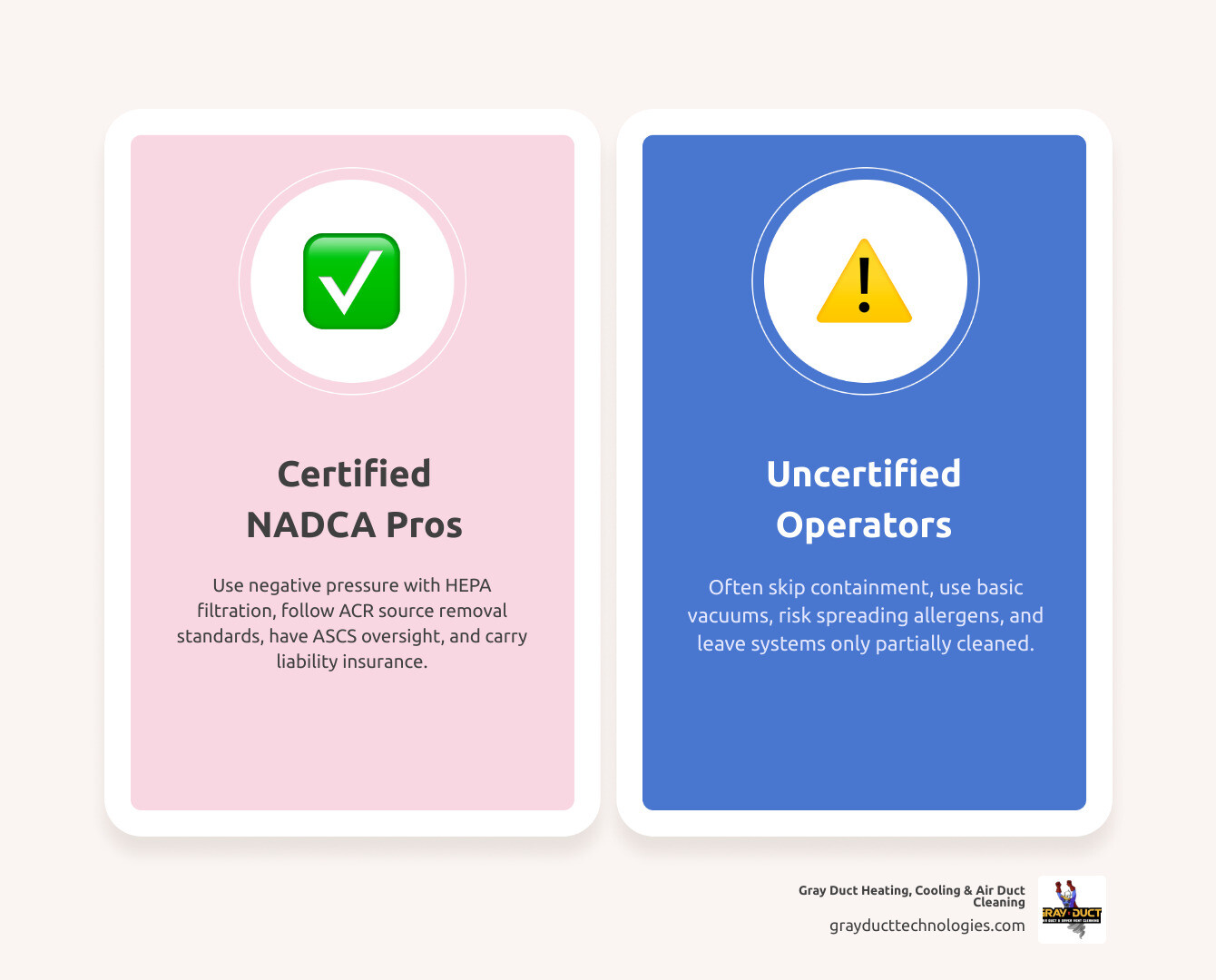
When uncertified companies perform duct cleaning, they often use what we call “showmanship” tools. They might attach a small brush to a standard portable shop vacuum, run it a few feet into your registers, and show you a handful of dust. Unfortunately, this does little to clean the actual system and can easily make your indoor air quality worse by stirring up settled contaminants.
NADCA-certified professionals use a completely different technical approach designed to protect your home and ensure a truly clean system:
| Feature / Standard | NADCA-Certified Standards | Non-Certified Standard Practices |
|---|---|---|
| Primary Method | Complete mechanical source removal | Partial vacuuming of accessible areas only |
| Containment | Continuous negative pressure via HEPA-filtered collection | No negative pressure; loose dust escapes into living areas |
| Equipment Power | Commercial-grade truck-mounted or high-CFM HEPA vacuums (up to 15,000 CFM) | Portable shop-vacs or light commercial units (1,000–3,000 CFM) |
| Scope of Work | Full system cleaning (ducts, coils, blower motor, plenums) | “Vents-only” cleaning, skipping critical mechanical components |
| Technician Oversight | Supervised by an active, certified ASCS | Unsupervised, untrained, or third-party contractors |
| Chemical Usage | Only EPA-registered products applied after physical cleaning | Unregistered chemicals sprayed to mask odors without cleaning |
By maintaining continuous negative pressure throughout the process, certified technicians ensure that every speck of dust, pet dander, and pollen dislodged during cleaning is pulled directly into a secure collection system. This prevents the redistribution of allergens into your bedrooms and living spaces.
Understanding these technical differences helps answer a common question: Is Air Duct Cleaning Worth It?. When performed using certified, high-powered methods, the answer is a resounding yes. For a deeper look at how this investment pays off in energy savings and system longevity, check out our guide on The Cost vs. Benefit Breakdown of Professional Air Duct Cleaning.
Why NADCA Certification Matters for Duct Cleaning and Protecting HVAC Components
Your HVAC system is a complex, finely tuned machine. If a technician uses overly aggressive brushes on delicate flexible ductwork, they can easily tear the inner plastic lining, leading to hidden air leaks behind your walls. Similarly, using the wrong tools on fiberglass-lined plenums can release harmful glass fibers directly into your breathing air.
NADCA-certified professionals are trained to recognize and safely handle all types of duct materials, including sheet metal, fiberboard, and flexible ducts. Furthermore, they understand that true duct cleaning is a misnomer; the entire HVAC system must be cleaned to prevent immediate recontamination.
This comprehensive scope of work includes:
- A/C Coil Cleaning: Dirty evaporator and condenser coils force your system to work harder, reducing heat transfer. Cleaning them can improve system efficiency by up to 21%.
- Blower Motor Decontamination: Removing dust buildup from the blower wheel ensures proper airflow and prevents motor burnout.
- Internal Cabinets and Drain Pans: Cleaning these areas prevents water stagnation and mold growth, protecting both your health and your equipment.
By treating the entire system with specialized, non-destructive tools, certified professionals protect your HVAC investment from premature wear and expensive mechanical failures.
The Danger of “Blow-and-Go” Scams
In the Twin Cities area, you have likely seen social media posts or flyers advertising whole-house duct cleaning for an unbelievably low flat rate. These are classic “blow-and-go” operations.
These uncertified companies rely on quick, high-pressure sales tactics. Once they arrive at your home, they will often perform a rushed, 60-minute job that only covers the surface vents. They then use fear tactics—such as claiming they found dangerous “black mold” in your system—to upsell you on expensive, unnecessary chemical treatments or extra fees.
Because they do not use proper negative pressure containment, these operators frequently leave your home dustier than when they arrived, dispersing years of settled allergens directly into your indoor air. To protect your family and your wallet, it is essential to learn the common warning signs of these dishonest operators. Read our article on Common Duct Cleaning Scams and How to Spot Them Early to stay one step ahead.
How Twin Cities Homeowners Can Verify Credentials and Avoid Scams
Fortunately, you do not have to take a contractor’s word when they claim to be certified. NADCA makes it incredibly simple for homeowners to verify a company’s credentials before scheduling a service.
To verify a contractor’s status like a pro, follow these steps:
- Visit the Official NADCA Directory: Go to the official NADCA website and navigate to the “Find a Professional” directory.
- Search by Location or Name: Enter your ZIP code or search directly for the company’s name. If they are an active member in good standing, their business profile will appear immediately.
- Ask for the ASCS Certificate: When the technicians arrive at your home, ask to see their physical or digital ASCS certificate. Verify that the name matches the supervisor and that the expiration date is current.
- Confirm General Liability Insurance: A legitimate, certified company will gladly provide proof of active liability insurance upon request.
Taking five minutes to run these quick checks is the best way to safeguard your home. For a detailed, step-by-step walkthrough of this verification process, check out our guide on How to Verify Duct Cleaning Credentials Like a Private Investigator. You can also arm yourself with further consumer protection strategies by reading The Homeowner’s Shield: Using Certification to Avoid Shady Service Scams.
Red Flags of Uncertified Operators
When searching for a local service provider, keep an eye out for these common warning signs that indicate a company may not be certified or operating ethically:
- Suspect Social Media Ads: Be wary of generic posts on local community groups offering incredibly cheap flat-rate services with no official business name or website listed.
- Rushed Job Times: A thorough, certified whole-home cleaning typically takes between 3 to 5 hours. If a crew claims they will be finished in 60 to 90 minutes, they are skipping critical steps.
- No Negative Pressure Equipment: If the technicians do not hook up a large, dedicated vacuum hose to your main trunk lines, they are not performing source removal.
- High-Pressure Upselling: Legitimate companies offer transparent, upfront pricing. If a technician pressures you into buying expensive add-on services or chemical sanitizers on the spot, ask them to stop.
By recognizing these warning signs, you can easily filter out dishonest operators and protect your property. For more tips on keeping your home safe from unethical contractors, read our guide on how to Protect Your Home from Dishonest Duct Cleaners.
Frequently Asked Questions About NADCA Certified Duct Cleaning
How often should I schedule a certified air duct cleaning in Minnesota?
According to NADCA guidelines, most homes should have their air ducts professionally cleaned every 3 to 5 years. However, you should consider scheduling a cleaning sooner if you have:
- Shedding pets that contribute hair and dander to the system
- Family members suffering from asthma, seasonal allergies, or respiratory sensitivities
- Recently completed a home renovation project that generated significant drywall dust and construction debris
- Recently moved into a newly built or previously owned home
Does NADCA certification guarantee the technician on-site is an ASCS?
NADCA requires that a member company have at least one active ASCS-certified specialist on staff to oversee all operations and ensure the company cleans according to the ACR Standard. While the individual technician performing the physical work in your home may not always hold the ASCS credential themselves, they must be trained, supervised, and held accountable to the high standards set by the company’s certified specialist.
What equipment standards do certified professionals use?
NADCA-certified professionals must use commercial-grade vacuum equipment capable of establishing continuous negative pressure (often up to 15,000 CFM with truck-mounted units). Any portable vacuum used inside the living space must be equipped with certified HEPA filtration to prevent fine dust and allergens from escaping back into your home’s air. Additionally, they use physical agitation tools, such as rotary brushes and air whips, to safely dislodge debris from the duct walls.
Conclusion
At the end of the day, why NADCA certification matters for duct cleaning comes down to peace of mind. Your home’s HVAC system is responsible for the very air your family breathes. Trusting this system to uncertified, untrained operators puts your indoor air quality, your equipment’s health, and your wallet at risk.
At Gray Duct Heating, Cooling & Air Duct Cleaning, we are proud to be a local, family-owned business serving our neighbors throughout the Twin Cities and South Metro area—including Bloomington, Eagan, Lakeville, Plymouth, Woodbury, and surrounding communities. We never rely on third-party contractors. Instead, our highly trained, in-house certified team handles every single project to ensure consistent quality and complete transparency.
Don’t leave your family’s comfort and health to chance. Schedule professional air duct cleaning in the Twin Cities with our certified team today, and experience the difference that true, verified standards make for your home.
