

What Are the Right Questions to Ask Before Hiring Duct Cleaners?
The most important questions to ask before hiring duct cleaners cover credentials, equipment, service scope, pricing transparency, and home protection. Here is a quick reference list to use before you book:
- Are you licensed, bonded, and insured — and can you provide proof?
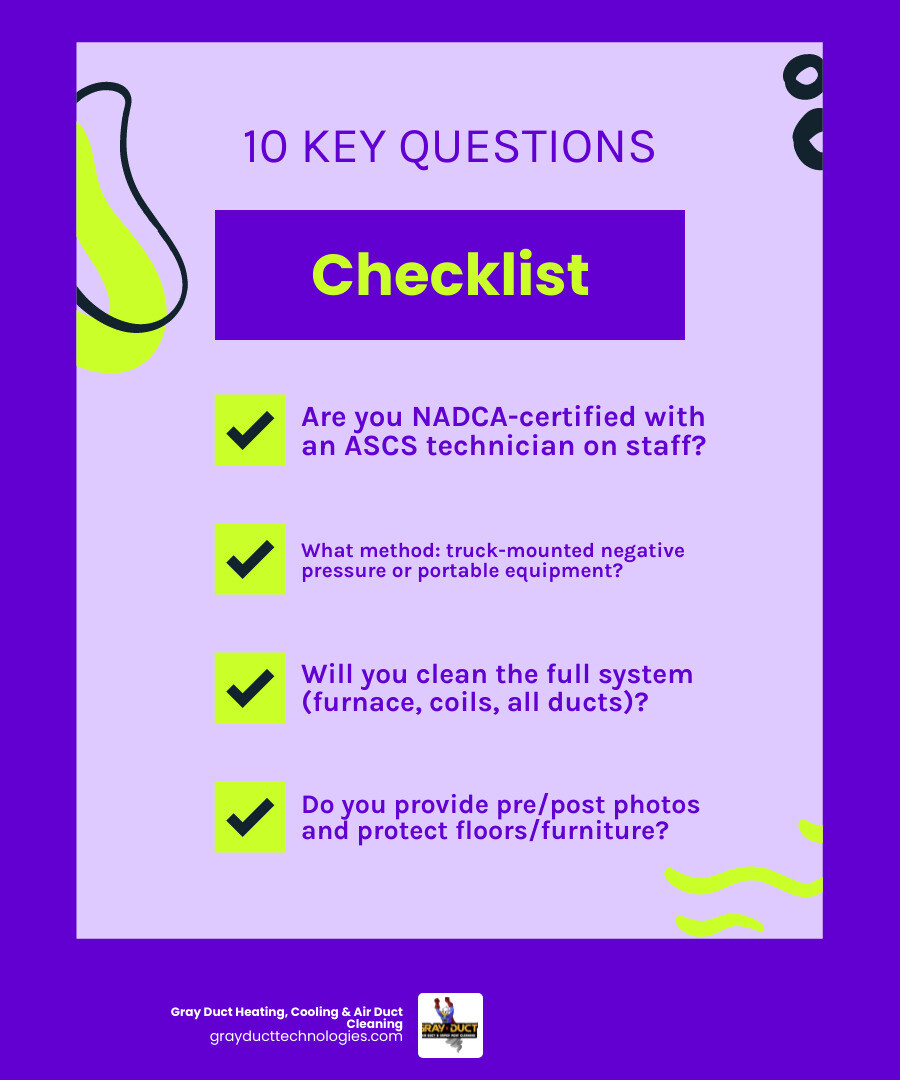
- Are you NADCA-certified, and do you have an ASCS-certified technician on staff?
- How long have you been in business, and can you share references or recent reviews?
- What cleaning method do you use — truck-mounted negative pressure or portable equipment?
- Will you clean the entire HVAC system, including the furnace, evaporator coils, and all supply and return ducts?
- Do you perform a pre-cleaning inspection with camera documentation and provide before-and-after photos?
- Is the quoted price the final price, or are there add-ons and upsells after the job starts?
- Do you use chemical biocides or sanitizers, and are they EPA-approved?
- How will you protect my floors, walls, and furniture during the cleaning?
- How long will a complete cleaning take?
Most homeowners in the Twin Cities never think to question a duct cleaning company’s methods or credentials until they are already locked into a service that underdelivers. The market has no shortage of companies that promise thorough cleaning but deliver incomplete work, aggressive upsells, or outright scams — and your home’s indoor air quality, your family’s health, and your HVAC system’s efficiency are all on the line.
Knowing the right questions to ask before hiring duct cleaners is the single most effective way to tell a professional apart from a problem. It is the difference between a technician who cleans your entire system under proper negative pressure and one who runs a portable shop vacuum through a few vents and calls it done.
I’m Jason Giandalia, founder of Gray Duct Heating, Cooling & Air Duct Cleaning and a NADCA-certified Air Systems Cleaning Specialist (ASCS) serving the Twin Cities metro area — and after years of hands-on work in Minnesota homes, I’ve put together this guide to give you the exact questions to ask before hiring duct cleaners so you can hire with confidence. Let’s walk through everything you need to know.
Know your questions to ask before hiring duct cleaners terms:
- duct cleaning scams to avoid in minnesota
- how to choose a reputable duct cleaning company
- how to verify duct cleaning credentials
Why Vetting Your HVAC Service Provider Matters in Minnesota
In Minnesota, our homes undergo extreme seasonal shifts. From the freezing-cold winters in Minneapolis and Saint Paul to the humid summer days in Bloomington and Lakeville, our heating, ventilation, and air conditioning (HVAC) systems run almost continuously. Because our windows remain shut for a large portion of the year, the air circulating through our homes is recycled over and over. If your ductwork is lined with dust, pet dander, pollen, or post-renovation drywall dust, your family is breathing those contaminants daily.
Vetting your provider is not just about keeping dust off your coffee table; it is a matter of home safety and system efficiency. When dust and debris accumulate on critical HVAC components, your system has to work significantly harder to heat or cool your home. For example, dirty evaporator coils can reduce HVAC system efficiency by up to 21%. Over time, this extra strain can lead to premature system failure, higher utility bills, and uneven heating or cooling.
Fortunately, investing in a professional service can restore your system’s performance. In fact, professional duct cleaning can reduce energy costs by 25-40% through improved HVAC efficiency. To understand the full scope of these advantages, you can read our comprehensive guide on Air Duct Cleaning Benefits: A Comprehensive Guide.

Unfortunately, the high demand for duct cleaning in the Twin Cities has attracted uncertified, low-quality operators who use deceptive tactics to take advantage of unsuspecting homeowners. These “blow-and-go” companies often hook customers with unbelievably cheap introductory rates, only to perform a quick, superficial cleaning before demanding massive additional fees for “discovered” mold or mandatory sanitizers.
Vetting your contractor protects you from these high-pressure tactics and ensures that the work performed actually improves your indoor air quality rather than making it worse. If you want to learn how to identify these bad actors and keep your household safe, check out our guide on how to Protect Your Home from Dishonest Duct Cleaners.
Core Questions to Ask Before Hiring Duct Cleaners Regarding Credentials
When evaluating a company, the very first step is checking their professional credentials. The air duct cleaning industry is largely self-regulated, which means anyone can buy a cheap portable vacuum, put a magnetic sign on a truck, and call themselves a professional. To ensure you are dealing with a legitimate expert, you must ask questions centered around recognized industry standards.
The primary national standard for HVAC system cleaning is set by the National Air Duct Cleaners Association (NADCA), specifically their ACR-2021 standard. This protocol outlines the exact requirements for assessing, cleaning, and restoring commercial and residential HVAC systems. Additionally, the Environmental Protection Agency (EPA) provides a post-cleaning checklist that homeowners can use to verify if a job was performed properly.
When you interview potential contractors, ask: “Are you a member of NADCA, and do you follow the ACR-2021 standard?”
A reputable company will proudly show their NADCA membership. This certification requires the company to have at least one certified Air Systems Cleaning Specialist (ASCS) on staff, pass a proctored exam, complete ongoing continuing education, and adhere to a strict code of ethics. For a deeper dive into choosing a contractor who meets these benchmarks, read our guide on How to Choose a Reputable Duct Cleaning Company Without Breaking a Sweat.
Understanding these credentials serves as your first line of defense. Think of certification as a shield that blocks uncertified, low-quality operators from ever stepping foot inside your home. You can learn more about utilizing these standards to protect your household in our article, The Homeowner’s Shield: Using Certification to Avoid Shady Service Scams.
Essential Questions to Ask Before Hiring Duct Cleaners About Insurance and Licensing
Any time a contractor enters your home to work on complex mechanical systems, there is a risk of accidental damage or personal injury. If an uncertified worker slips on your stairs or accidentally punctures an air conditioning line, you could be held financially liable if the company does not carry proper coverage.
Before booking, you should ask:
- “Are you fully licensed, bonded, and insured to operate in Minnesota?”
- “Can you provide a Certificate of Insurance (COI) proving you carry at least $1,000,000 in general liability insurance?”
- “Do you carry workers’ compensation insurance for all of your technicians?”
A professional service provider will have no problem emailing or handing you a physical copy of their COI. Licensing and bonding are equally critical. In Minnesota, legitimate mechanical contractors must hold the proper licensing and bonds to ensure they comply with local building and mechanical codes.
To learn how to verify these documents like a pro, read our article on How to Verify Duct Cleaning Credentials Like a Private Investigator. Taking these extra verification steps is the best way to protect your home and finances; you can find additional tips on our dedicated page to Avoid Scams.
Questions About Company Track Record and References
A company’s history and reputation in the local community speak volumes about the quality of their work. While new businesses can certainly do a good job, a company with a long, established track record in the Twin Cities metro area has proven its reliability and commitment to customer satisfaction over time.
Ask the contractor:
- “How long has your company been in business under this current name?”
- “Can you provide a list of recent local references from homeowners in my area?”
- “Where can I find verified, independent reviews of your service?”
When checking reviews, look beyond the star rating. Pay attention to what customers say about the technicians’ professionalism: Did they wear shoe booties? Did they clean up after themselves? Did they explain the process clearly?
As a family-owned business deeply rooted in the Twin Cities, we understand the unique layouts of homes in suburbs like Woodbury, Plymouth, and Eagan. You can read more about why local expertise and a strong track record matter in our post, 5 Reasons Why You Will Love MN Air Duct Cleaning.
Technical Questions About Equipment, Methods, and Home Protection
The technical methods a company uses will determine whether your ducts are actually cleaned or if dust is simply stirred up into your living spaces. True professional duct cleaning relies on a method called source removal. This involves placing your entire duct system under negative pressure while using specialized agitation tools to dislodge stuck-on debris, which is then drawn directly out of your home.
If a company shows up with nothing but a portable shop-style vacuum and a hand brush, they are not performing a professional-grade cleaning. In fact, using inadequate equipment can damage your ductwork and release millions of fine dust particles into your indoor air. This is a classic hallmark of low-cost operations. To learn what to look out for, read our guide on Common Duct Cleaning Scams and How to Spot Them Early.
To help you understand the difference between professional-grade equipment and low-quality portable units, we have compiled a comparison table:
| Feature | Truck-Mounted Negative Pressure Systems | Portable / Shop-Vac Systems |
|---|---|---|
| Suction Power | High-powered (creates negative pressure of at least -0.5 inches of water column static pressure) | Low to moderate suction (cannot create true negative pressure throughout the system) |
| Debris Collection | Sucks dust and debris directly outside the home into a truck-mounted containment tank | Collects debris inside the home; potential for fine dust to leak through filters into your air |
| System Scope | Cleans the entire system, including main trunk lines, branch lines, and air handler components | Typically only reaches close to the registers; leaves main trunk lines dirty |
| Agitation Compatibility | Designed to work in tandem with pneumatic whips, air sweeps, and rotary brushes | Limited compatibility; often relies on light manual brushing |
Technical Questions to Ask Before Hiring Duct Cleaners About Equipment and Methods
To ensure your contractor uses the industry’s best practices, you should ask specific technical questions about their gear:
- “Do you use a truck-mounted negative pressure system, and what is its suction capacity?”
- “What physical agitation tools do you use to dislodge caked-on dust and pet hair from the interior walls of the ductwork?”
- “How do you ensure that dust does not escape into my home during the cleaning process?”
NADCA recommends placing the entire duct system under negative pressure using truck-mounted equipment for proper cleaning. The technician should hook a large vacuum hose directly into your main trunk line near the furnace. They should then seal off all your registers to create a powerful vacuum.
While the vacuum pulls air downward, the technician should use pneumatic whips, air sweeps, or rotary brushes to physically scrub the interior of each duct run. This combination of mechanical agitation and high-powered suction is the only way to achieve a deep clean. For more information on professional tools and methods in the Twin Cities, see our service page on Professional Air Duct and Dryer Vent Cleaning Minneapolis St. Paul MN.
Questions About System Scope and Home Protection Protocols
A common trick among low-quality operators is cleaning only the visible supply registers while ignoring the rest of the system. However, a proper cleaning must cover the entire HVAC system. This includes the supply ducts, return ducts, registers, grills, blower motor and housing, and the evaporator coils. If a technician leaves the blower motor or evaporator coils covered in dust, that debris will immediately blow back into your newly cleaned ducts the moment the system turns on.
Ask these scope-of-work questions:
- “Will you clean the entire air duct system, including the furnace blower, air conditioner coils, and all return lines?”
- “Do you perform a pre-cleaning inspection using video cameras, and will you provide before-and-after photos?”
- “What specific steps will your technicians take to protect my walls, floors, and furniture?”
A professional crew will always protect your home. They should wear protective shoe booties, lay down drop cloths to protect your flooring, and install plastic corner guards to prevent vacuum hoses from scratching your drywall.
Whether you live in a historic home in Saint Paul or a modern townhouse in Burnsville, your property deserves to be treated with respect. For a practical look at how to get top-tier service that respects both your home and your wallet, read The Penny Pincher’s Guide: Affordable Duct Cleaning in Burnsville, MN.
Frequently Asked Questions About Twin Cities Ventilation Care
How often should air ducts be cleaned in Minnesota?
NADCA generally recommends air duct cleaning every 3 to 5 years. However, this timeframe can vary depending on your household’s lifestyle and local environment. You should consider scheduling a cleaning more frequently (every 2 to 3 years) if you have:
- Multiple pets that shed hair and dander.
- Family members who suffer from asthma, severe allergies, or respiratory conditions.
- Recently completed a home remodeling or renovation project (which generates massive amounts of fine drywall and wood dust).
- Recently moved into a newly constructed home, as construction debris often finds its way into the return vents.
Do professional duct cleaners use chemical biocides or treatments?
The routine use of chemical biocides or sanitizers is not recommended by the EPA or NADCA. In most cases, a thorough physical cleaning using negative pressure and mechanical agitation is all that is required to remove dust and debris.
However, if there is documented mold growth, pest infestation, or persistent odors from past water or fire damage, an EPA-approved sanitizer may be appropriate. If a contractor suggests using a chemical treatment, always ask:
- “Is this chemical specifically registered by the EPA for use in HVAC ductwork?”
- “Can you provide the Safety Data Sheet (SDS) for this chemical before you apply it?”
- “Are there any safety precautions my family or pets need to take, such as leaving the home during application?”
The EPA has not approved any chemical biocides for use on internally insulated duct systems. A reputable provider will always prioritize your family’s safety and follow strict guidelines before recommending any chemical application.
Will the duct cleaning process create a mess in my home?
No, a professional duct cleaning should never leave a mess in your home. When performed correctly by a certified team, the entire system is placed under continuous negative pressure. This means that any dust dislodged by the agitation tools is pulled directly into the vacuum hose and out to the containment tank in the service truck.
Furthermore, professional technicians will use floor protectors, drop cloths, and corner guards to safeguard your living spaces. Once the job is complete, they will perform a final walk-through, vacuum up any minor dust around the registers, and leave your home as clean as they found it.
Conclusion
Your home’s indoor air quality plays a fundamental role in your family’s health, comfort, and peace of mind. By armed yourself with the right questions to ask before hiring duct cleaners, you can easily filter out uncertified operators and choose a trustworthy professional who will get the job done right the first time.
At Gray Duct Heating, Cooling & Air Duct Cleaning, we are proud to be a local, family-owned business serving Twin Cities homeowners across Minneapolis, Saint Paul, Bloomington, Plymouth, and the surrounding communities. Our in-house, certified team never relies on third-party subcontractors, ensuring that you receive the highest standard of service, technical expertise, and home protection on every single visit.
If you are ready to experience the difference that professional, NADCA-certified cleaning can make for your home’s air quality and energy efficiency, we invite you to take the next step. Schedule Your Professional Air Duct Cleaning Today and let us help you and your family breathe easier.
