

Why Duct Cleaning Frequency for Minnesota Homeowners Is Different From the Rest of the Country
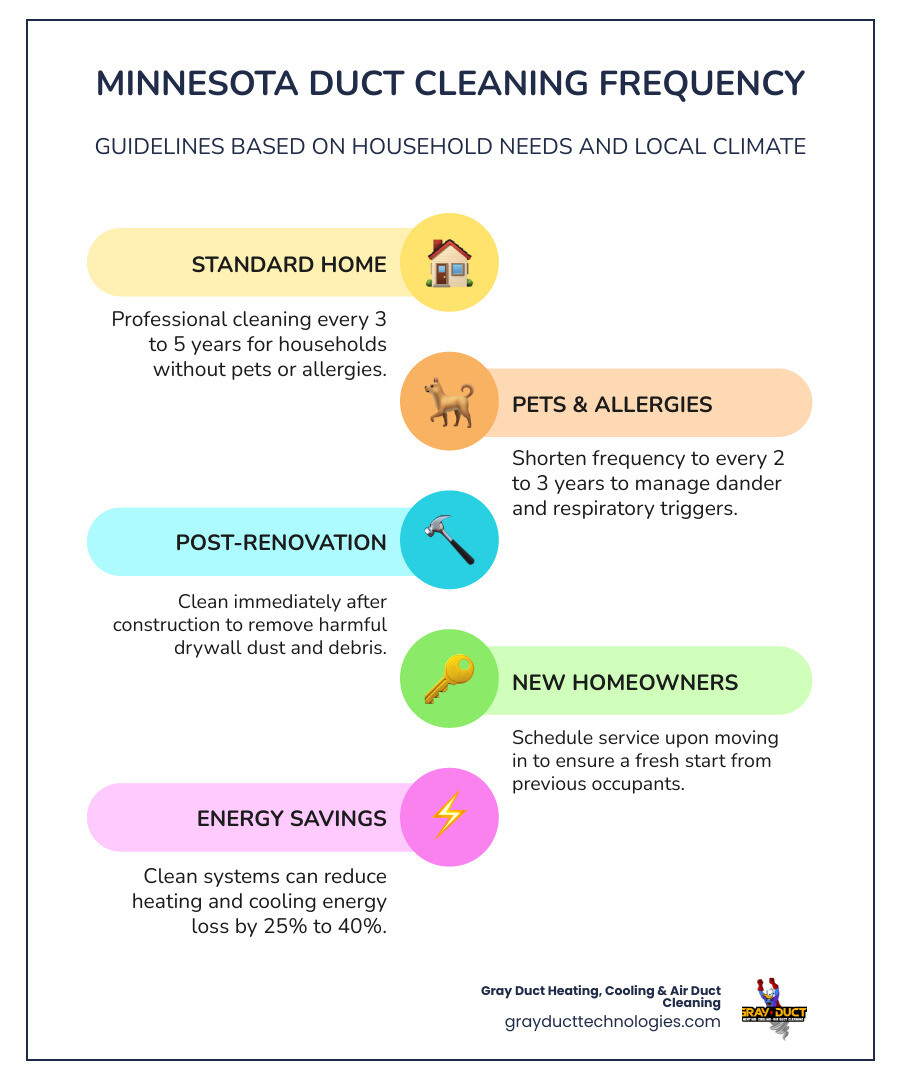
Understanding the right duct cleaning frequency for Minnesota homeowners starts with one simple answer: most homes should have their air ducts professionally cleaned every 3 to 5 years, according to the National Air Duct Cleaners Association (NADCA). But that baseline shifts depending on your household — sometimes significantly.
Here’s a quick reference to find your starting point:
| Household Situation | Recommended Cleaning Frequency |
|---|---|
| Standard home, no pets, no allergies | Every 3 to 5 years |
| Pets in the home | Every 2 to 3 years |
| Allergy or asthma sufferers | Every 2 to 3 years (some annually) |
| Smokers in the home | Every 2 to 3 years |
| Recent renovation or remodel | Immediately after construction |
| Just moved into a new home | As soon as possible |
| Visible mold, dust, or musty odors | Right away, regardless of last cleaning |
Minnesota homes face an added layer of complexity. Long, sealed-up winters mean your HVAC system runs hard for months on end — recirculating the same indoor air over and over. Then spring arrives with some of the highest pollen counts in the region. That cycle puts real pressure on your ductwork in ways that homes in milder climates simply don’t experience.
Indoor air can be up to five times more polluted than outdoor air, largely because contaminants build up inside duct systems and keep circulating every time your system runs. On top of that, dirty ducts can cause your home to lose anywhere from 25% to 40% of its heating or cooling energy — a number that hits hard when you’re running your furnace through a Minnesota January.
This guide walks you through everything you need to know to figure out the right schedule for your home — and how to keep your system running clean between professional visits.
I’m Jason Giandalia, founder of Gray Duct Heating, Cooling & Air Duct Cleaning and a NADCA-certified Air Systems Cleaning Specialist (ASCS) with years of hands-on experience helping Twin Cities homeowners navigate duct cleaning frequency for Minnesota homeowners and the unique HVAC challenges that come with our climate. If you want answers grounded in real-world experience — not guesswork — you’re in the right place.
Understanding the Standard Duct Cleaning Frequency for Minnesota Homeowners
For most homes in Minneapolis, Saint Paul, Apple Valley, Lakeville, Woodbury, Plymouth, and nearby communities we serve, the standard recommendation is simple: schedule professional duct cleaning every 3 to 5 years. That lines up with NADCA guidance for well-maintained systems.
That said, “most homes” is not the same as “all homes.” If your filter changes are inconsistent, your ductwork leaks, your HVAC system is older, or your household creates more indoor debris than average, that timeline can shorten fast.
We usually tell homeowners to think of 3 to 5 years as the baseline, not the law of the land. Your actual schedule should reflect how your home lives, not just what the calendar says.
If you want more background on timing, our guides on How Often Should You Clean Air Ducts and Importance of Regular Air Duct Cleaning break down the basics in more detail.
How often should air ducts be cleaned in homes with pets or allergies?
Pets and allergies are two of the biggest reasons we recommend cleaning more often.
If you have dogs or cats, especially heavy shedders, pet hair and dander can build up in the return side of the system and continue circulating through the home. In that case, every 2 to 3 years is a more realistic schedule.
If someone in the home has allergies, asthma, or other respiratory sensitivities, the goal is not just “clean ducts” but fewer irritants moving through the air. Many allergy-prone households do well with cleaning every 2 to 3 years, and some homes with severe sensitivities may benefit from annual evaluation and, in certain cases, more frequent service.
Homes with pets and allergy sufferers together? That is basically the ductwork version of “hard mode.”
For more on cleaner indoor air, see Air Duct Cleaning for Indoor Air Quality.
Factors that influence your specific cleaning schedule
Several home-specific factors affect how often ducts need cleaning:
- HVAC age and condition: Older systems often move more dust and may have worn seals or dirtier internal components.
- Filter quality: Higher-quality filters usually help reduce buildup.
- Filter replacement habits: Even the best filter does not help much if it stays in place too long.
- Smoking indoors: Tobacco residue and odor particles cling to duct surfaces and often call for more frequent cleaning.
- Home location and surroundings: Busy roads, nearby construction, rural dust, and heavy seasonal pollen can all increase debris.
- Duct sealing and insulation: Leaky ducts can pull in dust from attics, crawlspaces, or wall cavities.
- Household size and activity: More people generally means more dust, lint, and indoor contaminants.
Our article on How Often Should Air Ducts Be Cleaned goes deeper into these variables.
Why Minnesota’s Climate Impacts Your HVAC Cleaning Schedule
Minnesota weather does not exactly believe in moderation. Long heating seasons, spring pollen, summer humidity, and tightly sealed homes all affect duct cleanliness.
In winter, homes in the Twin Cities and South Metro stay closed up for months. That means indoor air keeps recirculating through the same duct system. Dust, pet dander, and everyday particles do not get much of a break.
In spring, pollen arrives and finds its way indoors through doors, shoes, clothing, and fresh-air intake points. In summer, humidity can contribute to musty odors and make moisture-related problems more noticeable if parts of the system are already dirty.
Here is a simple seasonal view:
| Season | Common Minnesota Duct Challenge | Effect on Cleaning Needs |
|---|---|---|
| Winter | Constant furnace use, closed windows, recirculated air | Faster buildup of indoor dust and dander |
| Spring | Heavy pollen and muddy debris tracked indoors | More allergens entering returns and filters |
| Summer | Humidity and A/C use | Odors and moisture concerns become more noticeable |
| Fall | Leaves, dust, and heating system startup | Good time to inspect before winter workload |
That is one reason duct cleaning frequency for Minnesota homeowners often needs a more customized approach than generic national advice. If you want more context on indoor air in our climate, read The Dirty Truth About Your Homes Air Quality and Why Its Important to Have Your Air Ducts Cleaned.
Critical Signs Your Twin Cities Home Needs Immediate Duct Service
Even if you are “not due yet,” some signs mean you should move cleaning higher on the to-do list.
Watch for:
- Dust blowing from supply vents
- Dark buildup around vent covers
- Musty, stale, or smoky odors when the system runs
- Reduced airflow in certain rooms
- Visible debris inside registers
- Mold-like growth around vents or HVAC components
- Frequent filter clogging
- Worsening allergy or asthma symptoms indoors
- Signs of pest activity in the duct system
If you are seeing or smelling any of those, do not wait for the 3-to-5-year mark just because it looks nice on paper.
For related reading, see Identifying Dirty Home Ductwork and Clogged Air Ducts Issues.
Determining duct cleaning frequency for Minnesota homeowners after renovations
After remodeling, the answer is easy: clean the ducts as soon as construction is complete.
Drywall dust, sawdust, insulation fibers, flooring debris, and general renovation mess can get pulled into the return system even when contractors try to contain it. Once that fine material settles into the ductwork, your HVAC system can keep redistributing it through the house.
This matters after:
- Kitchen remodels
- Basement finishing
- Bathroom renovations
- Flooring replacement
- Drywall work
- Interior painting with sanding or prep dust
- Whole-home projects
Post-construction dust is one of the clearest reasons to schedule cleaning outside the normal cycle. Our Dirty Ductwork: Common Problems article covers common contamination issues homeowners miss.
When to schedule a cleaning after moving into a new home
If you just bought a home in Minneapolis, Saint Paul, Rochester, Maple Grove, or anywhere else in our service area, scheduling duct cleaning early is often a smart move.
Why? Because you usually do not know:
- When the ducts were last cleaned
- What kind of filters the previous owners used
- Whether they had pets
- Whether anyone smoked indoors
- Whether remodeling dust was left behind
- Whether the home sat vacant for a long period
A move-in cleaning can give you a cleaner starting point and help remove old dust and odors you did not invite to live with you. Our post How Often Should You Clean Your Air Ducts What Minneapolis Homeowners Need to Know explains why move-in service is so common.
The Professional Process: What to Expect During Your Cleaning
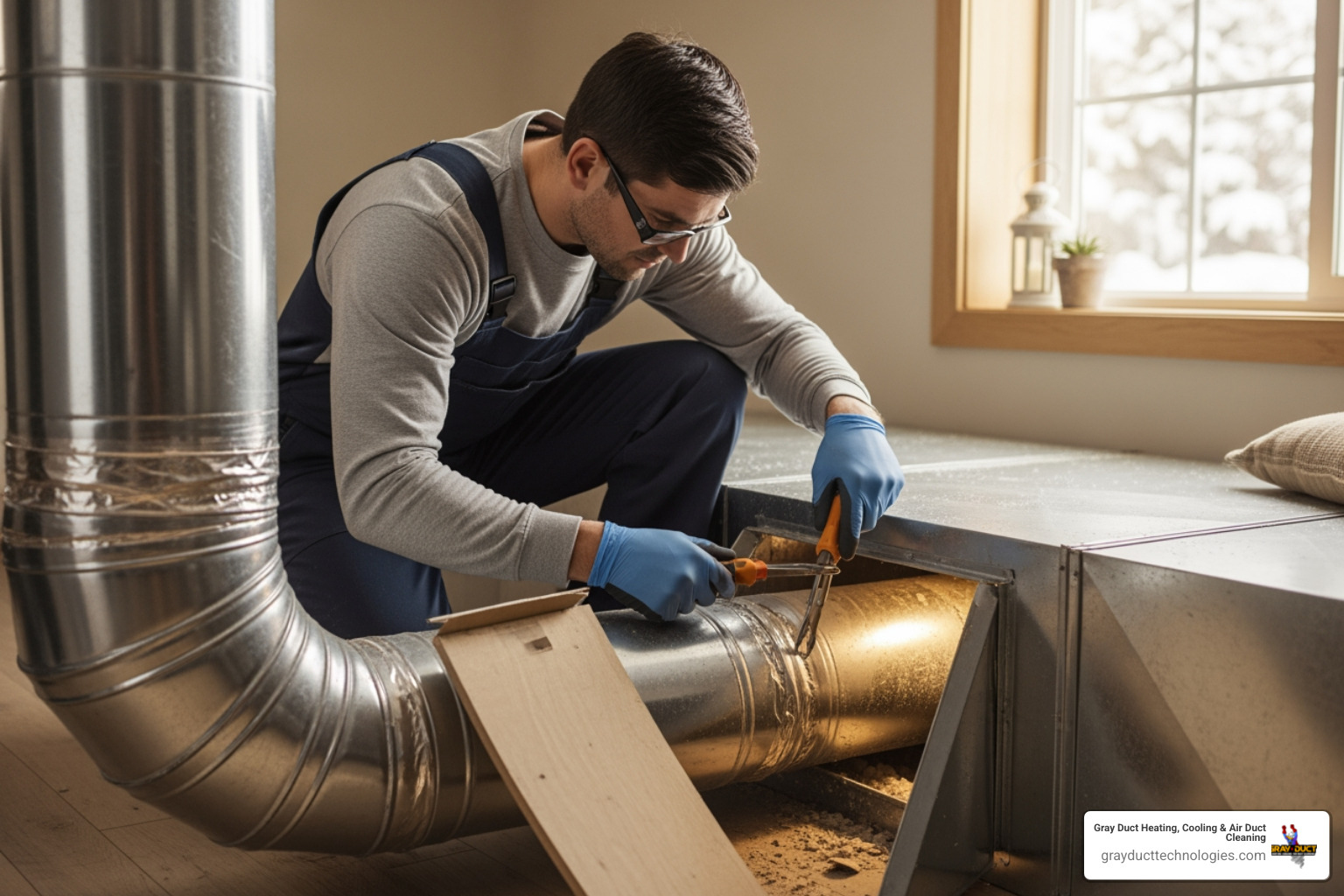
A professional duct cleaning is much more than vacuuming what you can reach through a register with a shop vac and good intentions.
A proper cleaning typically includes:
- System inspection
- Protection of floors and work areas
- Creation of negative pressure with specialized vacuum equipment
- Agitation of debris inside supply and return ducts using professional tools
- Cleaning of registers, grilles, and accessible HVAC components
- Optional treatment steps when appropriate for odor or contamination concerns
- Final review of the cleaned system
Negative pressure is important because it helps pull loosened dust and debris out of the system rather than letting it drift back into the home. Agitation tools are also key because much of the buildup sticks to the duct walls and does not come out on its own.
In some situations, system fogging or odor-neutralizing treatment may be used after cleaning, especially when musty smells or lingering odors are part of the problem. That is not necessary in every home, but it can be helpful when conditions call for it.
You can learn more in our Air Duct Cleaning Process and Why Professional Air Duct Cleaning Matters articles.
Maximizing Efficiency and Indoor Air Quality Between Cleanings
Regular duct cleaning is helpful, but what you do between appointments matters just as much.
A well-maintained system can support:
- Better indoor air quality
- More consistent airflow
- Less dust recirculation
- Reduced strain on HVAC equipment
- Longer system life
Dirty ductwork can affect performance across the whole HVAC system. Research commonly cited in the industry notes that dirty air pathways can contribute to 25% to 40% energy loss in heating or cooling delivery. In plain English: when the system has to work harder to move air, your furnace and A/C do not get to coast.
For more on efficiency and system wear, read Dirty Ductwork Impact on HVAC and Is Air Duct Cleaning Worth It.
Is DIY duct cleaning frequency for Minnesota homeowners effective?
DIY maintenance has its place. Homeowners can absolutely remove vent covers, vacuum around registers, and keep surrounding areas clean. That is useful.
But full DIY duct cleaning is usually not effective enough to replace professional service.
Why?
- Most debris sits deeper inside the system than household tools can reach
- Specialized negative-pressure equipment is designed to remove loosened contaminants safely
- Improper DIY cleaning can stir up dust without fully removing it
- Aggressive tools can damage duct liners or components
- You may miss the blower area, returns, or other critical problem spots
Some industry sources note that a professional cleaning can remove large amounts of dust and debris from a typical system. That is hard to match with a household vacuum and a brave attitude.
If you are considering the DIY route, our How to Clean HVAC Ducts Yourself article explains what homeowners can reasonably handle and where professional equipment makes a real difference.
Maintaining your system to prevent premature buildup
The best way to extend time between cleanings is not magic. It is maintenance.
We recommend:
- Change HVAC filters on schedule
- Use high-quality filters that fit properly
- Schedule regular HVAC inspections
- Keep supply and return vents unobstructed
- Vacuum and dust around registers often
- Seal leaky duct sections when needed
- Control indoor humidity
- Clean after pet-heavy shedding seasons if needed
- Address smoking-related residue promptly
- Schedule coil and HVAC maintenance so the whole system stays cleaner
If your home has dry winter air followed by sticky summer humidity, balancing moisture levels can also help reduce comfort issues and keep the system running better. More on the risks of neglect is covered in What Happens If You Dont Clean Your Air Ducts.
Frequently Asked Questions about Minnesota Duct Maintenance
How often should I clean my dryer vents compared to air ducts?
Dryer vents usually need attention more often than air ducts because lint buildup creates a direct fire and performance hazard. Air ducts are typically every 3 to 5 years for average homes, while dryer vent frequency depends on how often you run the dryer, the length of the vent, and household laundry volume.
Large families, pet owners, and households doing frequent laundry may need dryer vent cleaning much sooner than they need full duct cleaning. Our Dryer Vent Cleaning Frequency guide explains the differences.
Does cleaning my air ducts really lower my energy bills?
It can help, especially if buildup is affecting airflow or forcing the system to work harder. Clean ducts alone are not a magic wand, but as part of overall HVAC maintenance they can support better efficiency. If your system is battling dust, debris, clogged pathways, or related contamination, cleaning can improve airflow and reduce unnecessary strain.
The biggest gains usually happen when duct cleaning is paired with good filters, regular maintenance, clean coils, and properly sealed ductwork.
Can dirty ducts cause my furnace to fail prematurely?
Dirty ducts can contribute to system strain, and strain is never a furnace’s favorite hobby. Restricted airflow and excessive debris can lead to more wear on key HVAC components over time. While dirty ducts are not the only reason systems fail, neglecting them can be part of a bigger pattern that shortens equipment life.
That is why we view duct cleaning as one part of preventive care, not a standalone fix for everything.
Conclusion
For most Minnesota households, the right starting point is professional duct cleaning every 3 to 5 years. But if you have pets, allergies, smokers in the home, recent remodeling, or obvious signs of contamination, your schedule should be sooner.
The goal is not just to check a maintenance box. It is to keep your air cleaner, your HVAC system more efficient, and your home more comfortable through every Minnesota season.
At Gray Duct Heating, Cooling & Air Duct Cleaning, we help homeowners across Minneapolis, Saint Paul, Bloomington, Burnsville, Eden Prairie, Eagan, Lakeville, Rochester, and surrounding communities make smart decisions about indoor air quality and HVAC upkeep. As a family-owned company with in-house certified technicians, we focus on practical solutions that fit real homes and real families.
If you are ready to reset your system or want help deciding whether it is time, explore our Air Duct Cleaning service page.
