

System Fogging Benefits Beyond Standard Cleaning: What Twin Cities Homeowners Need to Know
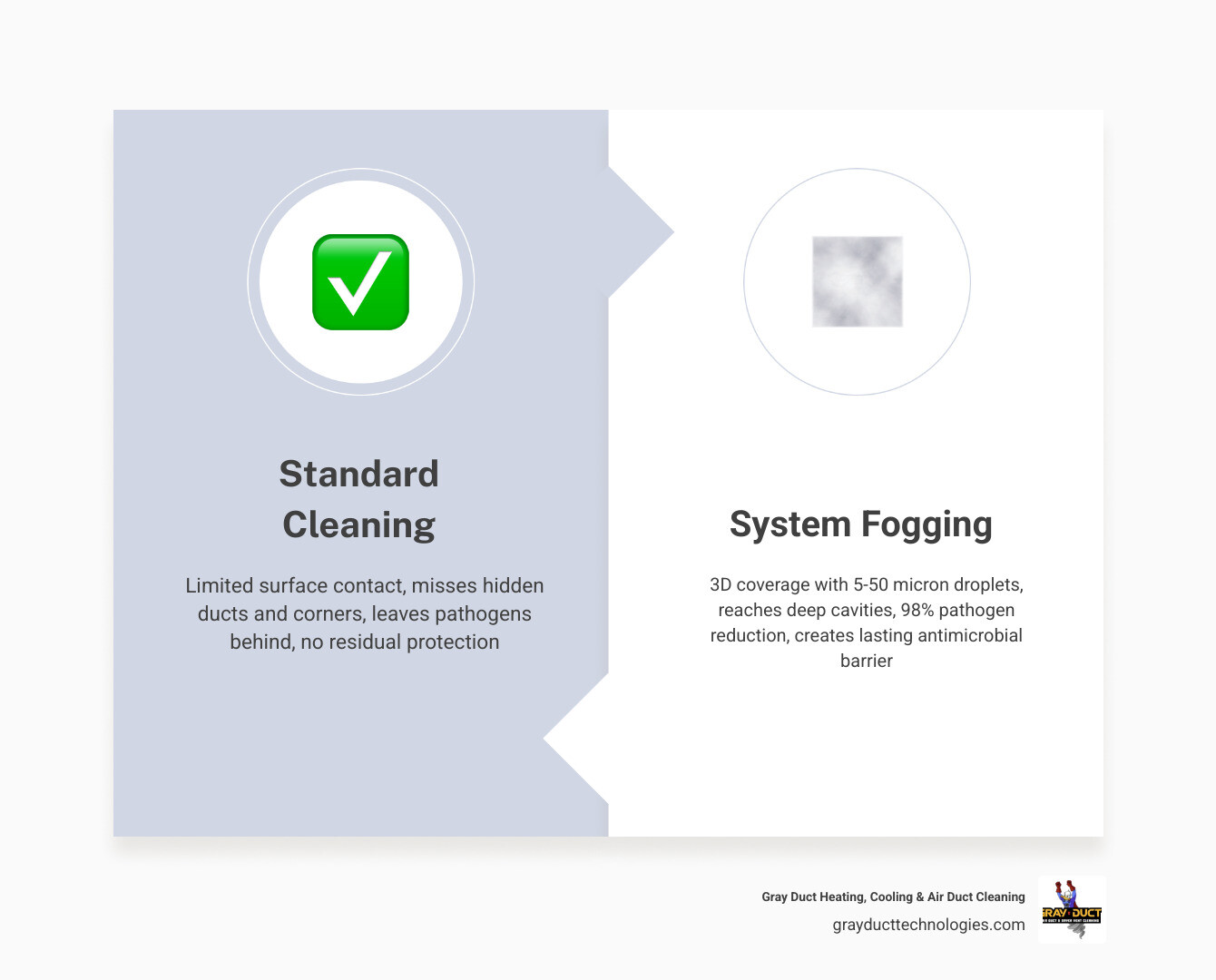
Understanding system fogging benefits beyond standard cleaning starts with a simple truth: a home that looks clean isn’t always a home with clean air. Here’s a quick look at what system fogging adds that standard methods miss:
- Reaches hidden areas — fog penetrates deep into ductwork, corners, and cavities that mops and brushes can’t access
- Eliminates airborne and surface pathogens — including mold spores, bacteria, and allergens that survive routine cleaning
- Delivers 3D coverage — ultra-fine droplets (5–50 microns) stay suspended and coat surfaces evenly throughout the entire system
- Reduces microbial load dramatically — research shows up to 98% reduction in aerobic colony counts compared to standard cleaning alone
- Supports better indoor air quality long-term — not just immediately after treatment, but through a residual antimicrobial barrier
- Complements HVAC maintenance — works alongside duct cleaning, coil cleaning, and filtration rather than replacing them
Standard cleaning methods — whether manual wiping, vacuuming, or even UV light — have real limits. They can’t consistently reach every surface inside a complex duct system, and they leave invisible contamination behind. In Minnesota homes, where windows stay closed for months and HVAC systems recirculate the same indoor air repeatedly, that gap matters. Mold, bacteria, and allergens build up in places you can’t see, and they get pushed through your living spaces every time the system runs.
System fogging changes that equation by dispersing a fine antimicrobial mist throughout the entire ventilation system — reaching the spots that standard cleaning simply can’t.
I’m Jason Giandalia, founder of Gray Duct Heating, Cooling & Air Duct Cleaning, and after years of inspecting ductwork and HVAC systems across the Twin Cities, I’ve seen how much contamination hides in places standard cleaning never touches — which is exactly why understanding system fogging benefits beyond standard cleaning is something I’m passionate about sharing with every homeowner I work with. Let’s walk through what the evidence shows and how this service fits into a smarter home air quality strategy.
Quick system fogging benefits beyond standard cleaning terms:
- how antimicrobial fogging adds to duct cleaning
- system fogging vs standard duct cleaning comparison
- when fogging is recommended after duct cleaning
What is System Fogging and How Does It Differ From Standard Methods?
To appreciate the true value of system fogging, it is helpful to look at how it works compared to traditional cleaning and disinfection technologies. At its core, system fogging is a professional indoor air quality treatment that uses specialized machines to disperse an EPA-registered, eco-friendly antimicrobial solution.
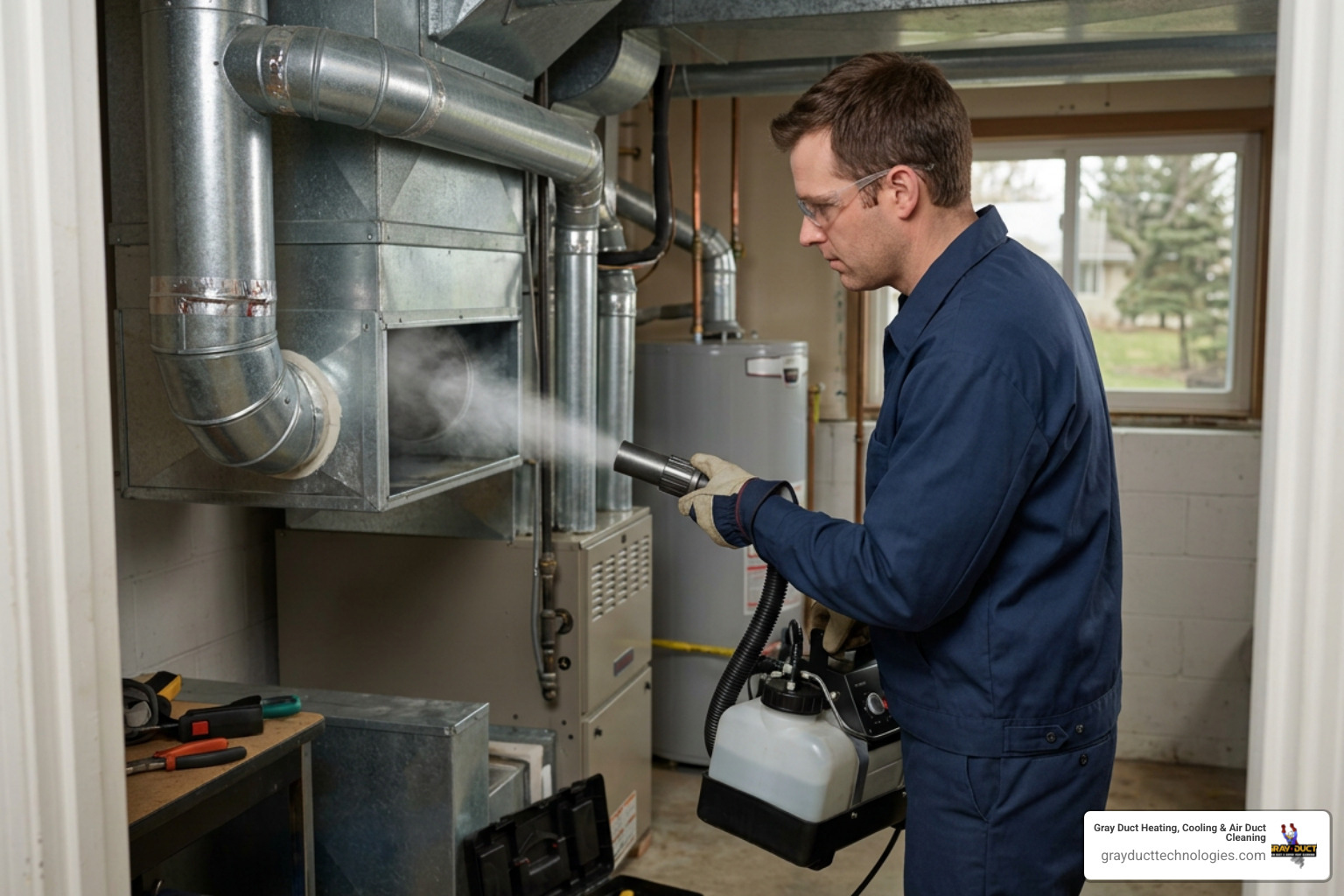
When we perform system fogging, we typically use ultra-low volume (ULV) or hybrid hydrogen peroxide (HHP) fogging systems. These devices break down the liquid disinfectant into extremely fine droplets, usually ranging from 5 to 50 microns in size. To put that in perspective, a single strand of human hair is about 70 microns wide. Some advanced systems even generate submicron particles under 5 microns. Because these droplets are so minuscule, they behave more like a gas than a liquid. They remain suspended in the air for hours and drift naturally through the entire volume of your HVAC system, ensuring complete three-dimensional coverage.
Traditional methods fall short in several distinct ways:
- Manual Cleaning: While physically brushing and vacuuming ductwork is essential for removing heavy dust, dirt, and debris, it cannot sterilize the surfaces. Brushes cannot reach every microscopic nook, cranny, or seam in your ductwork. Manual wiping is also limited by human reach and physical access points.
- UV Disinfection: Ultraviolet (UV-C) lights are excellent for keeping AC coils clean, but they are strictly “line-of-sight” technologies. If a shadow is cast, or if a pathogen is hiding on the backside of a damper, a turning vane, or deep within a flex-duct bend, the UV light cannot neutralize it. Furthermore, UV light requires a specific exposure duration (contact time) to kill pathogens, which is hard to achieve with fast-moving air.
By choosing system fogging, we overcome these mechanical limitations. The fog flows exactly where your air flows, wrapping around curves, penetrating insulation fibers, and coating every square inch of the system’s interior.
If you are trying to decide which approach fits your home, reading our guide on Choosing Between System Fogging and Traditional Duct Cleaning will help clarify how these services work together.
| Feature / Metric | Manual Cleaning | UV Light Disinfection | System Fogging (HHP/ULV) |
|---|---|---|---|
| Primary Purpose | Physical debris & dust removal | Continuous surface/air sanitizing | Deep, comprehensive pathogen elimination |
| Physical Reach | Limited to accessible duct runs | Line-of-sight only (creates shadows) | Complete 3D coverage of all hidden areas |
| Droplet Size | N/A (Wipes/Vacuum brushes) | N/A (Light waves) | 5 to 50 microns (behaves like gas) |
| Pathogen Reduction | Low (does not sanitize) | Moderate (limited to direct light path) | Extremely high (98%+ bioburden reduction) |
| Water/Chemical Use | Low | None | Very low (highly concentrated micro-droplets) |
Key System Fogging Benefits Beyond Standard Cleaning for Twin Cities Homes
When we talk about system fogging benefits beyond standard cleaning, we are focusing on the unique advantages this method brings to homes in areas like Minneapolis, Saint Paul, and the surrounding suburbs. In our local climate, our heating and cooling systems run almost continuously. Whether we are sealing up our homes against the freezing winter cold in Eden Prairie or running the air conditioner during a humid summer in Burnsville, our indoor air is constantly recirculated.
This continuous recirculation creates a perfect environment for biological contaminants to settle inside our ductwork. Here is how system fogging provides benefits that standard cleaning simply cannot match:
1. Unmatched 3D Coverage of Hard-to-Reach Areas
Your ductwork is a complex maze of sheet metal, flexible tubes, dampers, and plenums. Standard vacuuming tools can clean the straight runs, but they cannot effectively scrub the tight corners, joints, and transitions. Because fog droplets behave like a gas, they travel through the entire system, ensuring that even the most remote sections of your supply and return lines receive a uniform coating of disinfectant.
2. Neutralization of Microscopic Mold Spores and Bacteria
Standard duct cleaning removes the “food source” for mold (such as dust and skin cells), but it does not kill the invisible mold spores that have already settled into the porous surfaces of your system. System fogging attacks these pathogens at the cellular level. By coating the interior surfaces, the antimicrobial solution neutralizes active mold, bacteria, and viruses on contact, preventing them from multiplying and blowing back into your living spaces.
To learn more about how this advanced process protects your household, you can read about the overall Benefits of System Fogging and discover The Importance of System Fogging for maintaining a healthy indoor environment.
Scientific Evidence: Pathogen Reduction and Measurable Outcomes
We do not expect you to just take our word for it. The efficacy of system fogging is backed by rigorous scientific research and real-world testing in critical environments, including healthcare facilities and laboratories.
In clinical studies evaluating HHP and dry fogging technologies, the measurable outcomes are striking:
- 98% Reduction in Aerobic Colony Counts (ACC): Following fogging treatments, environmental sampling showed that ACC levels dropped to a range of 0 to 1.33 ACC (with a median of 0 ACC). This represents a further 98% reduction in viable bacteria compared to standard environmental cleaning practices alone.
- 88% Reduction in ATP Levels: Adenosine Triphosphate (ATP) testing is the gold standard for measuring organic bioburden on surfaces. Studies show that fogging achieves an average post-treatment ATP reading of 1,109 RLU, representing an overall average reduction of 88% in organic matter.
- 100% Elimination of MRSA and Pseudomonas: In comparative testing, Methicillin-resistant Staphylococcus aureus (MRSA) and Pseudomonas aeruginosa—which were still present on surfaces after standard manual cleaning and UV-C treatments—were completely eliminated (100% reduction) after fogging was applied.
- Long-Term Airborne Control: In a 180-day study of daily dry fogging, airborne microbial colonies were reduced from an average of 439 down to just 27 colonies. The surface microbial burden in these treated spaces showed a continuous, steady downward trend over time.
- Sporicidal Efficacy: Professional fogging has been proven to achieve a 6-log (99.9999%) reduction of highly resilient bacterial spores, such as Geobacillus stearothermophilus and Clostridium difficile (C. diff), which are notoriously resistant to standard liquid disinfectants.
For a deeper dive into the science of how these microscopic agents are neutralized inside your ventilation system, check out Duct Fogging 101: How It Kills Mold and Bacteria and our guide on How to Eliminate Mold in Ductwork with System Fogging.
Integrating Fogging into Your Home Maintenance and IAQ Strategy
To get the most out of system fogging, it shouldn’t be viewed as a standalone miracle cure, but rather as the final step of a layered indoor air quality (IAQ) strategy.
Think of it this way: you wouldn’t wax a car before washing it. Similarly, we do not recommend fogging a system that is heavily coated in dust and debris. The dust can act as a physical shield, preventing the antimicrobial fog from contacting the actual duct walls.
A comprehensive, layered approach looks like this:
- Physical Removal: We first perform a thorough mechanical duct cleaning using commercial vacuums and brushes to remove the accumulated dust, pet dander, and physical debris.
- System Fogging: Once the surfaces are clean and exposed, we apply the antimicrobial fog. This allows the micro-droplets to bond directly to the clean duct walls, neutralizing any remaining microscopic spores or bacteria and establishing an active protective barrier.
- HVAC Maintenance: To keep your air fresh, we pair these services with regular A/C coil cleaning, dryer vent cleaning, and the installation of high-efficiency filters or polarized media air cleaners.
For a complete breakdown of how we execute this dual-action process in local homes, read The Complete Guide to Fogging After Duct Cleaning in Minneapolis and Everything You Need to Know About Professional Air Duct Fogging in Eden Prairie MN.
When to Choose System Fogging Benefits Beyond Standard Cleaning for Your Property
While some homeowners choose to include fogging with every routine duct cleaning, there are specific situations where it serves as a highly recommended targeted intervention:
- After Water Damage or High Humidity: If your home in Lakeville or Woodbury has experienced a plumbing leak, a wet basement, or high indoor humidity, mold spores can quickly colonize your HVAC system. Fogging is critical to stop mold from spreading.
- Moving Into a New Home: If you’re moving into a property in Plymouth or Minnetonka, you don’t know what the previous owners (or their pets) left behind. Fogging sanitizes the entire system, giving you a fresh start.
- Severe Seasonal Allergies or Asthma: If family members suffer from chronic respiratory issues, reducing the biological load in the air ducts can significantly alleviate their symptoms during peak pollen and mold seasons in Minnesota.
- Post-Contamination Events: If your household has recently dealt with a stubborn viral or bacterial outbreak (such as flu or respiratory infections), fogging helps ensure the pathogens aren’t continuously recirculated through your home.
If any of these scenarios apply to your home, you can read more about our specialized Professional System Fogging Services to see how we tailor the treatment to your needs.
Operational and Safety Considerations for System Fogging Benefits Beyond Standard Cleaning
Because professional system fogging involves dispersing an active antimicrobial agent, it requires careful planning, specialized equipment, and trained technicians to ensure safety and efficacy.
- Downtime and Aeration: During the fogging process, occupants and pets must temporarily vacate the treated areas. The application process itself is relatively quick, but we always allow a brief dwell time (usually 10 to 60 minutes) for the disinfectant to work, followed by thorough ventilation and aeration before you return to the home.
- Material Compatibility: The solutions we use are chosen for their safety and compatibility. Unlike harsh industrial chemicals that can corrode sheet metal or degrade flexible ductwork, our EPA-registered, botanical, or pH-neutral solutions are non-corrosive and safe for your HVAC components.
- Professional Application: Achieving the correct droplet size and distribution requires precise calibration. If the droplets are too large, they will wet out too quickly and pool in the ducts; if they are too small, they may dissipate without coating the surfaces. Our in-house, certified technicians use professional-grade foggers to ensure an even, dry-mist application.
To learn more about the safety protocols and the eco-friendly products we use, check out our dedicated page on System Fogging Solutions.
Frequently Asked Questions About System Fogging
How long does the protection from system fogging last?
The immediate sanitizing effect of system fogging is instantaneous, neutralizing active bacteria and mold on contact. Additionally, the high-quality solutions we use leave a micro-thin, residual antimicrobial barrier on the interior surfaces of your ductwork. This barrier can continue to inhibit the growth of new mold and bacteria for several weeks to months.
However, the exact duration depends on environmental factors in your home, such as humidity levels and how quickly new dust and recontamination enter the system. To maximize this protection, we recommend maintaining your HVAC filters and keeping your indoor humidity below 50%. You can learn more by reading our System Fogging Benefits Guide 2026.
Is system fogging safe for pets, plants, and sensitive electronics?
Yes, when performed by our trained, certified team. We use eco-friendly, EPA-registered, and pH-neutral solutions that are botanical or hydrogen-peroxide-based. These solutions naturally break down into harmless water vapor and oxygen, leaving no toxic chemical residues behind.
As a standard safety protocol, we require pets and family members to be out of the immediate area during the active fogging and aeration process. Because the fog is dispersed as an ultra-fine dry mist, it does not create dampness or harm sensitive home electronics when applied at the correct professional concentrations. For additional details on our safety standards, explore our Guide to System Fogging Services.
Does system fogging completely replace physical duct cleaning?
No, system fogging does not replace physical duct cleaning. Think of them as a team: physical duct cleaning removes the heavy dirt, pet hair, and dust, while system fogging sanitizes the clean surfaces at a microscopic level.
Attempting to fog a system that hasn’t been physically cleaned is ineffective because the dust and debris will absorb the disinfectant, preventing it from reaching the actual duct surfaces where mold and bacteria cling. For a complete understanding of how these two steps work together, read How to Understand Fogging Benefits in Duct Cleaning.
Conclusion
At Gray Duct Heating, Cooling & Air Duct Cleaning, we believe that true indoor comfort goes far beyond what you can see. Standard cleaning is an excellent first step, but to truly protect your home and family from invisible mold, bacteria, and allergens, system fogging is the ultimate upgrade. By delivering 3D coverage to the deepest corners of your ventilation system, fogging ensures that the air recirculating through your home is genuinely clean, healthy, and safe.
As a local, family-owned business serving Minneapolis, Saint Paul, and the surrounding Twin Cities suburbs—from Savage and Eagan to Maple Grove and Woodbury—we pride ourselves on delivering high-quality, honest service. Our certified, in-house team handles every job directly, with no third-party contractors, ensuring that your home receives the care and precision it deserves.
Ready to experience the difference that professional system fogging can make for your home’s indoor air quality? Schedule your professional system fogging service today to get started.
